
Objective: To evaluate the clinical characteristics of gastric motility disorder (GMD) in early-stage Parkinson’s disease (PD) and investigate the predictive value of baseline objective gastric indices on motor function deterioration.
Background: GMD is prevalent across all PD stages, significantly impairing quality of life. However, the longitudinal impact of objective GMD on PD progression remains unclear.
Method: 56 early-stage PD patients and 26 healthy controls (HCs) underwent comprehensive clinical assessments, including GCSI and MDS-UPDRS, and objective gastric evaluations via electrogastrography (EGG) and gastric emptying ultrasound (assessing gastric emptying rates, GER). PD patients were categorized into PD-GMD and PD-nGMD groups. A 12-month longitudinal follow-up was conducted to evaluate changes in clinical symptoms (ΔMDS-UPDRS).
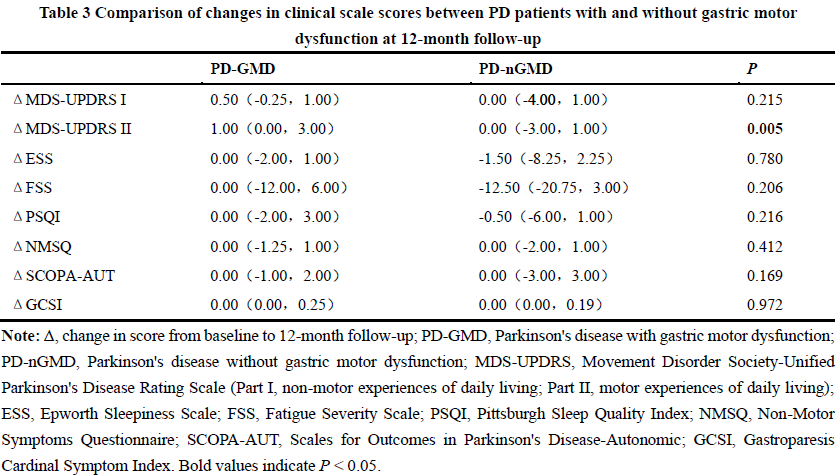
Results: PD patients exhibited significantly worse gastrointestinal, autonomic, and emotional symptoms than HCs. The PD-GMD group frequently experienced gastroparesis symptoms prior to motor onset. After a 12-month follow-up, MDS-UPDRS II scores increased significantly faster in PD-GMD patients than in PD-nGMD patients. Moreover, the longitudinal deterioration in MDS-UPDRS II (ΔMDS-UPDRS II) was significantly negatively correlated with baseline objective indices, specifically antral GER30, GER60, and EGG power ratios (PR1, PR2) (all P < 0.05).
Conclusion: Objective GMD is intrinsically linked to broader clinical severity in early-stage PD. Crucially, baseline deficits in gastric emptying rates and electrical rhythms independently predict a more rapid deterioration of daily motor function, suggesting GMD’s potential prediction for PD progression.
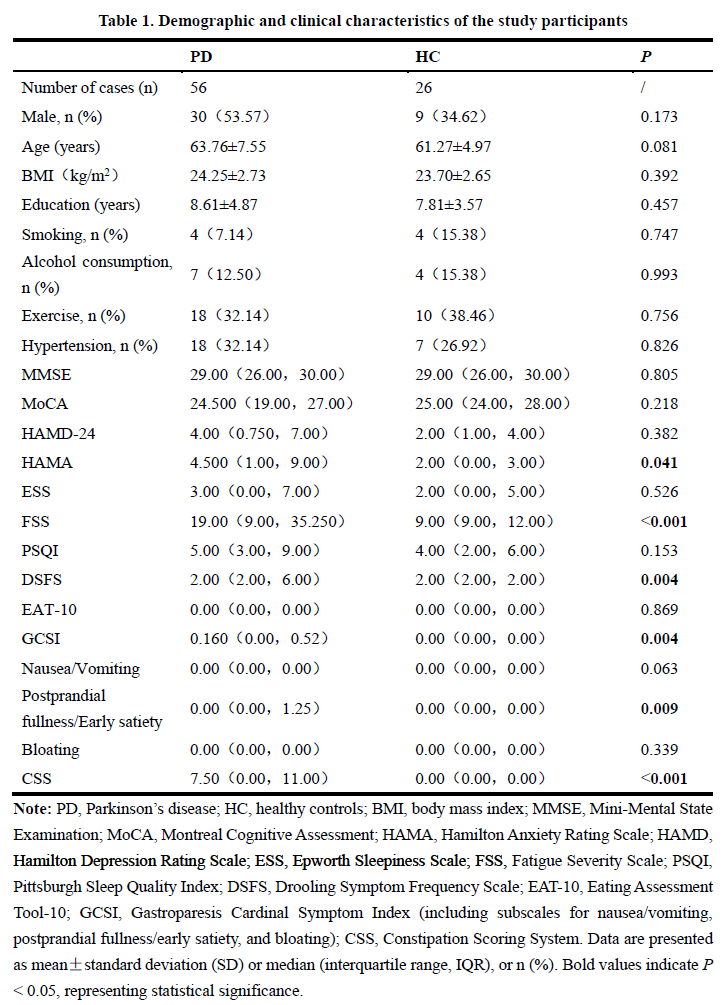
clinical characteristics of the study participants
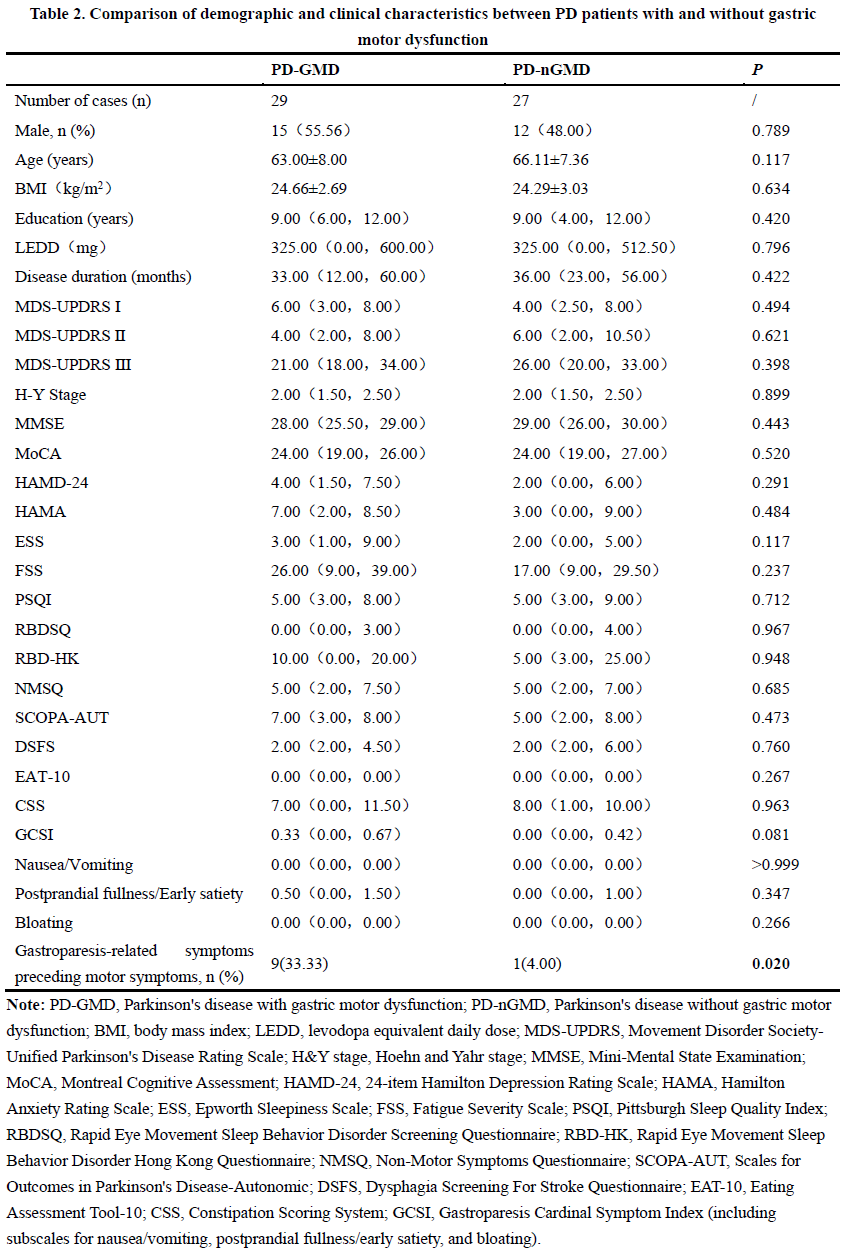
Characteristics of PD with vs. without GMD
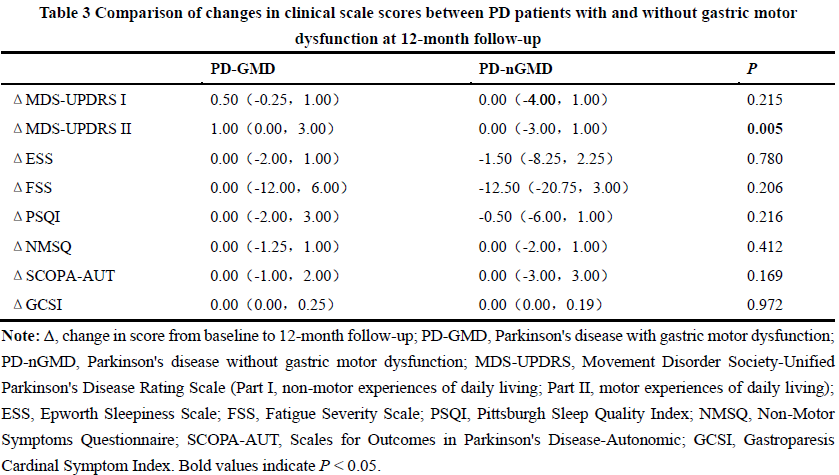
12-month scale changes PD with vs without GMD
ΔMDS-UPDRS II correlates GCSI and motility
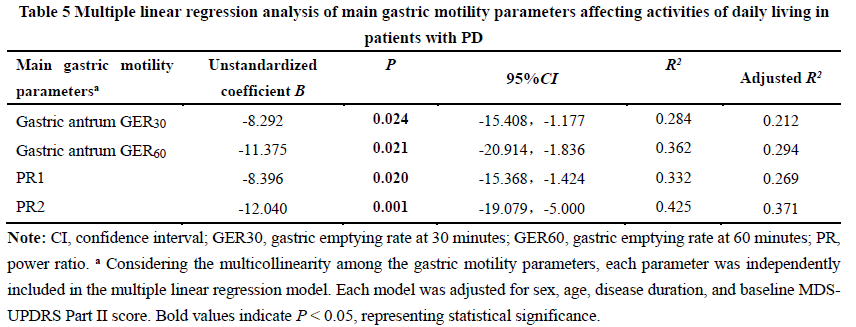
Gastric predictors of MDS-UPDRS II in PD
To cite this abstract in AMA style:
X-Y. Cheng, J-Y. Jin, C-J. Mao, C-F. Liu. Clinical Characteristics of Gastric Motility Disorder in Early-Stage Parkinson’s Disease and Its Longitudinal Predictive Value for Disease Progression [abstract]. Mov Disord. 2026; 41 (suppl 1). https://www.mdsabstracts.org/abstract/clinical-characteristics-of-gastric-motility-disorder-in-early-stage-parkinsons-disease-and-its-longitudinal-predictive-value-for-disease-progression/. Accessed October 1, 2026.« Back to 2026 International Congress
MDS Abstracts - https://www.mdsabstracts.org/abstract/clinical-characteristics-of-gastric-motility-disorder-in-early-stage-parkinsons-disease-and-its-longitudinal-predictive-value-for-disease-progression/