
Category: Technology
Objective: To evaluate the feasibility, performance, and diagnostic accuracy of a semi-automated olfactometry system (NOS-DX1000) for standardized assessment of olfactory dysfunction in α-synucleinopathies.
Background: Olfactory dysfunction is a frequent non-motor symptom of Lewy body diseases, including Parkinson’s disease (PD) and may precede motor symptoms by several years. In contrast, olfactory impairment is typically less pronounced in multiple system atrophy (MSA), highlighting the potential of olfactory testing to aid in the differentiation of α-synucleinopathies. However, established olfactory tests such as Sniffin’ Sticks require trained personnel and are relatively time-consuming, limiting their use in clinical practice. Automated olfactometry systems may allow standardized odor presentation and reduce operator dependency, facilitating scalable assessments.
Method: Participants with parkinsonian disorders (n=17,PD=14,MSA=3), and healthy controls (n=10) underwent olfactory testing using both the standardized Sniffin’ Sticks battery and a semi-automated olfactometry system (NOS-DX), assessing odor threshold, discrimination, and identification. NOS-DX testing was performed manually by the participants and supervised by an untrained study assistant to evaluate the feasibility of operator-independent testing. Administration time and olfactory scores were compared between testing methods.
Results: NOS-DX demonstrated strong agreement with the gold-standard Sniffin’ Sticks test across total scores (ρ=.69, 95%CI 0.41–0.85, p<.001). Differences between methods were minor and primarily related to the threshold subtest (Δ=3.8, W=57.5, p=.003, FDR q=.01). Administration time was comparable between systems, with significant differences observed only for the discrimination subtest (Δ=144 s, W=20.0, p<.001, FDR q<.001). The identification subtest showed particularly high diagnostic accuracy for differentiating PD from healthy controls (AUC≥.90) while requiring the shortest administration time.
Conclusion: NOS-DX demonstrates high concordance with Sniffin’ Sticks while offering advantages in standardization and reduced operator dependency. Given the importance of olfactory dysfunction for Lewy body diseases and differentiating them from other α-synucleinopathies, semi-automated olfactometry may represent a scalable tool for standardized olfactory assessment in clinical research and future screening approaches.
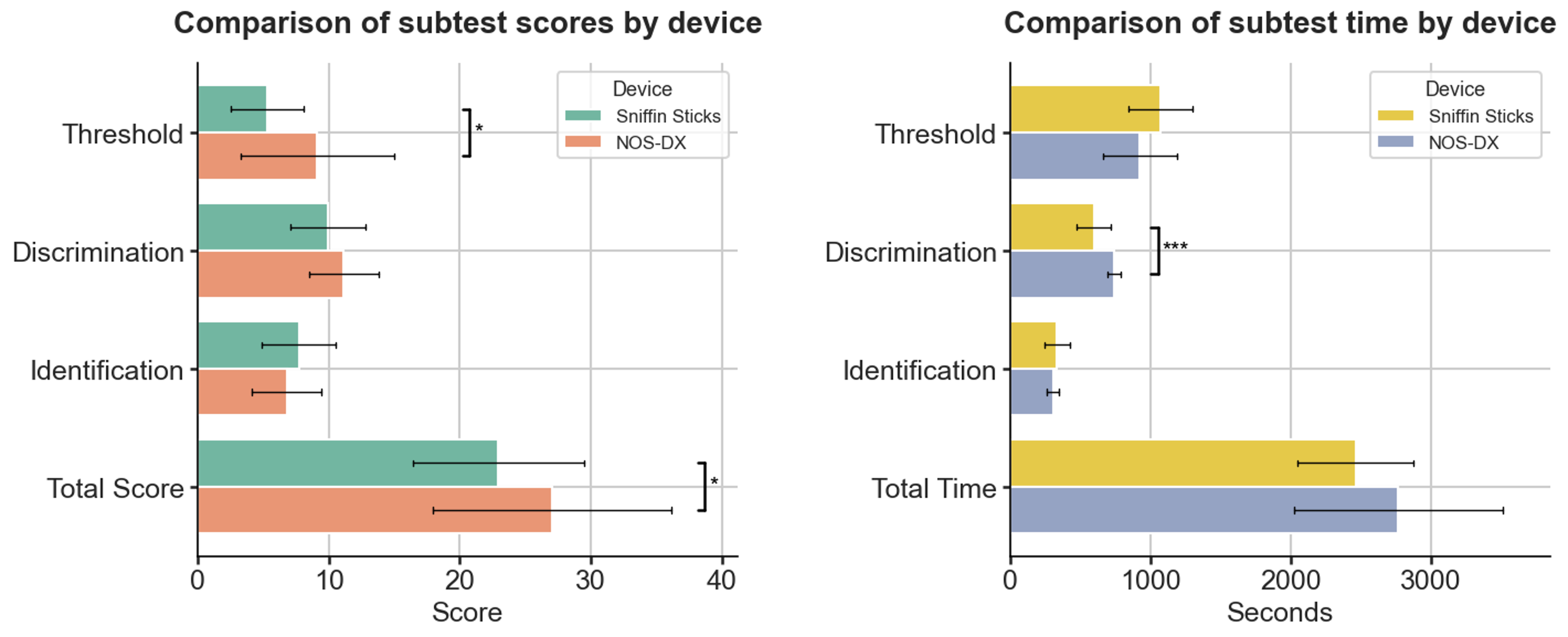
Comparison Subtest Performance by Scores and Times
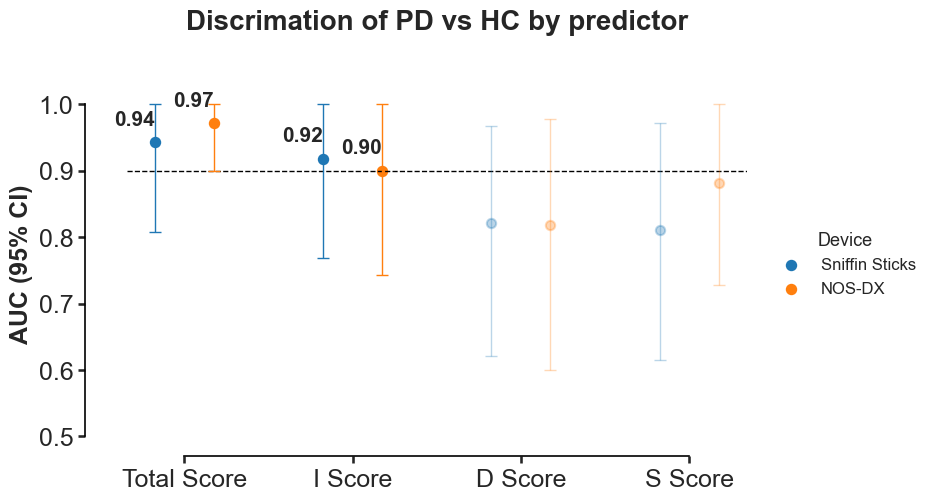
Discrimination of PD vs. HC by score predictors
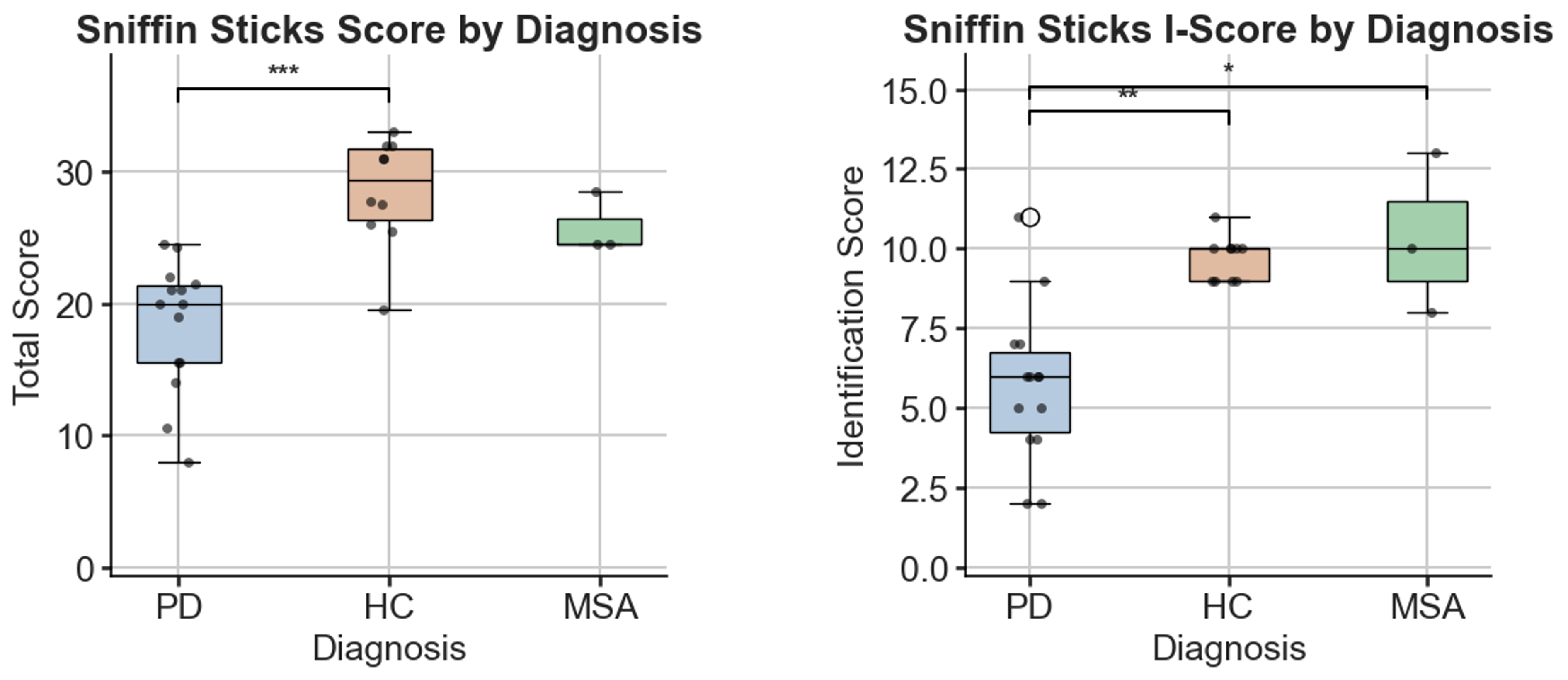
Sniffin’ Sticks Total and Identification Sub-Score
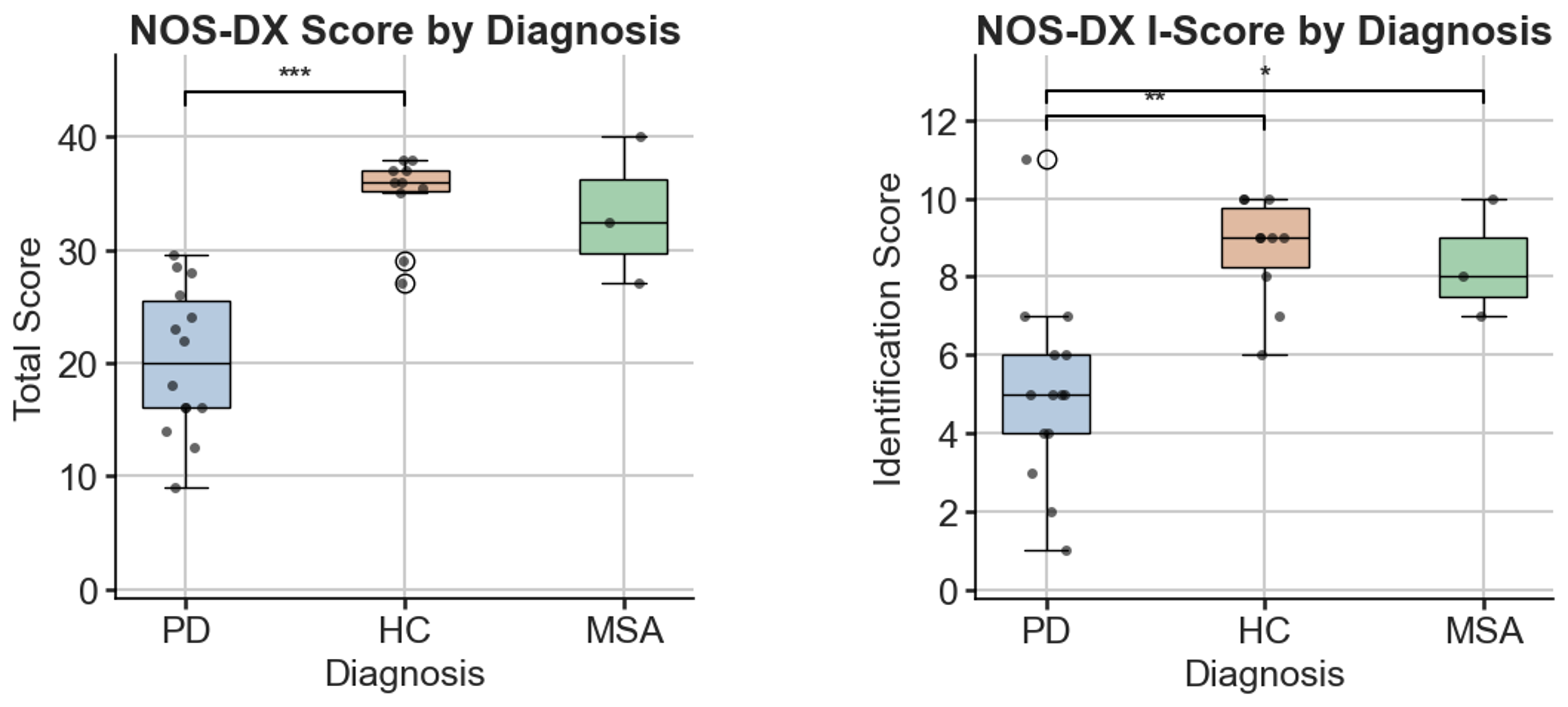
NOS-DX Total Score and Identification Sub-Score
To cite this abstract in AMA style:
A. Jäck, K. Pusl, L. Schlage, A. Bernhardt, K. Katzdobler, S. Kinoshita, M. Sasaki, T. Hummel, S. Fujita, G. Höglinger, J. Levin. Clinical feasibility of a semi-automated Olfactometry System in α-Synucleinopathies [abstract]. Mov Disord. 2026; 41 (suppl 1). https://www.mdsabstracts.org/abstract/clinical-feasibility-of-a-semi-automated-olfactometry-system-in-%ce%b1-synucleinopathies/. Accessed October 1, 2026.« Back to 2026 International Congress
MDS Abstracts - https://www.mdsabstracts.org/abstract/clinical-feasibility-of-a-semi-automated-olfactometry-system-in-%ce%b1-synucleinopathies/