
Category: Ataxia
Objective: To systematically review the clinical characteristics, etiological associations, electroencephalographic findings, management strategies, and outcomes of cerebellar fits across pediatric and adult populations.
Background: Cerebellar fits are rare paroxysmal motor events characterized by transient tonic posturing and decerebrate rigidity, typically occurring in the setting of acute posterior fossa pathology. Because of their abrupt onset and dramatic motor manifestations, these episodes are frequently misinterpreted as epileptic seizures, which may delay appropriate diagnosis and treatment.
Method: A systematic review was conducted in accordance with PRISMA-2020 guidelines. Electronic databases were searched for published case reports, case series, and observational studies describing cerebellar fits. Due to the rarity of the condition and heterogeneity of available reports, quantitative meta-analysis was not feasible. Data regarding clinical presentation, underlying pathology, EEG findings, treatment approaches, and outcomes were synthesized descriptively.
Results: Nineteen studies met the inclusion criteria. Cerebellar fits were consistently associated with posterior fossa pathology, including cerebellar tumors, Chiari malformations, hydrocephalus, cerebellar hemorrhage or infarction, and inflammatory disorders. The characteristic clinical manifestation was abrupt tonic extensor posturing with forearm hyperpronation and wrist flexion. EEG findings were uniformly nonepileptiform and typically demonstrated diffuse low-amplitude slowing. In most cases, episodes resolved following treatment of the underlying pathology, particularly interventions aimed at relieving increased intracranial pressure.
Conclusion: Cerebellar fits represent a distinctive nonepileptic neurological emergency resulting from acute cerebellar–brainstem dysfunction. Early recognition is essential to prevent misdiagnosis as epilepsy, avoid unnecessary antiseizure therapy, and facilitate timely management of underlying posterior fossa pathology.
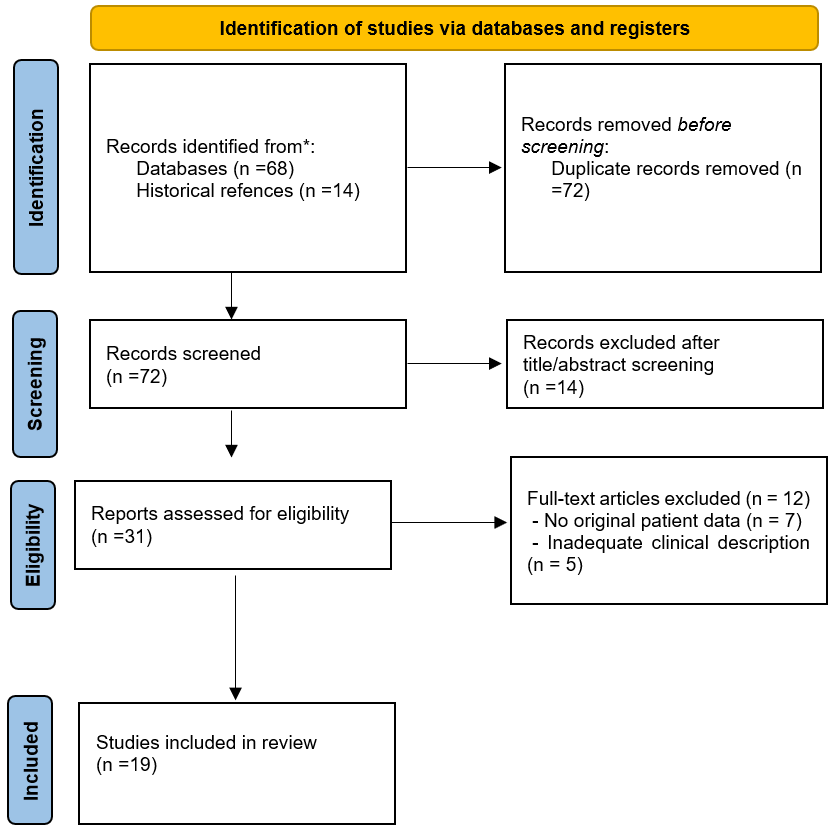
Prisma flow diagram
To cite this abstract in AMA style:
P. Bhatele, P. Kukkle. Clinical Spectrum of Cerebellar Fits in Adults and Children: A Systematic Review [abstract]. Mov Disord. 2026; 41 (suppl 1). https://www.mdsabstracts.org/abstract/clinical-spectrum-of-cerebellar-fits-in-adults-and-children-a-systematic-review/. Accessed October 1, 2026.« Back to 2026 International Congress
MDS Abstracts - https://www.mdsabstracts.org/abstract/clinical-spectrum-of-cerebellar-fits-in-adults-and-children-a-systematic-review/