
Objective: To evaluate the effectiveness and tolerability of continuous subcutaneous foslevodopa/foscarbidopa (LDp/CDp) infusion in patients with advanced Parkinson’s disease (PD) in a real-world setting.
Background: In advanced PD, motor fluctuations and dyskinesias often persist despite optimized oral therapy, supporting the transition toward therapeutic strategies based on continuous dopaminergic drug delivery. Continuous subcutaneous infusion of LDp/CDp has recently expanded the therapeutic landscape, however, real-world evidence remains limited.
Method: This prospective observational study included patients with PD referred to the outpatient clinics for device-aided therapies at Fondazione IRCCS Istituto Neurologico “Carlo Besta”, consecutively screened from March 2025 over the following 18 months. Patients were followed for up to 6 months after treatment initiation. Motor complications were assessed using part IV of the Movement Disorder Society–Unified Parkinson’s Disease Rating Scale (MDS-UPDRS IV) the MDS–Unified Dyskinesia Rating Scale (MDS-UDysRS) and 3-day Hauser diaries. Non-motor symptoms, sleep quality and quality of life were assessed using validated scales. Levodopa equivalent daily dose (LEDD), adverse events and treatment discontinuations were recorded.
Results: Ninety-nine patients were screened for eligibility. Forty-five patientswere initiated on LDp/CDp and followed up in outpatient clinics. Treatment discontinuation occurred in 9 (20.0%) patients, mainly due to local infusion-site reactions. In patients who continued therapy, MDS-UPDRS IV, MDS-UDysRS scores, as well as daily on-time with dyskinesias, significantly decreased, while on-time without dyskinesias increased. Oral LEDD was markedly reduced, while total LEDD increased, reflecting continuous 24-hour dopaminergic delivery. Non-motor symptoms and sleep quality showed a tendency toward improvement.
Conclusion: In a real-world cohort of patients with advanced PD, continuous subcutaneous LDp/CDp infusion reduced motor complications and improved on-time quality with acceptable tolerability, supporting its use in clinical routine with careful patient selection and structured follow-up.
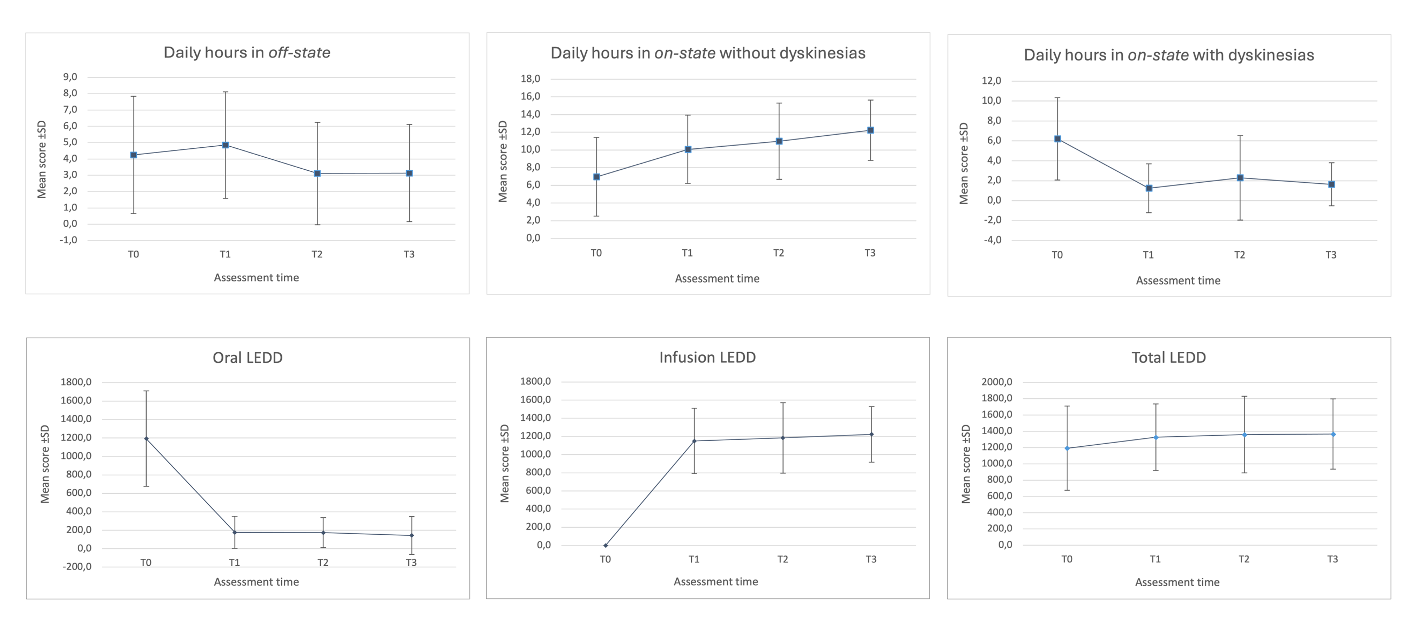
Changes in motor-diary outcomes and LEDD
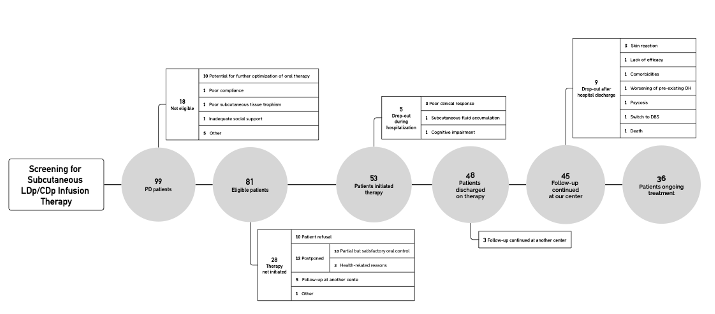
Patients screened and initiated on LDp/CDp
References: 1. Olanow CW, Obeso JA, Stocchi F. Continuous dopamine-receptor treatment of Parkinson’s disease: scientific rationale and clinical implications. The Lancet Neurology. 2006 Aug;5(8):677–87.
2. Soileau MJ, Aldred J, Budur K, Fisseha N, Fung VS, Jeong A, et al. Safety and efficacy of continuous subcutaneous foslevodopa-foscarbidopa in patients with advanced Parkinson’s disease: a randomised, double-blind, active-controlled, phase 3 trial. The Lancet Neurology. 2022 Dec;21(12):1099–109.
3. Rukavina K, Ebersbach G, Gruber D. Foslevodopa/Foscarbidopa Continuous Subcutaneous Infusion in Parkinson’s Disease: Real‐World Short‐Term Data on Tolerability, Infusion Rate Adjustments and Concomitant Medication. Movement Disord Clin Pract. 2025 July 28;mdc3.70249.
To cite this abstract in AMA style:
G. Pinola, V. Leta, M. Tosi, C. Leuzzi, F. Colucci, G. Gaudiano, A. Braccia, F. Pirone, S. Rinaldo, R. Cancilla, N. Golfrè Andreasi, L. Romito, G. Devigili, R. Cilia, AE. Elia, R. Eleopra. Continuous Subcutaneous Foslevodopa/Foscarbidopa Infusion in Advanced Parkinson’s Disease: Results from a Prospective Real-world Study [abstract]. Mov Disord. 2026; 41 (suppl 1). https://www.mdsabstracts.org/abstract/continuous-subcutaneous-foslevodopa-foscarbidopa-infusion-in-advanced-parkinsons-disease-results-from-a-prospective-real-world-study/. Accessed October 1, 2026.« Back to 2026 International Congress
MDS Abstracts - https://www.mdsabstracts.org/abstract/continuous-subcutaneous-foslevodopa-foscarbidopa-infusion-in-advanced-parkinsons-disease-results-from-a-prospective-real-world-study/