
Category: MSA, PSP, CBS: Neuroimaging
Objective: To explore whether cortical hemodynamic responses during swallowing are associated with aspiration risk in patients with Multiple System Atrophy for convenient screening method.
Background: Swallowing dysfunction is common in MSA, increasing aspiration pneumonia risk. Aspiration risk is typically assessed using video-fluoroscopic swallowing examination (VFSS) and the Penetration-Aspiration Scale (PAS). However, these methods are time-consuming and require radiographic equipment. Alternatively, functional near-infrared spectroscopy (fNIRS) is a portable and non-invasive tool that assesses cortical hemodynamic responses during swallowing tasks, providing insights into the neural control of swallowing. Therefore, fNIRS can offer a more portable and radiation-free alternative for investigating cortical correlates of swallowing. We aimed to determine whether cortical activity during swallowing correlates with aspiration risk in MSA patients, potentially facilitating screening.
Method: The duration of each swallowing phase was measured by VFSS, and swallowing safety was evaluated using PAS as well as the Video-fluoroscopic Dysphagia Scale (VDS), including its oral, pharyngeal, and total scores. Subsequently, cortical hemodynamic responses during swallowing tasks were measured using fNIRS. The fNIRS data were preprocessed and analyzed using the NIRS-KIT toolbox based on MATLAB. A general linear model was applied to estimate cortical activation, calculating beta (β) values for each channel during swallowing. Finally, correlation analyses were performed between the cortical activation β-values and the swallowing function parameters.
Results: Fifteen patients diagnosed with Multiple System Atrophy (MSA) were enrolled in this study. After multiple comparison correction (p < 0.004), significant positive correlations were found between PAS scores and β in four fNIRS channels: Ch9 (primary sensory cortex: r = 0.70, p = 0.004), Ch17, Ch22, and Ch27 (frontal pole: r = 0.79 p = 0.0005, r = 0.76 p = 0.0009, r = 0.78 p = 0.0007). No significant correlations were observed in other channels.
Conclusion: Higher cortical activation in the primary sensory cortex and frontal pole during swallowing is positively correlated with increased aspiration risk in MSA patients. fNIRS may become a new approach to identifying aspiration risks in MSA, though larger studies are needed.
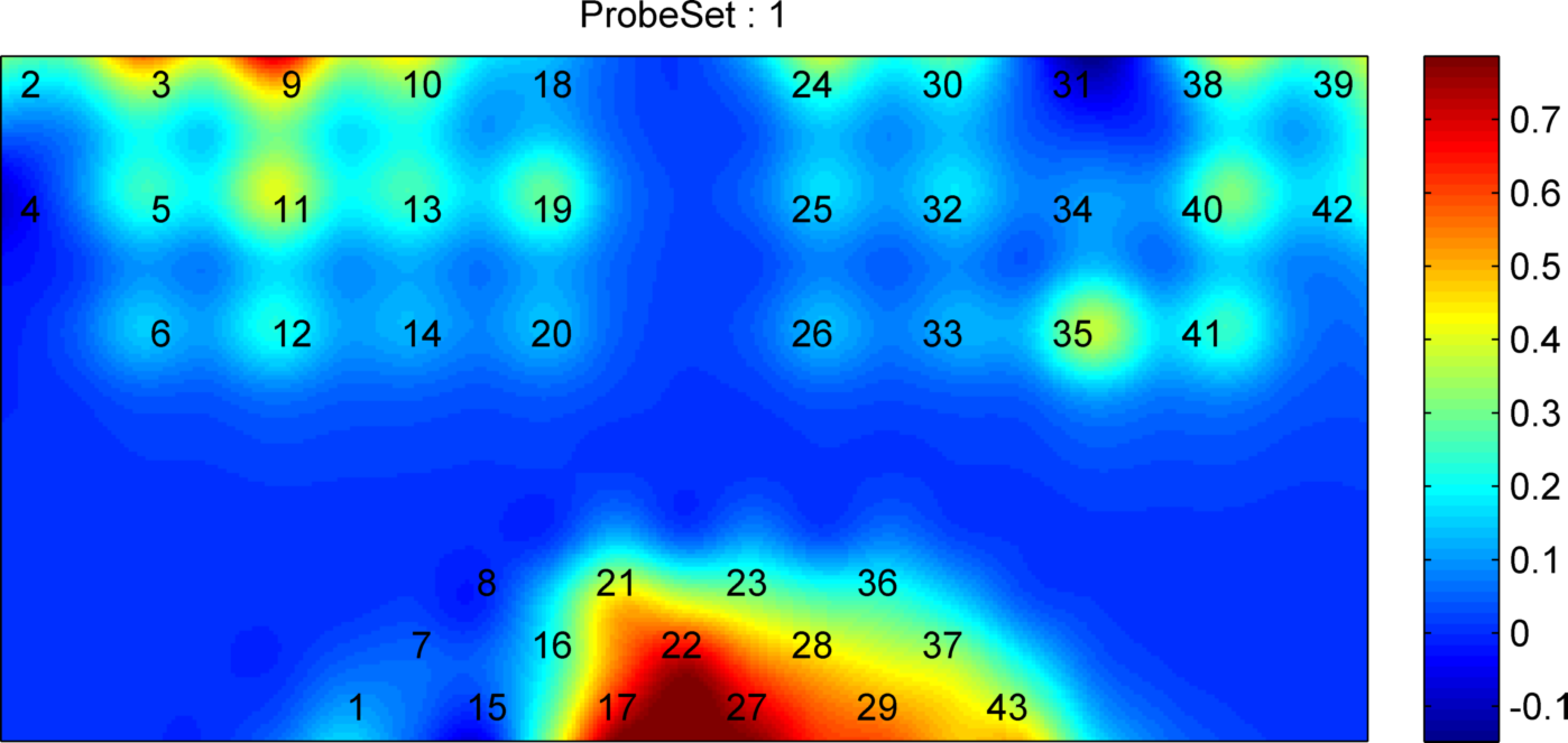
Correlation Figure
To cite this abstract in AMA style:
YF. Xia, B. Xiong, P. Wang, N. Chen, W. Luo. Correlation Analysis of Cortical Activation and Aspiration Risk During Swallowing in Patients with Multiple System Atrophy [abstract]. Mov Disord. 2026; 41 (suppl 1). https://www.mdsabstracts.org/abstract/correlation-analysis-of-cortical-activation-and-aspiration-risk-during-swallowing-in-patients-with-multiple-system-atrophy/. Accessed October 1, 2026.« Back to 2026 International Congress
MDS Abstracts - https://www.mdsabstracts.org/abstract/correlation-analysis-of-cortical-activation-and-aspiration-risk-during-swallowing-in-patients-with-multiple-system-atrophy/