
Objective: To correlate daily vitamin intake, assessed via a 24-hour dietary recall, with clinical severity measured by the Movement Disorders Society Unified Parkinson’s Disease Rating Scale (MDS-UPDRS) in an exploratory cohort of patients from Northeastern Mexico.
Background: Nutrition plays a fundamental role in Parkinson’s progression. Evidence suggests that micronutrient deficiencies, particularly vitamin D [1] and the B-complex [2], exacerbate motor and non-motor symptoms. However, the dietary reality and its clinical impact on patients from Northeastern Mexico remain unexplored, necessitating region-specific exploratory data to guide localized interventions.
Method: An exploratory cross-sectional study was conducted in October 2024. Dietary assessment of patients from Northeastern Mexico was performed using a 24-hour recall, alongside the clinical application of the MDS-UPDRS. Micronutrient intakes were analyzed using the Nutrimind software. Pearson’s correlation coefficient was used for statistical analysis, as the data met the application criteria.
Results: Seven patients with Parkinson’s were included: 4 males, 3 females; mean age 68.86 (10.73) years. The mean daily vitamin intake was: B6 0.71 mg (0.95), B9 383 mcg (254.2), B12 1.28 mcg (0.75), and D 3.85 mcg (4.01). No statistically significant correlations were found. However, a strong negative correlation was observed between vitamin B12 and D intake with Part III and the total MDS-UPDRS score. A moderate negative correlation was also found with Parts I and II, as exemplified in Figure 1.
Conclusion: As a regional exploratory study, the small sample size limited statistical significance; however, a clinically relevant trend was identified. The moderate to strong negative correlations between vitamin B12 and D intake and MDS-UPDRS scores suggest that lower dietary contributions of these micronutrients may worsen clinical status in this demographic. These preliminary findings highlight the need for tailored neuro-nutritional assessments in Northeastern Mexico and justify larger regional cohorts to confirm if targeted dietary optimization mitigates symptomatic burden. [3]
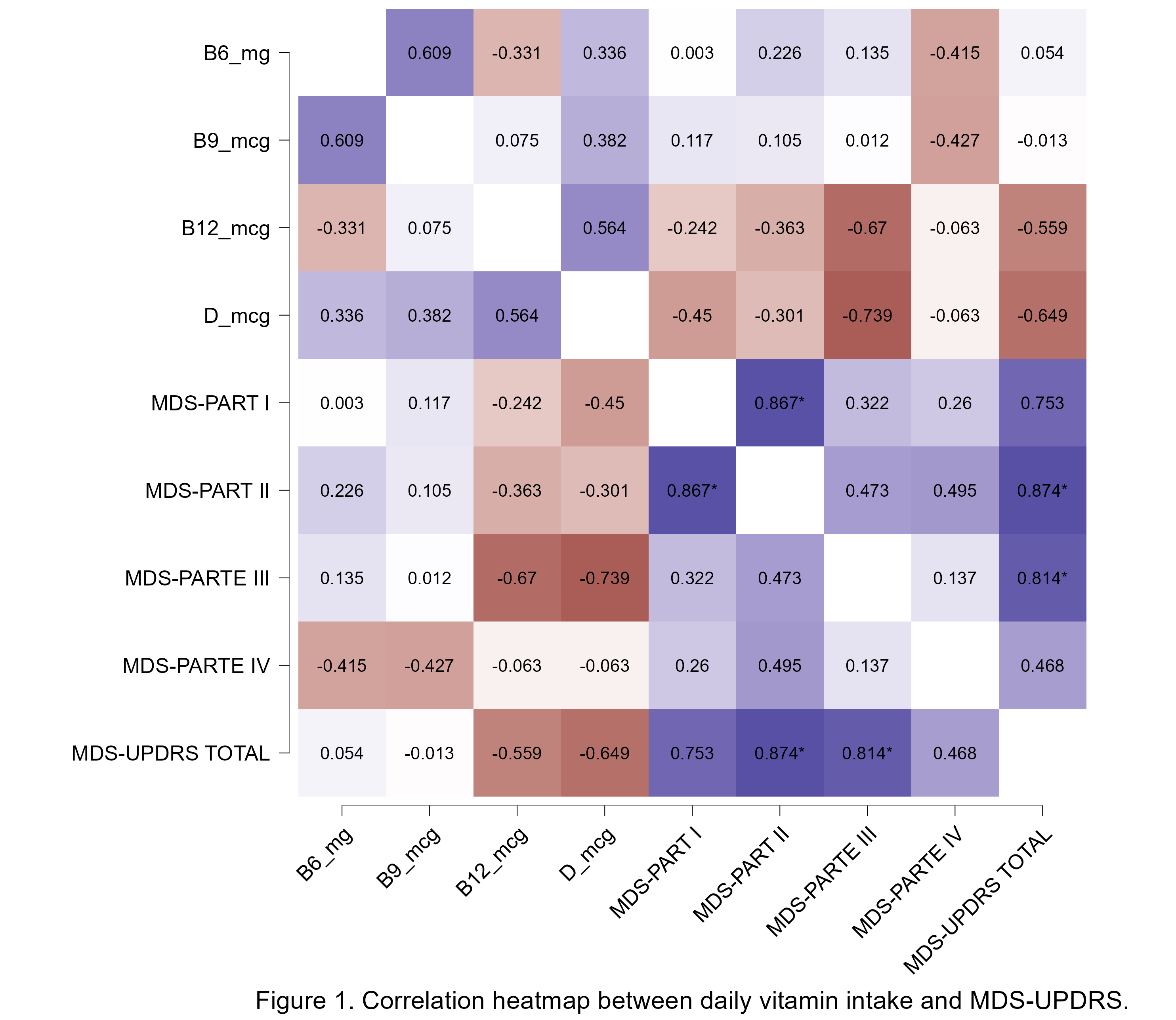
Figure 1. Correlation heatmap
References: 1.- Sleeman I, Aspray T, Lawson R, Coleman S, Duncan G, Khoo TK, et al. The Role of Vitamin D in Disease Progression in Early Parkinson’s Disease. J Parkinsons Dis. 2017;7(4):669-675. doi:10.3233/JPD-171122.
2.- Christine CW, Auinger P, Joslin A, Yelpaala Y, Green R. Vitamin B12 and Homocysteine Levels Predict Different Outcomes in Early Parkinson’s Disease. Mov Disord. 2018;33(5):762-770. doi:10.1002/mds.27301.
3.- López-Botello CK, González-Peña MI, Ancer-Rodríguez PR, et al. Nutritional status in patients with Parkinson’s disease at a third-level hospital in Northeastern Mexico. Med Univ. 2017;19(75):45-49. doi:10.1016/j.rmu.2017.03.002.
To cite this abstract in AMA style:
R. Trejo-Ayala, P. Ancer-Rodríguez, M. Herrera-López, K. Chapa-Ancer, J. Bermudes-Mendoza, A. Trejo-Ayala, R. Enriquez-Menchaca, B. Chávez-Luévanos, I. Estrada-Bellmann. Correlation Between Daily Vitamin Intake and Clinical Severity of Parkinson’s in Northeastern Mexico: An Exploratory Study [abstract]. Mov Disord. 2026; 41 (suppl 1). https://www.mdsabstracts.org/abstract/correlation-between-daily-vitamin-intake-and-clinical-severity-of-parkinsons-in-northeastern-mexico-an-exploratory-study/. Accessed October 1, 2026.« Back to 2026 International Congress
MDS Abstracts - https://www.mdsabstracts.org/abstract/correlation-between-daily-vitamin-intake-and-clinical-severity-of-parkinsons-in-northeastern-mexico-an-exploratory-study/