
Category: Parkinson's Disease: Disease mechanisms
Objective: To explore neural mechanisms underlying the variable response of rest tremor to dopaminergic treatment by comparing tremor-related cortical oscillations between OFF and ON medication states, using residual tremor in the ON state as a proxy for drug‑resistant tremor components.
Background: Rest tremor in PD exhibits heterogeneous responses to dopaminergic medication. Its neural basis is unclear.
Method: We recorded 64‑channel EEG and accelerometry signals in 14 PD patients with rest tremor. Tremor‑related brain activity was localized using the dynamic imaging of coherent sources (DICS). Effective connectivity between identified tremor‑related sources was estimated using Granger causality analysis, and cross‑frequency coupling (CFC) was analyzed to assess interactions between primary motor cortex (M1) activity at tremor frequency and other sources across canonical frequency bands.
Results: Source localization revealed distinct patterns of tremor-coherent cortical activity. In the OFF state, coherent activity was confined to M1. In the ON state, residual tremor was associated with additional coherent sources in primary (S1) and secondary (S2) somatosensory cortices (Figure 1). In the ON state, S2→S1 effective connectivity was stronger (Figure 2A) and correlated positively with tremor improvement (Figure 2B) and negatively with residual tremor severity (Figure 2C). CFC between M1 tremor activity and S1 gamma activity was negatively correlated with tremor severity. Subgroup analysis revealed a significant medication-by-group interaction. In the ON state, the CFC strength decreased in patients with drug-responsive rest tremor, while increased in those with drug‑resistant rest tremor (Figure 2D).
Conclusion: Residual tremor after dopaminergic therapy exhibits a distinct pattern of cortico-muscular coherence, involving an expanded cortical network that includes somatosensory cortices. Increased S2→S1 effective connectivity after medication correlates with better tremor suppression, and individual differences in this connectivity may underlie varied dopaminergic responses. S1 may inhibit M1 tremor activity via gamma-band CFC; this modulation was enhanced in patients with drug-resistant tremor, possibly as a compensatory mechanism. These findings highlight the critical role of the somatosensory cortex in the persistence of drug-resistant rest tremor in PD.
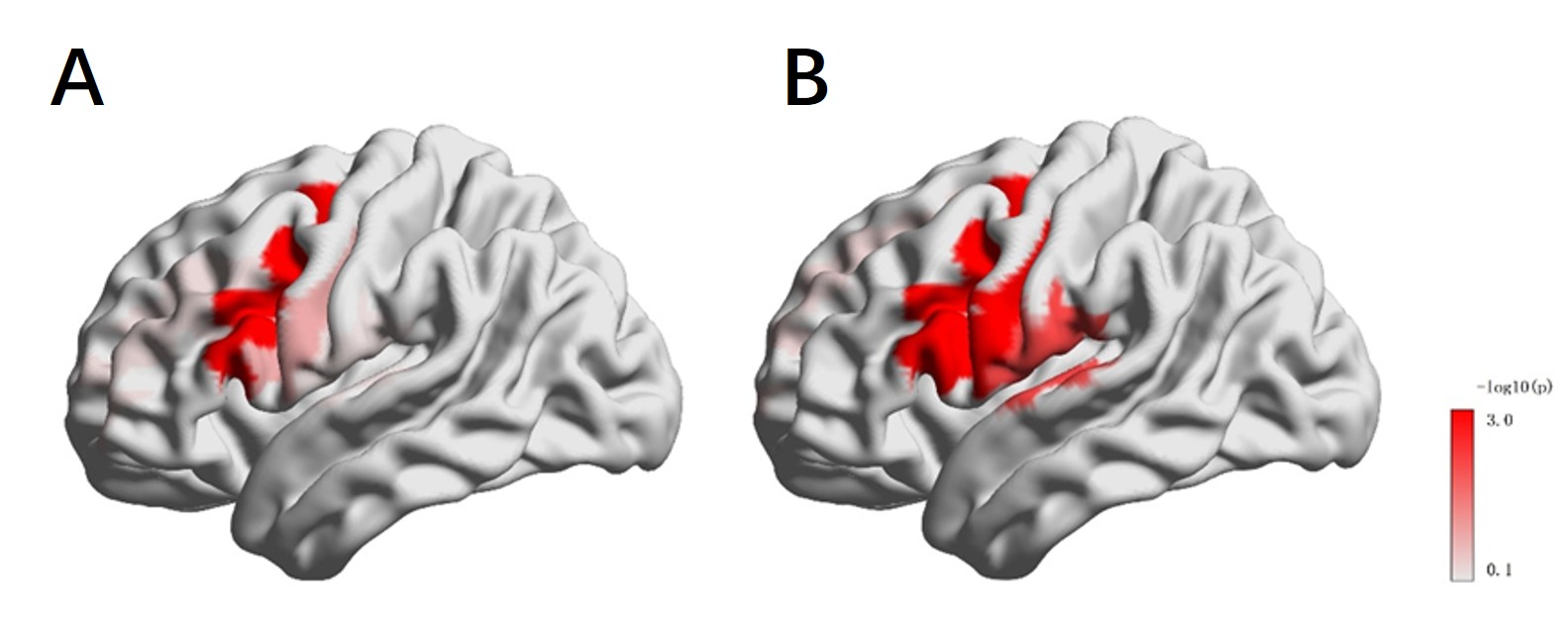
Figure 1
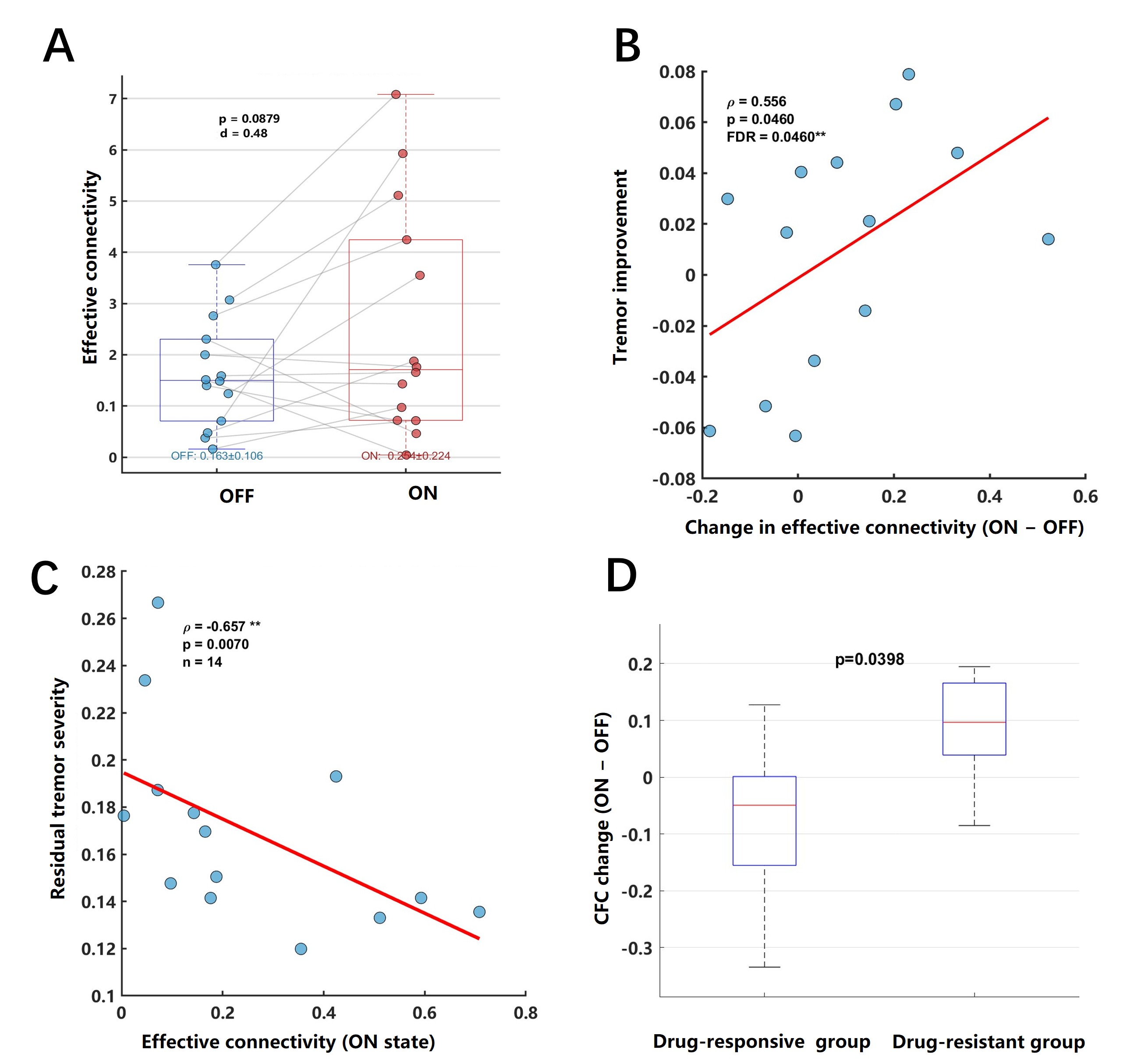
Figure 2
To cite this abstract in AMA style:
X. Xu, Y. Zang, P. Chan. Cortical Dynamics Underlying the Heterogeneous Dopamine Responsiveness of Rest Tremor in Parkinson’s Disease [abstract]. Mov Disord. 2026; 41 (suppl 1). https://www.mdsabstracts.org/abstract/cortical-dynamics-underlying-the-heterogeneous-dopamine-responsiveness-of-rest-tremor-in-parkinsons-disease/. Accessed October 1, 2026.« Back to 2026 International Congress
MDS Abstracts - https://www.mdsabstracts.org/abstract/cortical-dynamics-underlying-the-heterogeneous-dopamine-responsiveness-of-rest-tremor-in-parkinsons-disease/