
Category: Tics/Stereotypies
Objective: To report on the extent and reasons underpinning DBS removal in TS patients by utilizing the data drawn from a large multi-country cohort.
Background: Tourette syndrome (TS) is a complex neuropsychiatric disorder. A small percentage of individuals with TS will persist to experience severe, refractory, and impairing tics. Deep brain stimulation (DBS) has been increasingly used for symptom management especially in these settings. There has been a concern in the literature that TS DBS is associated with a higher incidence of hardware complications and with infections.
Method: Data was analyzed from patients enrolled in the Tourette Association of America’s International Tourette Syndrome Registry and Database.
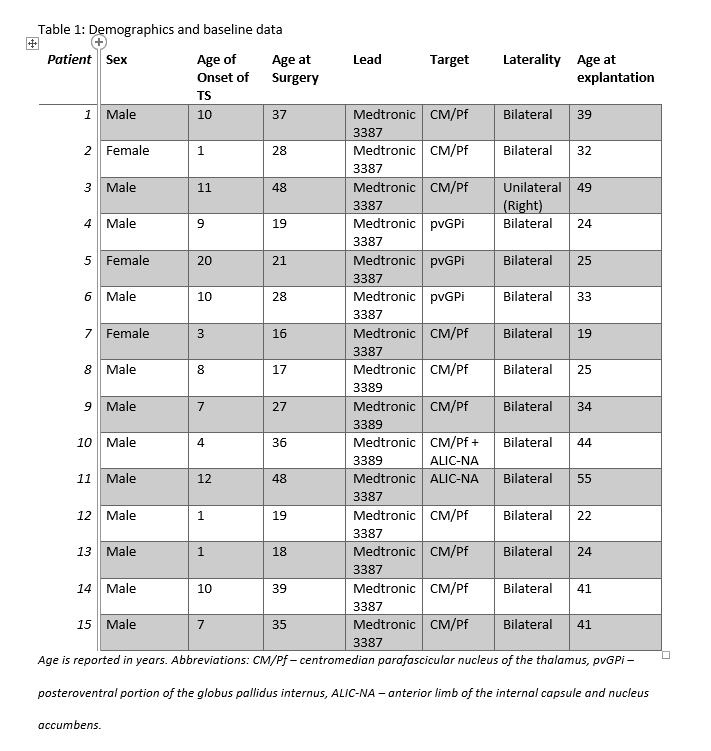
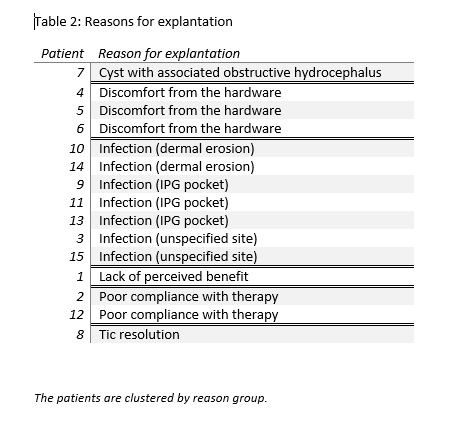
Results: Fifteen of 269 (5.6%) patients required removal of their DBS systems. The mean age at removal was 33.8 years. In these cases we observed a rate of 1.9 hardware removal per year of follow up from implantation. None of the hardware removals took place in the immediate post-operative period. Infection was the most common cause (46.7%). Only one patient received hardware removal for tic resolution. There were no significant associations with removal and the presence of specific psychiatric comorbidities, including OCD, depression, anxiety, or ADHD.
Conclusion: The rate of hardware removal of 5.6% was lower than the previously reported rate in the TS DBS literature. Infections account for nearly half of the TS DBS removals. No relationship to psychiatric comorbidities has been established.
To cite this abstract in AMA style:
W. Deeb, J. Wong, A. Leentjens, A. Mogilner, D. Servello, F. Meng, J. Zhang, T. Galbiati, M. Okun. Deep brain stimulation lead removal in Tourette syndrome: Data from the International Tourette DBS Registry and Database [abstract]. Mov Disord. 2020; 35 (suppl 1). https://www.mdsabstracts.org/abstract/deep-brain-stimulation-lead-removal-in-tourette-syndrome-data-from-the-international-tourette-dbs-registry-and-database/. Accessed October 2, 2026.« Back to MDS Virtual Congress 2020
MDS Abstracts - https://www.mdsabstracts.org/abstract/deep-brain-stimulation-lead-removal-in-tourette-syndrome-data-from-the-international-tourette-dbs-registry-and-database/