
Category: Parkinson's disease: Neuroimaging
Objective: While brain imaging studies have shown disruptions in the default mode network (DMN) related to cognitive difficulties in PD (Wolters et al., 2019; Díez-Cirarda et al., 2018; Gu et al., 2023), how cognitive status shapes the relationship between these moment-to-moment brain activity patterns and cognitive performance has not been fully explored.
Background: In Parkinson’s disease (PD), cognitive decline is common, with some patients developing mild cognitive impairment (PD-MCI) while others remain cognitively normal (PD-NC). This study used Co-Activation Pattern (CAP) analysis to (a) examine the dynamics of the task-negative default mode network (DMN), (b) how it switches between patterns in PD-MCI, PD-NC, and healthy controls (HC), and (c) how these relate to memory and thinking abilities.
Method: Neuroimaging data from 45 participants (18 PD-MCI, 12 PD-NC, 15 HC) were analyzed using the same preprocessing steps. DMN CAPs were derived using the posterior cingulate cortex (PCC) as a seed, identifying six recurring whole-brain states. We measured how long the brain stayed in each pattern (dwell time), how often it switched between patterns (transition probabilities), and how these measures related to scores on memory, language, attention, and executive function tests.
Results: In PD-MCI, the relationship between how long the brain stayed in a pattern and how it switched between patterns and cognitive test scores was weak or reversed compared to PD-NC and HC. Specifically, better language scores were associated with less time in CAP 3 in PD-NC but more time in PD-MCI, and better attention scores predicted more time in CAP 5 in HC but showed no relationship in PD-MCI. Longer disease duration in PD-MCI led to irregular brain state switches through CAP 1↔6 and CAP 3↔6 that were not observed in PD-NC. Better executive function reduced CAP 1↔5 switching in PD-NC but had no effect in PD-MCI.
Conclusion: Cognitive impairment in PD modulates both how long the brain stays in a state and how it moves between states, and breaks the normal link between cognitive function and these brain patterns. These changes can be detected using CAP analysis, suggesting it may be a useful tool for identifying and tracking cognitive decline in PD.
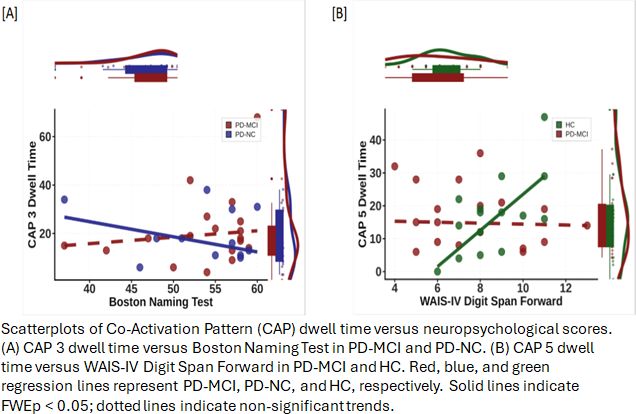
Fig.1
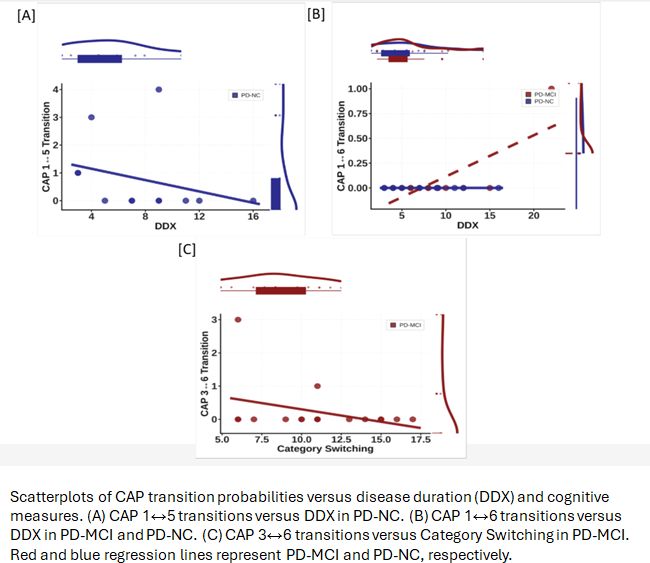
Fig.2
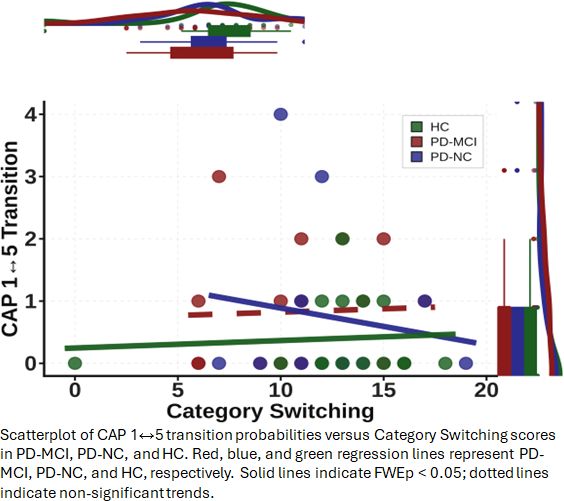
Fig.3
To cite this abstract in AMA style:
P. Chunchu, N. Singhal, T. Davis, V. Mari, V. Mishra. Default Mode Network Co-Activation Pattern Dynamics and Their Relationship to Cognition in Parkinson’s Disease with and without Mild Cognitive Impairment [abstract]. Mov Disord. 2026; 41 (suppl 1). https://www.mdsabstracts.org/abstract/default-mode-network-co-activation-pattern-dynamics-and-their-relationship-to-cognition-in-parkinsons-disease-with-and-without-mild-cognitive-impairment/. Accessed October 1, 2026.« Back to 2026 International Congress
MDS Abstracts - https://www.mdsabstracts.org/abstract/default-mode-network-co-activation-pattern-dynamics-and-their-relationship-to-cognition-in-parkinsons-disease-with-and-without-mild-cognitive-impairment/