
Objective: This study aims to ascertain whether OFF-state dentate nucleus glutamate, measured using J-difference edited MRS, predicts residual postural tremor following levodopa in Parkinson’s disease (PD), and to evaluate its specificity relative to rest tremor.
Background: Postural tremor in PD frequently persists despite adequate dopaminergic therapy. The dentate nucleus is the primary output of the cerebello-thalamo-cortical(CTC) circuit and has been implicated in tremor generation[1,2], however whether its neurochemical profile influences postural tremor levodopa responsiveness remains unexamined[3].
Method: 54 subjects with PD (age:52.8±8.8y; duration:6.2±3.3y; MDS-UPDRS-III OFF:48.8±12.1; 45M/9F; tremor-dominant) were evaluated in OFF(≥12h withdrawal) and ON states(post 200/50mg levodopa/carbidopa). Tremor was disaggregated into rest (items 3.17–3.18) and postural(item 3.15) subscores, residual ON-state tremor defined as score >0. MEGA-semiLASER MRS was acquired from motor cortex, thalamus and dentate nucleus(3T Siemens CIMA.X; 64-channel head coil-hemisphere corresponding to more severe tremor). Dentate spectral quality was verified (SNR=35.9±6.5;LW=8.8±0.8Hz). Absolute Glx (Glutamate+Glutamine) and GABA+ (GABA+macromolecule) were quantified using MRSpa [4]. ROC analysis evaluated dentate Glx as a classifier for residual postural tremor and Fisher z-tests assessed tremor specificity.
Results: Residual postural tremor in the ON state was observed in 39/54(72%). OFF-state dentate Glx was significantly higher in subjects with residual compared to resolved postural tremor (3.88±0.56 vs 3.56±0.44 i.u.,p=0.047; Cohen’s d=0.64;Figure-1A). ROC analysis yielded AUC=0.681(95%CI: 0.52–0.83;Figure-1B), at the optimal threshold (Glx=3.91 i.u.) specificity was 93% and positive predictive value 95%. Dentate Glx was inversely related to postural tremor improvement (r=−0.38,p=0.006) but not rest tremor response (r=+0.07,p=0.62, Fisher z-test confirmed specificity for postural tremor (z=−2.32, p=0.021;Figure-1C).
Conclusion: At the identified threshold, OFF-state dentate Glx demonstrated 93% specificity and 95% positive predictive value for residual postural tremor ON medication, suggesting it may be of value in stratifying tremor treatment response in PD. These findings indicate that elevated dentate excitatory neurochemistry may contribute to dopamine-resistant postural tremor and prospective validation is warranted.
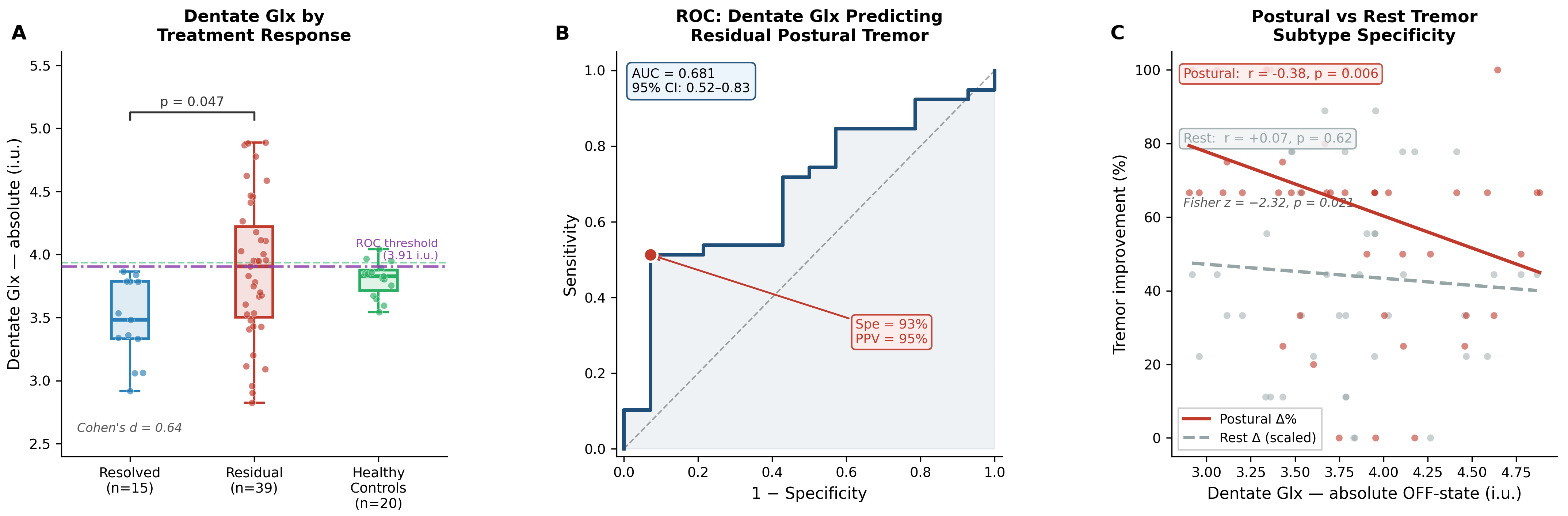
Figure-1: Dentate Glx and tremor response
References: [1] Helmich RC, Hallett M, Deuschl G, Toni I, Bloem BR. Cerebral causes and consequences of parkinsonian resting tremor: a tale of two circuits? Brain. 2012;135(Pt 11):3206-26.
[2] Dirkx MF, den Ouden H, Aarts E, Timmer M, Bloem BR, Toni I, Helmich RC. The Cerebral Network of Parkinson’s Tremor: An Effective Connectivity fMRI Study. J Neurosci. 2016;36(19):5362-72.
[3] Zach H, Dirkx MF, Roth D, Pasman JW, Bloem BR, Helmich RC. Dopamine-responsive and dopamine-resistant resting tremor in Parkinson disease. Neurology. 2020;95(11):e1461-70.
[4] Deelchand D. MRspa: Magnetic Resonance signal processing and analysis. Available at: https://www.cmrr.umn.edu/downloads/mrspa/
To cite this abstract in AMA style:
S. Prasad, A. Xavier, D. Deelchand, M. Kumar, R. Yadav, P. Pal, J. Saini. Dentate Glutamate as an OFF-State Biomarker of Levodopa-Resistant Postural Tremor in Parkinson’s Disease [abstract]. Mov Disord. 2026; 41 (suppl 1). https://www.mdsabstracts.org/abstract/dentate-glutamate-as-an-off-state-biomarker-of-levodopa-resistant-postural-tremor-in-parkinsons-disease/. Accessed October 1, 2026.« Back to 2026 International Congress
MDS Abstracts - https://www.mdsabstracts.org/abstract/dentate-glutamate-as-an-off-state-biomarker-of-levodopa-resistant-postural-tremor-in-parkinsons-disease/