
Category: Tremor
Objective: To analyze determinants of neuromodulation treatment selection, including patient preferences and clinical eligibility, in a large real-word cohort of patients diagnosed with Parkinson’s Disease (PD) and Essential Tremor (ET).
Background: Deep Brain Stimulation (DBS) and MR-guided Focused Ultrasound (MRgFUS) are both established therapies for medically refractory movement disorders. The increasing availability of MRgFUS has introduced new decision points in clinical practice, prompting the need to evaluate real-world clinical and patient-driven factors influencing treatment selection between DBS and MRgFUS.
Method: We conducted a retrospective cohort study of 637 neuromodulation procedures (108 DBS, 529 MRgFUS) for medically refractory movement disorders between March 2020 and March 2025. Treatment allocation was influenced by neurologic evaluation, patient preference, and clinical eligibility criteria including age (<80 for DBS), comorbidities, and Skull Density Ratio (SDR > 0.40 for MRgFUS).
Results: Among 461 patients who underwent MRgFUS (303 men, 158 women; all diagnosed with ET; mean age 74.1, range 49-92), 395 (85.7%) cited fear of open-skull surgery as the primary reason for choosing MRgFUS. Additional motives included anesthesia risk (n=48), prior surgical complications (n=19), and desire to avoid implants (n=30). Seventy-nine patients underwent bilateral MRgFUS thalamotomy, including 11 referred from outside institutions. SDR served as a key exclusion factor: 53 patients (10.5%) were ineligible for MRgFUS due to SDR < 0.40 and were referred for DBS. Among the 100 patients who underwent DBS (58 men, 42 women; 65 PD, 34 ET, 1 Dystonia; mean age 67.3, range 43-83), six had previously received unilateral MRgFUS and later transitioned to DBS.
Conclusion: This real-world cohort analysis demonstrates how patient preferences, age, medical comorbidities, and objective imaging thresholds collectively shape treatment selection between DBS and MRgFUS. To our knowledge, this represents the largest reported analysis of neuromodulation decision-making in a mixed ET and PD population. These findings can support individualized clinical counseling, enhance shared decision-making, and assist in the development of future treatment guidelines.
Presented at: AANS Annual Meeting; May 2nd, 2026.
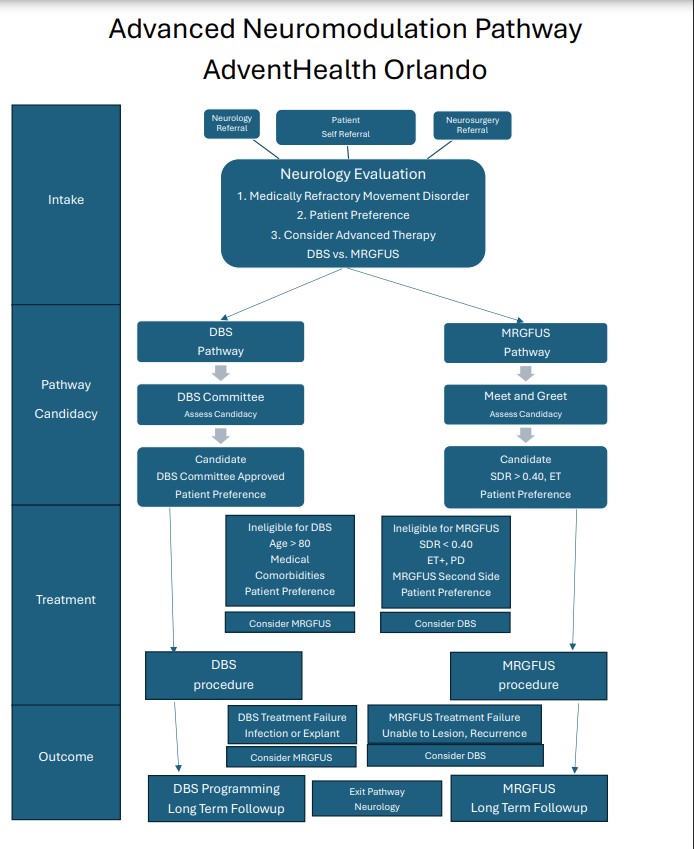
AH Orlando Advanced Neuromodulation Pathway
References: [1] Park YS, Jung NY, Na YC, Chang JW. Four-year follow-up results of magnetic resonance-guided focused ultrasound thalamotomy for essential tremor. Mov Disord. 2019 May;34(5):727-734. doi: 10.1002/mds.27637. PMID: 30759322.
[2] Sarica C, Yamamoto K, Iorio-Morin C, et al. Bilateral Focused Ultrasound Thalamotomy for Essential Tremor: Clinical Outcomes Compared to Bilateral Deep Brain Stimulation and Probabilistic Lesion Mapping. Mov Disord. 2025 May 2. doi: 10.1002/mds.30221. PMID: 40318052.
[3] Fullard ME, Dafoe A, Shelton E, et al. How Women and Men with Parkinson’s Disease Approach Decision-Making for Deep Brain Stimulation Surgery. Mov Disord Clin Pract. 2025 Apr;12(4):453-463. doi: 10.1002/mdc3.14284. PMID: 39692295.
[4] Halpern CH, Santini V, Lipsman N, et al. Three-year follow-up of prospective trial of focused ultrasound thalamotomy for essential tremor. Neurology. 2019 Dec 10;93(24):e2284-e2293. doi: 10.1212/WNL.0000000000008561. PMID: 31748250.
[5] Chang JW, Park CK, Lipsman N, et al. A prospective trial of magnetic resonance-guided focused ultrasound thalamotomy for essential tremor: Results at the 2-year follow-up. Ann Neurol. 2018 Jan;83(1):107-114. doi: 10.1002/ana.25126. PMID: 29265546.
[6] Cosgrove GR, Lipsman N, Lozano AM, et al. Magnetic resonance imaging-guided focused ultrasound thalamotomy for essential tremor: 5-year follow-up results. J Neurosurg. 2022 Aug 5;138(4):1028-1033. doi: 10.3171/2022.6.JNS212483. PMID: 35932269.
[7] Dallapiazza RF, De Vloo P, Fomenko A, et al. Considerations for Patient and Target Selection in Deep Brain Stimulation Surgery for Parkinson’s Disease. In: Stoker TB, Greenland JC, editors. Parkinson’s Disease: Pathogenesis and Clinical Aspects. Brisbane (AU): Codon Publications; 2018. PMID: 30702838.
[8] Hamberg K, Hariz GM. The decision-making process leading to deep brain stimulation in men and women with parkinson’s disease: An interview study. BMC Neurol. 2014 Apr 25;14:89. doi: 10.1186/1471-2377-14-89. PMID: 24761767.
To cite this abstract in AMA style:
A. Zoana, M. Lotia, N. Reddy, A. Ahmed, C. Reddy. Developing a Unified Advanced Neuromodulation Clinical Pathway for MR-Guided Focused Ultrasound and Deep Brain Stimulation [abstract]. Mov Disord. 2026; 41 (suppl 1). https://www.mdsabstracts.org/abstract/developing-a-unified-advanced-neuromodulation-clinical-pathway-for-mr-guided-focused-ultrasound-and-deep-brain-stimulation/. Accessed October 1, 2026.« Back to 2026 International Congress
MDS Abstracts - https://www.mdsabstracts.org/abstract/developing-a-unified-advanced-neuromodulation-clinical-pathway-for-mr-guided-focused-ultrasound-and-deep-brain-stimulation/