
Objective: To evaluate whether a multimodal digital intervention produces broader improvements in insomnia and emotional symptoms compared with self-monitoring alone, and to explore associated changes in functional connectivity within related brain networks.
Background: Sleep disturbances and insomnia are widespread conditions that impair function, well-being and quality of life. These challenges are common in Parkinson’s disease (PD), where sleep disruption and mood symptoms represent key non-motor features. Although digital tools are increasingly used to address sleep difficulties, the relative contribution of individual intervention components and their potential relevance to PD remain unclear.
Method: We conducted a 4-week randomized study in 63 adults with sleep complaints, comparing a digital sleep diary (DSD) to a multimodal app combining self-monitoring, psychological training, and a cognitive multisensory task. Sleep and psychological outcomes were assessed pre- and post-intervention. A subsample completed resting-state fMRI to explore neural mechanisms.
Results: Both groups showed improvements in PSQI, indicating better subjective sleep quality. However, only the multimodal group demonstrated significant reductions in ISI scores and broader gains in depression, anxiety, stress, and attention. Neuroimaging revealed shared increases in nucleus accumbens (NAc) connectivity with default mode regions across groups. Unique to the multimodal group were reductions in NAc-insula and NAc-anterior cingulate connectivity, key salience network regions implicated in emotional regulation, attentional control, and motivational processing. Improvements in insomnia severity correlated with psychological improvements only in the multimodal group. Notably, these ventral frontostriatal and salience network circuits overlap with neural systems disrupted in PD, suggesting potential mechanistic relevance.
Conclusion: While self-monitoring improved sleep quality, only the multimodal intervention significantly reduced insomnia severity and emotional symptoms. Given the high prevalence of sleep and mood disturbances in Parkinson’s disease and the involvement of overlapping frontostriatal networks, multimodal digital interventions may represent a scalable strategy to target non-motor symptoms and enhance quality of life in PD populations.
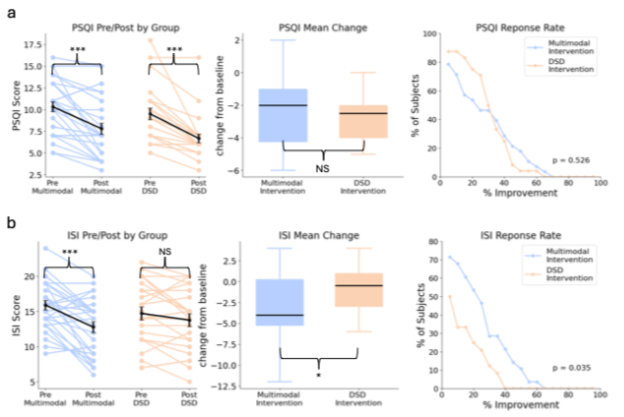
Sleep improvement
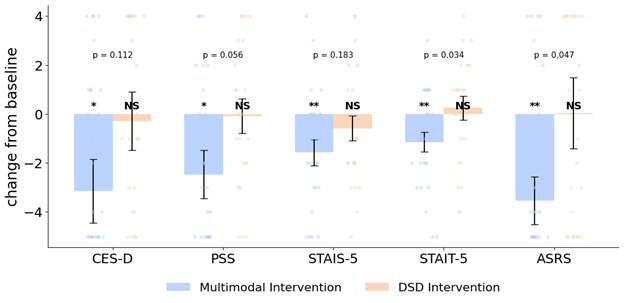
Psychological improvement
To cite this abstract in AMA style:
T. Tamir, M. Catalogna, N. Saporta, O. Shoval, S. Molcho, A. Amedi. Differential Effects of Digital Self-Monitoring and Multimodal Training in Adults with Sleep Difficulties on Sleep and Psychological Outcomes: Relevance to Parkinson’s Disease [abstract]. Mov Disord. 2026; 41 (suppl 1). https://www.mdsabstracts.org/abstract/differential-effects-of-digital-self-monitoring-and-multimodal-training-in-adults-with-sleep-difficulties-on-sleep-and-psychological-outcomes-relevance-to-parkinsons-disease/. Accessed October 1, 2026.« Back to 2026 International Congress
MDS Abstracts - https://www.mdsabstracts.org/abstract/differential-effects-of-digital-self-monitoring-and-multimodal-training-in-adults-with-sleep-difficulties-on-sleep-and-psychological-outcomes-relevance-to-parkinsons-disease/