
Category: Parkinson's Disease: Genetics
Objective: To compare the relative expression of XPC, XPA, ERCC5, and ERCC4 between patients with Parkinson’s disease (PD) and controls.
Background: DNA damage and impaired repair mechanisms have been implicated in PD. The nucleotide excision repair pathway may contribute to neuronal vulnerability; however, the expression profile of key repair genes in PD remains insufficiently characterized [1,2].
Method: A case-control study included 21 patients with PD and 23 controls. Relative gene expression (RQ) of XPC, XPA, ERCC5, and ERCC4 were assessed and compared between groups. Correlation analyses were performed between gene expression and clinical variables. A regression model adjusted for smoking and alcohol use was used to evaluate the association between group status and fold change.
Results: Cases showed lower cognitive performance on MoCA than controls (18.05 ± 7.39 vs 23.09 ± 4.57; p=0.011), and higher frequencies of smoking (61.9% vs 26.1%; p=0.037) and alcohol use (66.7% vs 30.4%; p=0.036). XPA expression was significantly lower in PD cases than in controls (p<0.001), whereas ERCC5 expression was significantly higher in cases (p<0.001). No significant between-group differences were observed for XPC (p=0.128) or ERCC4 (p=0.138). In the overall sample, ERCC5 correlated positively with age (r=0.36, p=0.019) and negatively with nutritional status and cognition. In controls, XPA and ERCC5 correlated positively with age, while XPC and ERCC4 correlated negatively with nutritional status; no significant correlations were observed in cases. After adjustment for smoking and alcohol use, only ERCC5 remained independently associated with PD (2^β=1.71, 95% CI 1.40–2.09; p<0.001) [Figure1,2,3].
Conclusion: PD was associated with lower XPA expression and higher ERCC5 expression, supporting altered nucleotide excision repair activity in disease. The persistent association of ERCC5 after adjustment suggests that this gene may be a relevant molecular marker in PD [3].
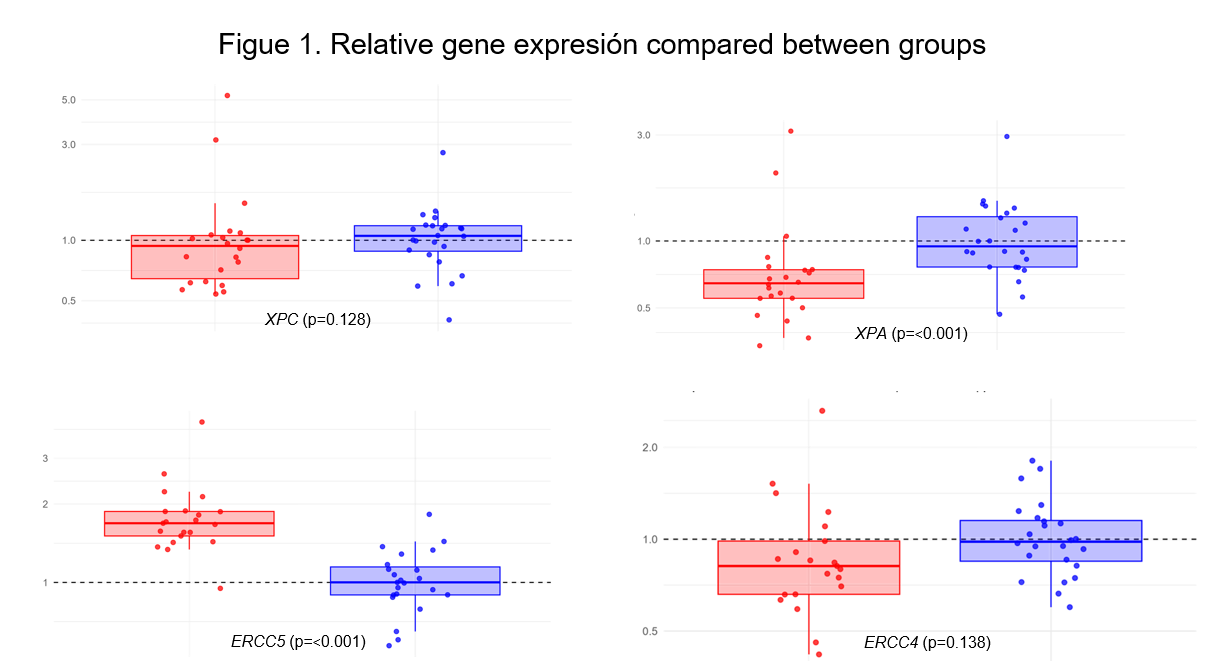
Relative gene expresión compared between groups
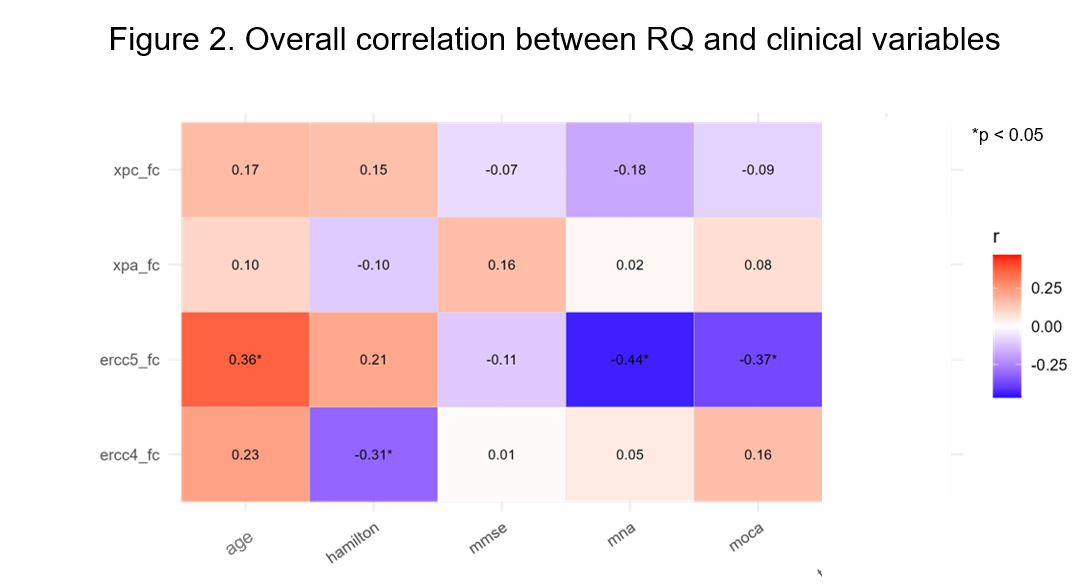
Correlation between RQ and clinical variables
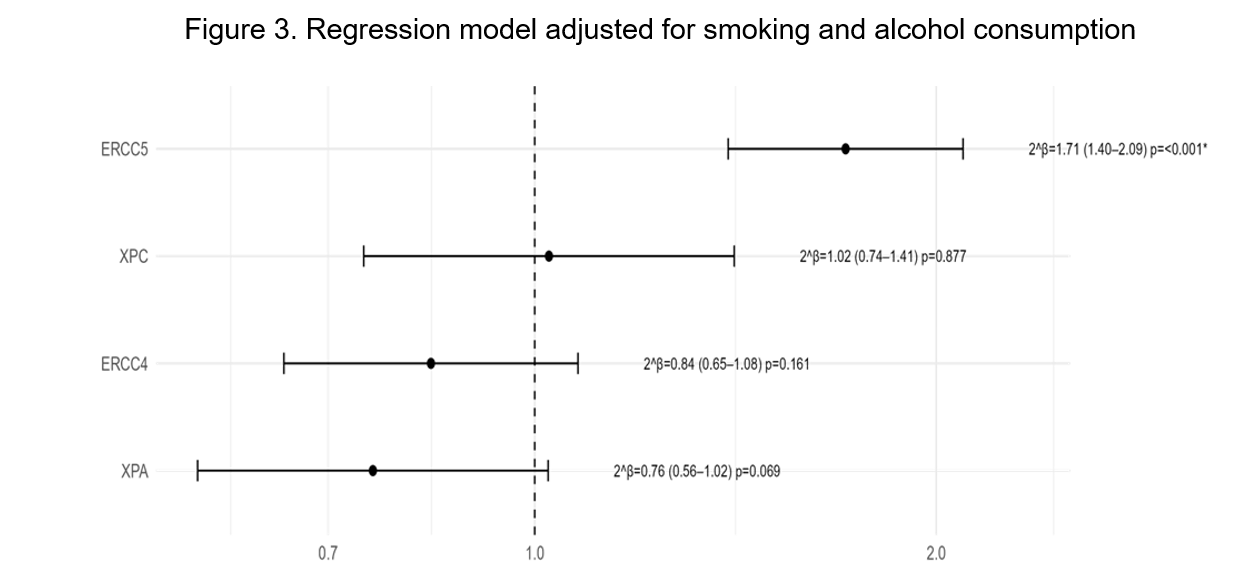
Regression model adjusted
References: 1. Gonzalez-Hunt CP, Sanders LH. DNA damage and repair in Parkinson’s disease: Recent advances and new opportunities. J Neurosci Res. 2021;99(1):180-189.
2. Pfeifer GP. DNA damage and Parkinson’s disease. International Journal of Molecular Sciences. 2024 Apr 10;25(8):4187.
3. Pinho R, Guedes LC, Soreq L, Lobo PP, Mestre T, Coelho M, Rosa MM, Goncalves N, Wales P, Mendes T, Gerhardt E. Gene expression differences in peripheral blood of Parkinson’s disease patients with distinct progression profiles. PloS one. 2016 Jun 20;11(6):e0157852.
To cite this abstract in AMA style:
PBR. Bermúdez Ramírez, SMS. Salas Pacheco, FCJ. Castellanos Juárez, JSP. Salas Pacheco, ASL. Salas Leal, ASC. Sandoval Carrillo. Differential expression of nucleotide excision repair genes in Parkinson’s disease [abstract]. Mov Disord. 2026; 41 (suppl 1). https://www.mdsabstracts.org/abstract/differential-expression-of-nucleotide-excision-repair-genes-in-parkinsons-disease/. Accessed October 1, 2026.« Back to 2026 International Congress
MDS Abstracts - https://www.mdsabstracts.org/abstract/differential-expression-of-nucleotide-excision-repair-genes-in-parkinsons-disease/