
Objective: To investigate predictors of responsiveness to a multimodal cognitive training intervention in individuals with isolated REM sleep behavior disorder (iRBD).
Background: The prodromal phase of Parkinson’s disease is often accompanied by incipient cognitive decline. The study CogTrAiL-RBD (study protocol in Ophey et al. 2024) provides first evidence for the potential of lifestyle-based cognitive enhancement in this target group (unpublished yet). Identifying predictors of training responsiveness will improve our mechanistic understanding of these interventions and enable personalized interventions for individuals at risk for PD and cognitive decline.
Method: In this trial, 82 individuals with iRBD were randomized to either the intervention group (INT, n=40, age 69.62±5.50, 87.50% male, 27.50% MCI) or the waiting-list control group (CON, n=42, age 68.88±6.30, 88.10% male, 35.71% MCI). The intervention consisted of a 5-week digital, adaptive, multi-domain cognitive training and a module promoting a healthy, active lifestyle. Predictors of intervention responsiveness were evaluated with multiple linear regression models. The absolute change in a composite score of executive functions between baseline (t0), 6-week post-allocation (t1), and 6-month follow-up (t2) served as the dependent variable. Age, executive performance, global cognition, cognitive reserve, measured with the Lifestyle of Experiences Questionnaire, and mean cortical thickness (CT, available for n=45) –all assessed at t0– were entered as independent variables.
Results: Higher intervention responsiveness in executive functions was associated with higher t0 global cognition, lower executive performance, lower cognitive reserve, and lower mean CT (Figure 1A). These associations were specific for the INT, as they were attenuated or even reversed when assessing associations with retest/practice effects in the CON. Regarding cortical thickness, whole-brain atlas-based analyses revealed this difference to be primarily driven by parieto-occipital regions (Figure 1B). [figure1]
Conclusion: Our results indicate that both existing cognitive resources but also room for improvement are important for cognitive intervention responsiveness. We hypothesize that the intervention may act as a booster for cognitive reserve, thereby reducing the reliance of cognitive plasticity on structural brain reserve in individuals with iRBD.
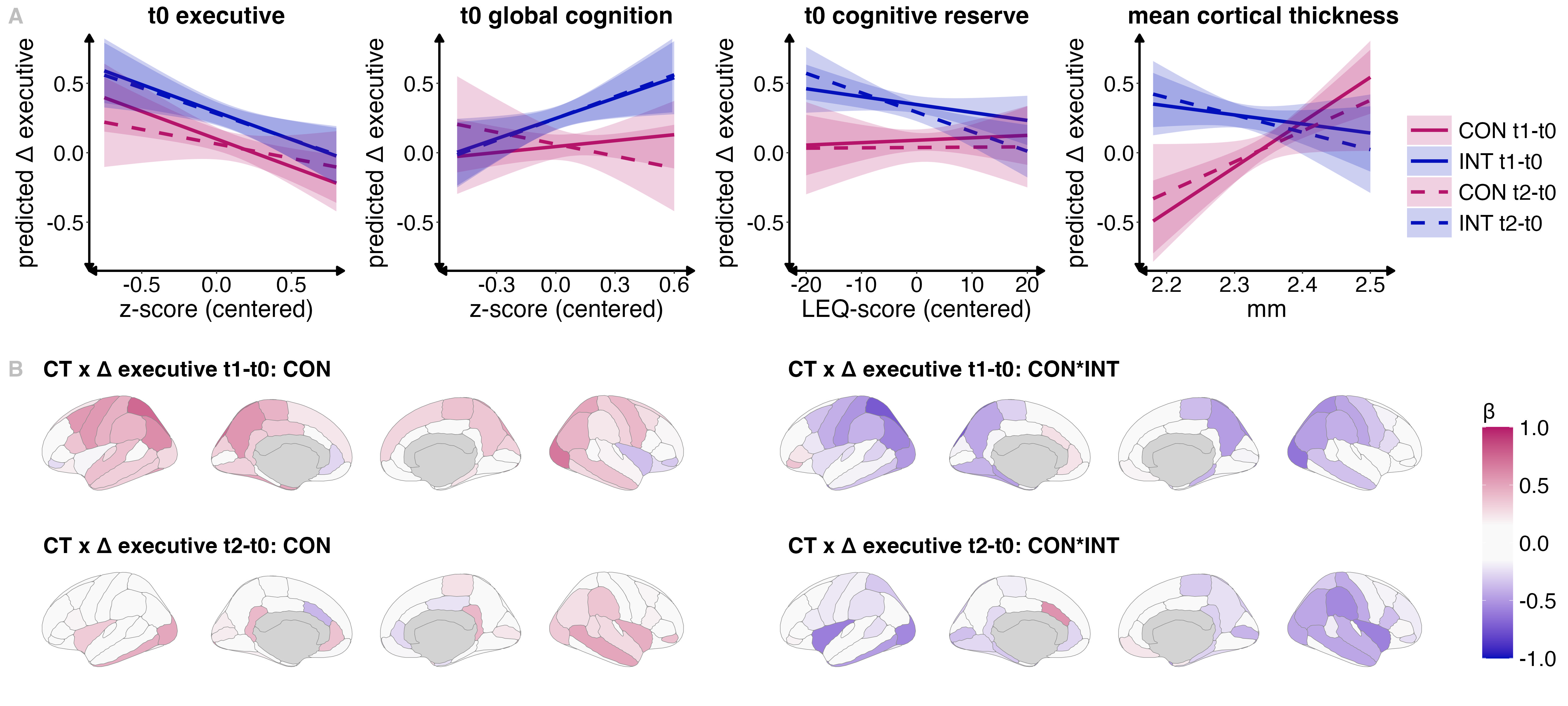
Figure 1
References: Ophey, A., Röttgen, S., Pauquet, J., Weiß, K. L., Scharfenberg, D., Doppler, C. E. J., Seger, A., Hansen, C., Fink, G. R., Sommerauer, M., & Kalbe, E. (2024). Cognitive training and promoting a healthy lifestyle for individuals with isolated REM sleep behavior disorder: study protocol of the delayed-start randomized controlled trial CogTrAiL-RBD. Trials, 25(1), 428. https://doi.org/10.1186/s13063-024-08265-9
To cite this abstract in AMA style:
A. Ophey, S. Röttgen, K. Kufer, J. Pauquet, D. Scharfenberg, P. Armbrust, A. Kammerzell, N. Knopf, S. Kollath, P. Sommer, CEJ. Doppler, E. Farrher, A. Seger, NJ. Shah, D. Zopfs, K. Reetz, GR. Fink, M. Sommerauer, E. Kalbe. Digital cognitive training and promoting a healthy lifestyle as a booster for cognitive reserve in prodromal Parkinson’s disease? [abstract]. Mov Disord. 2026; 41 (suppl 1). https://www.mdsabstracts.org/abstract/digital-cognitive-training-and-promoting-a-healthy-lifestyle-as-a-booster-for-cognitive-reserve-in-prodromal-parkinsons-disease/. Accessed October 1, 2026.« Back to 2026 International Congress
MDS Abstracts - https://www.mdsabstracts.org/abstract/digital-cognitive-training-and-promoting-a-healthy-lifestyle-as-a-booster-for-cognitive-reserve-in-prodromal-parkinsons-disease/