
Category: Parkinson's disease: Neuroimaging
Objective: To develop a machine learning framework using resting-state functional connectivity to identify neural signatures of Parkinson’s disease (PD) and forecast disease progression.
Background: PD exhibits substantial heterogeneity in clinical progression. No reliable neuroimaging biomarkers exist to stratify patients for individualized care or clinical trials. REM sleep behavior disorder (RBD) predicts a malignant non-motor phenotype [1]; whether these phenotypes have detectable neural substrates remains unknown.
Method: We analyzed baseline resting-state fMRI from 336 early-stage PD patients from the Parkinson’s Disease Markers Initiative stratified by suspected RBD (sRBD) status using the RBD Screening Questionnaire. Adjacency matrices and graph theory metrics characterizing brain network topology were extracted and integrated into machine learning classifiers (logistic regression, SVM, ensemble voting). Feature importance was assessed via SHAP values. Predictions were validated against three-year longitudinal clinical outcomes using repeated measures ANOVA.
Results: Group-level analyses (GLM, permutation testing, network-based statistic) revealed no significant differences in functional connectivity between sRBD groups after correction for multiple comparisons. In contrast, machine learning models incorporating graph theory metrics achieved robust sRBD classification (balanced accuracy 0.91–0.93), substantially outperforming adjacency-only models (0.79). Basal ganglia-thalamic, temporal-limbic, and cerebello-cortical circuits were the primary predictive regions [Figure 1]. Feature importance was stable across network density thresholds (Jaccard index 0.48 – 0.67). Patients classified as sRBD-positive demonstrated significantly worse motor outcomes, accelerated autonomic dysfunction, and higher rates of hallucinations, dyskinesias, and depression over three years [Figure 2].
Conclusion: The DEGAS framework identifies clinically distinct PD subtypes from baseline neuroimaging by combining graph theory metrics with machine learning. While conventional group comparisons failed to detect differences, multivariate models revealed distributed network signatures with prognostic value. This approach enables prospective risk stratification and offers a pathway toward personalized prognosis and individualized benchmarks for clinical trials.
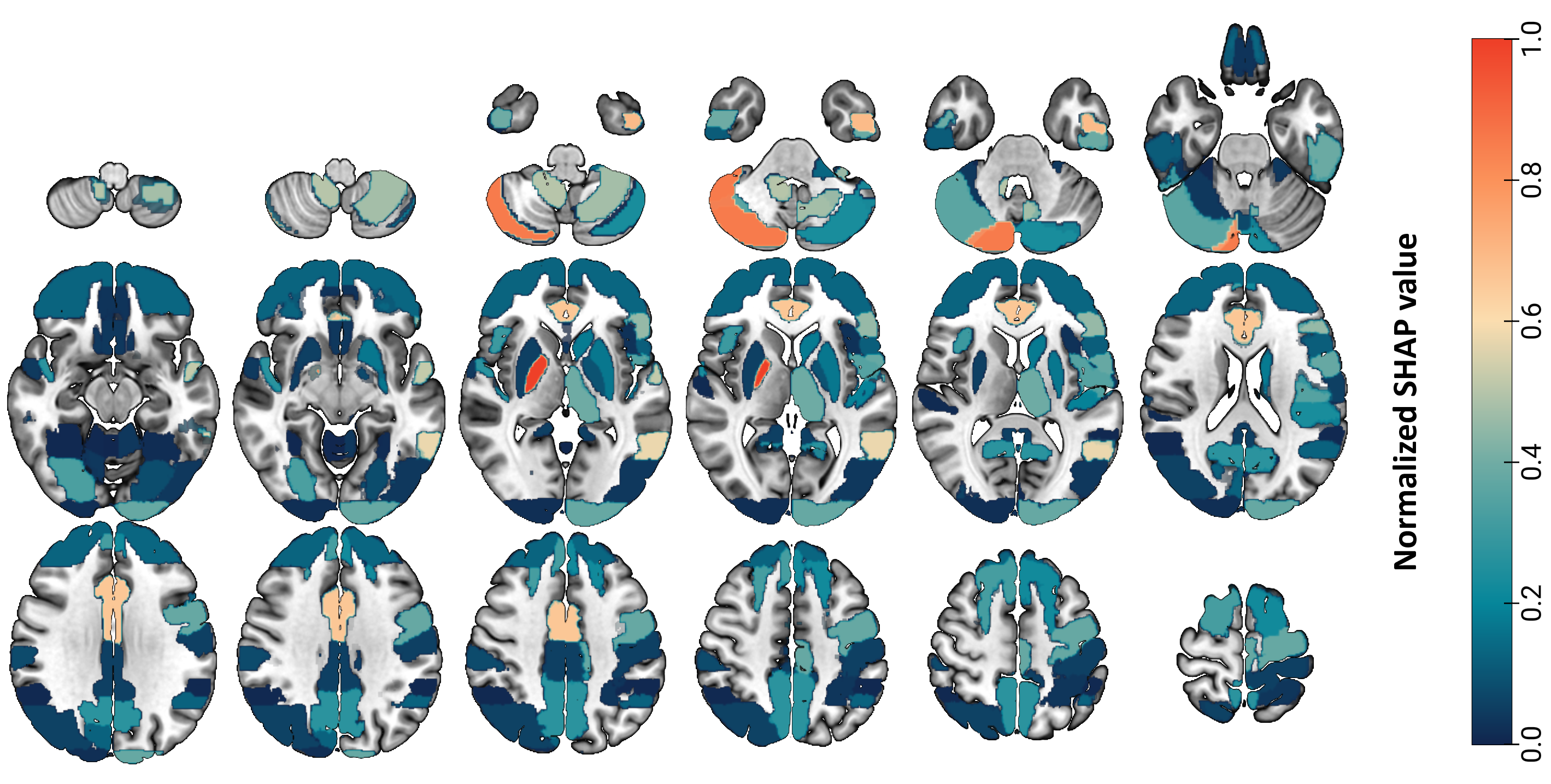
Regional feature importance for model prediction
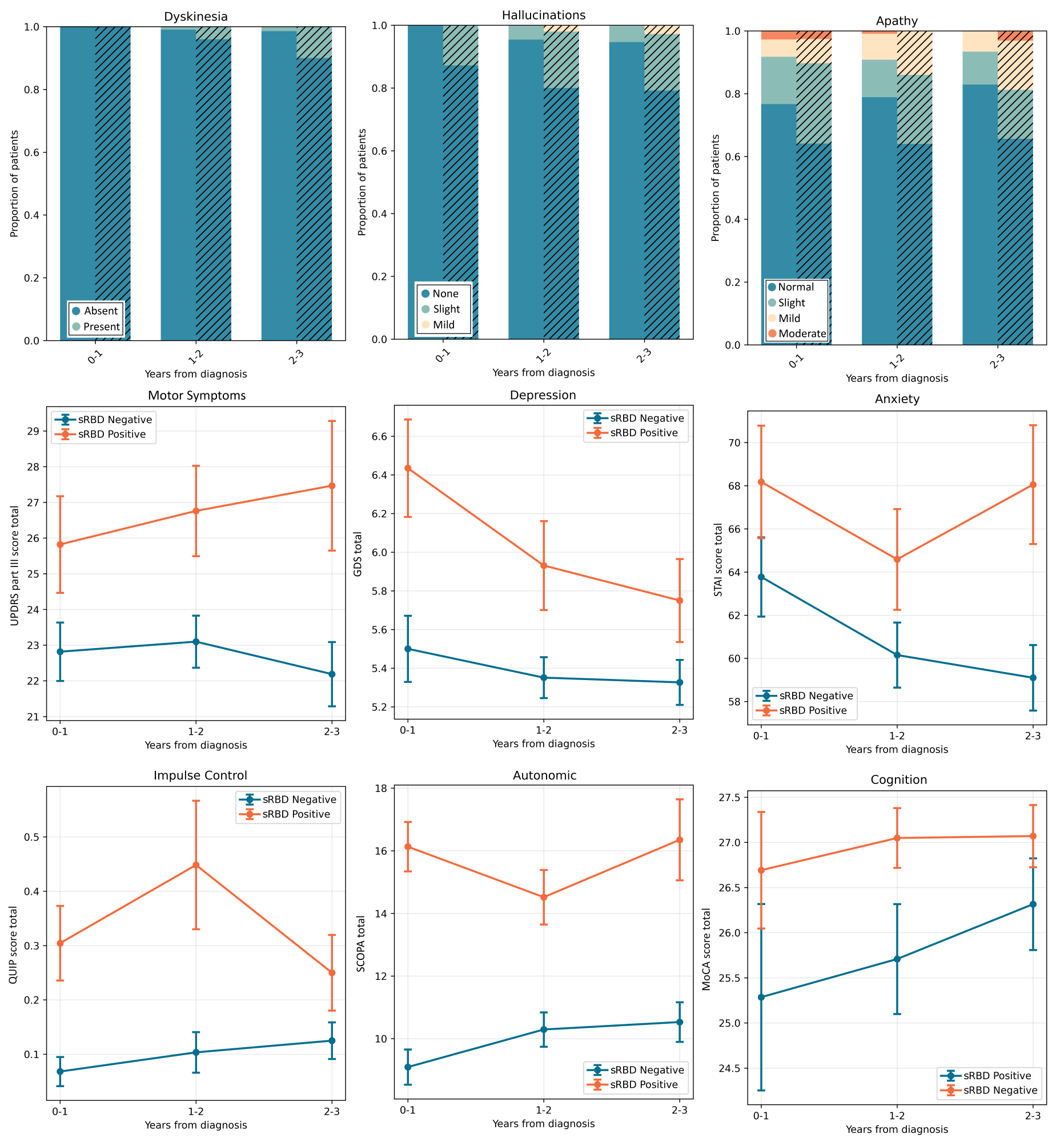
Clinical outcomes by predicted sRBD status
References: [1] Martinez‐Nunez AE, Chandra V, Fleeting CR, Patel A, Foote KD, Hilliard JD, San Luciano Palenzuela M, de Hemptinne C, Okun MS, Wong JK. Functional Connectivity to the Cerebellum and Resting‐State Networks Predict Earlier Improvement of Dystonia Following Globus Pallidus Internus‐Deep Brain Stimulation (GPi‐DBS). Movement Disorders. 2025 Dec 30.
To cite this abstract in AMA style:
A. Martinez-Nunez, M. Okun, J. Wong. Disease Endophenotyping through Graph and Adjacency Metrics (DEGAS): Network Biomarkers for Parkinson’s Disease Prognosis [abstract]. Mov Disord. 2026; 41 (suppl 1). https://www.mdsabstracts.org/abstract/disease-endophenotyping-through-graph-and-adjacency-metrics-degas-network-biomarkers-for-parkinsons-disease-prognosis/. Accessed October 1, 2026.« Back to 2026 International Congress
MDS Abstracts - https://www.mdsabstracts.org/abstract/disease-endophenotyping-through-graph-and-adjacency-metrics-degas-network-biomarkers-for-parkinsons-disease-prognosis/