
Objective: To describe the natural history of RFC1-related ataxia, identify discriminative features compared to MSA-C, and study their survival outcomes.
Background: AAGGG intronic expansions in RFC1 is responsible for Cerebellar ataxia, Neuropathy and Vestibular Areflexia Syndrome (CANVAS), but also ataxia associated to dysautonomia, parkinsonism and pyramidal syndrome, creating clinical overlap with multiple system atrophy of cerebellar type (MSA-C).
Method: From clinical, imaging and electrophysiological data of a French prospective cohort of 418 sporadic late-onset cerebellar ataxia, we extracted 65 MSA-C and 20 RFC1-related ataxia, and conducted cross-sectional and longitudinal analysis.
Results: Earlier age at onset, later parkinsonism, dysautonomia, pyramidal syndrome onset and slower disease progression are significantly associated with RFC1-related ataxia (p <0.05). Sensory impairment and chronic cough are key differentiating features. Median survival in RFC1-related ataxia is longer than 20 years (p<0.0001).
Conclusion: RFC1 ataxia is clinically distinguished from MSA-C by earlier onset, slower disease progression and prolonged survival.
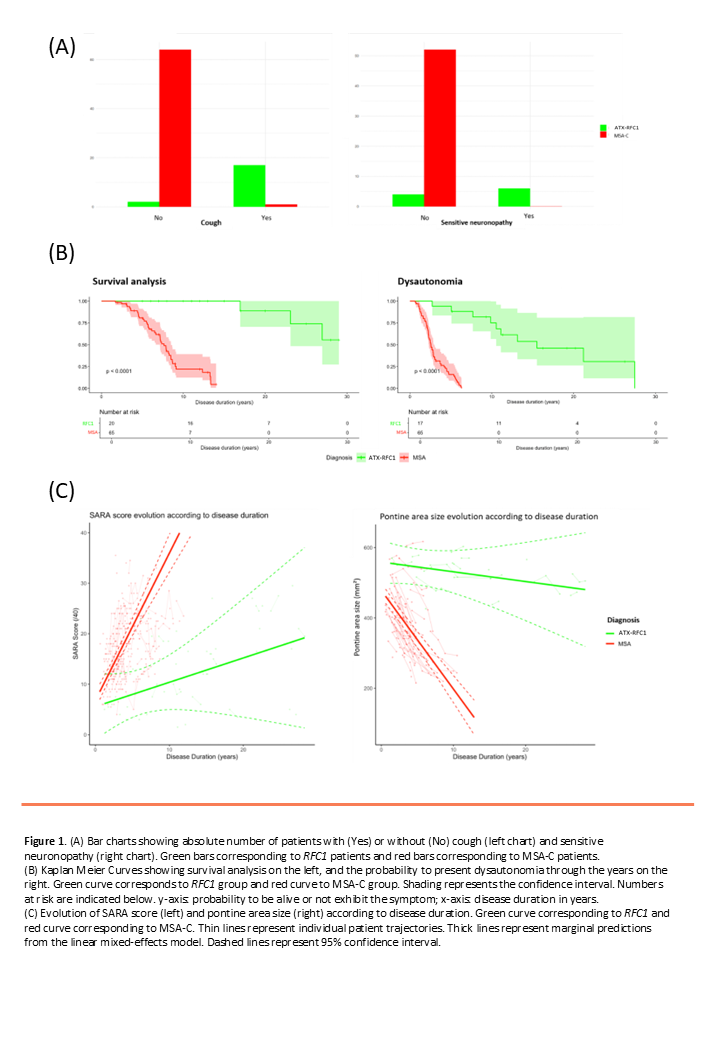
Figure 1
To cite this abstract in AMA style:
I. Pei, A. Storck, T. Bogdan, C. Tranchant, IJ. Namer, S. Kremer, T. Thomas, M. Anheim. Does CANVAS mimic MSA-C [abstract]. Mov Disord. 2026; 41 (suppl 1). https://www.mdsabstracts.org/abstract/does-canvas-mimic-msa-c/. Accessed October 1, 2026.« Back to 2026 International Congress
MDS Abstracts - https://www.mdsabstracts.org/abstract/does-canvas-mimic-msa-c/