
Objective: To describe four patients in whom laryngeal dystonia manifesting as cough and spasmodic dysphonia preceded Cerebellar Ataxia with Neuropathy and Vestibular Areflexia Syndrome (CANVAS) with genetically confirmed biallelic RFC1 expansions.
Background: Neurally mediated chronic cough is a recognised early manifestation of CANVAS and a feature of laryngeal dystonia. However, adductor spasmodic dysphonia symptoms have not been reported in RFC1-CANVAS.
Method: We report four patients with genetically confirmed CANVAS who initially presented with prominent laryngeal symptoms. Laryngeal dystonia was diagnosed based on clinical phenomenology, nasendoscopy and consistent EMG findings, supported by improvement following EMG-guided botulinum toxin injection.
Results: All four patients had longstanding paroxysmal chronic cough triggered by environmental irritants. Three had concurrent adductor spasmodic dysphonia, and in two of these cases there was concurrent adductor respiratory laryngeal dystonia with stridor. In all four cases, this preceded the development of progressive sensory neuronopathy, bilateral abnormal head impulse tests and mild cerebellar features such as dysdiadochokinesis and heel-shin dysmetria. Three patients displayed signs of extra-laryngeal dystonia (including blepharospasm, cervical and upper limb dystonia). In all cases, RFC1 genetic testing revealed biallelic mutations with repeat expansions. Three patients underwent laryngeal EMG, which demonstrated hyperfunctional thyroarytenoid activity consistent with dystonia. EMG-guided botulinum toxin injection in these three patients resulted in significant improvement of laryngeal symptoms.
Conclusion: These cases suggest that dystonic laryngeal phenomena may represent an early manifestation of CANVAS. Sensory pathway involvement may disrupt laryngeal reflexes, which can in turn lead to laryngeal hyperexcitability, predisposing to laryngeal dystonia. Recognition of this novel phenotype may facilitate earlier genetic diagnosis. These cases broaden the clinical spectrum of RFC1-related disease.
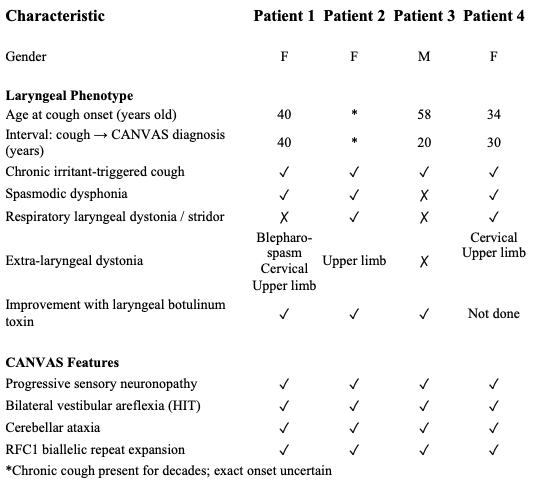
Clinical Characteristics Table
To cite this abstract in AMA style:
O. Chan, N. Simon, S. Tisch. Early Manifestations of Cerebellar Ataxia with Neuropathy and Vestibular Areflexia Syndrome (CANVAS) Include Dystonic Laryngeal Phenomena [abstract]. Mov Disord. 2026; 41 (suppl 1). https://www.mdsabstracts.org/abstract/early-manifestations-of-cerebellar-ataxia-with-neuropathy-and-vestibular-areflexia-syndrome-canvas-include-dystonic-laryngeal-phenomena/. Accessed October 1, 2026.« Back to 2026 International Congress
MDS Abstracts - https://www.mdsabstracts.org/abstract/early-manifestations-of-cerebellar-ataxia-with-neuropathy-and-vestibular-areflexia-syndrome-canvas-include-dystonic-laryngeal-phenomena/