
Category: Ataxia
Objective: This study aimed to examine the effects of a neurologic physiotherapy on ataxia, balance, and gait in a patient with cerebellar ataxia, neuropathy, and vestibular areflexia syndrome (CANVAS).
Background: CANVAS is a rare neurodegenerative disorder characterized by the triad of cerebellar ataxia, sensory neuropathy, and bilateral vestibular areflexia. These impairments lead to progressive balance deficits, gait instability, and an increased risk of falls [1]. Although physiotherapy approaches such as balance and gait training are commonly used in patients with cerebellar and vestibular disorders, evidence regarding their effectiveness in individuals with CANVAS remains limited [2,3].
Method: A 60-year-old male with a four-year history of CANVAS participated in a six-week neurorehabilitation program (two sessions per week). A CANVAS-specific biallelic (homozygous) AAGGG repeat expansion was detected at RFC1 gene were analysed using fPCR and RP-PCR. Motor symptom severity was evaluated using the International Cooperative Ataxia Rating Scale (ICARS) and the Scale for the Assessment and Rating of Ataxia (SARA). Balance was assessed using a K-Invent® force platform and the Berg Balance Scale (BBS). Spatio-temporal gait parameters were measured using the BTS® G-Walk system, and functional mobility was evaluated using the Timed Up and Go (TUG) test.
Results: Following the six-week neurorehabilitation program, improvements were observed in motor symptoms, balance, and gait performance. Ataxia severity decreased, as reflected by reductions in SARA and ICARS scores. Postural sway decreased under both eyes-open and eyes-closed conditions. Balance improved, with BBS scores increasing from 25 to 41 points. Gait analysis demonstrated improvements in spatio-temporal parameters, including increased cadence, increased gait speed, longer stride length, and a reduced double support period (12.7→10.9%). Functional mobility improved, with TUG decreasing from 10.36 to 8.35 s [Table 1].
Conclusion: This case report suggests that a structured neurorehabilitation program may improve balance, gait performance, and motor symptoms in individuals with CANVAS syndrome. These findings highlight the potential role of neurorehabilitation in managing functional impairments in this rare neurodegenerative disorder. Further studies with larger samples are required to confirm these findings.
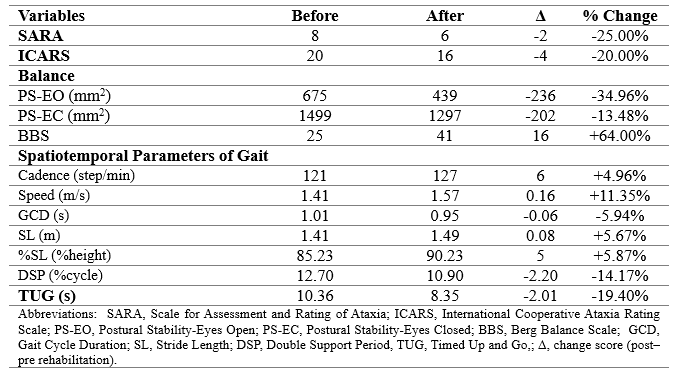
Pre- and post-treatment results of the patient
References: [1] Wu, T. Y., Taylor, J. M., Kilfoyle, D. H., Smith, A. D., McGuinness, B. J., Simpson, M. P., … & Roxburgh, R. H. (2014). Autonomic dysfunction is a major feature of cerebellar ataxia, neuropathy, vestibular areflexia ‘CANVAS’syndrome. Brain, 137(10), 2649-2656.
[2] Matsugi, A., Bando, K., Kondo, Y., Kikuchi, Y., Miyata, K., Hiramatsu, Y., … & Yamasaki, Y. (2025). Effects of physiotherapy on degenerative cerebellar ataxia: a systematic review and meta-analysis. Frontiers in Neurology, 15, 1491142.
[3] Szmulewicz, D. J., McLean, C. A., MacDougall, H. G., Roberts, L., Storey, E., & Halmagyi, G. M. (2014). CANVAS an update: clinical presentation, investigation and management. Journal of vestibular research, 24(5-6), 465-474.
To cite this abstract in AMA style:
M. Salamci, A. Guclu-Gunduz, M. Akbostanci. Effects of a Six-Week Neurorehabilitation Program on Ataxia, Balance and Gait in a Patient with CANVAS Syndrome: A Case Report [abstract]. Mov Disord. 2026; 41 (suppl 1). https://www.mdsabstracts.org/abstract/effects-of-a-six-week-neurorehabilitation-program-on-ataxia-balance-and-gait-in-a-patient-with-canvas-syndrome-a-case-report/. Accessed October 1, 2026.« Back to 2026 International Congress
MDS Abstracts - https://www.mdsabstracts.org/abstract/effects-of-a-six-week-neurorehabilitation-program-on-ataxia-balance-and-gait-in-a-patient-with-canvas-syndrome-a-case-report/