
Category: Parkinson’s Disease: Clinical Trials
Objective: This study aimed to examine the effects of auricular vagus nerve stimulation (aVNS) combined with neurorehabilitation on motor symptoms, balance, and gait in people with Parkinson’s disease (pwPD).
Background: Neurorehabilitation is known to improve motor function, balance, and gait in pwPD by promoting motor learning and neuroplasticity [1]. Vagus nerve stimulation has also shown potential benefits for motor symptoms in pwPD [2]. While combining aVNS with neurorehabilitation has demonstrated enhanced motor recovery in stroke [3], the effects of combining aVNS with rehabilitation in Parkinson’s disease have not yet been investigated.
Method: Ten pwPD (Modified Hoehn and Yahr stages 1–3) were enrolled in this randomized controlled trial. Participants were randomly assigned to either an active-aVNS (n=5) or sham-aVNS group (n=5). Motor symptom severity was evaluated using the Movement Disorders Society–Unified Parkinson’s Disease Rating Scale (MDS-UPDRS III). Balance was assessed using the Berg Balance Scale (BBS) and a K-Invent® force platform, while spatio-temporal gait parameters were analysed using the BTS® G-Walk system and gait performance with the 6-minute walk test (6MWT). All participants received an intensive multi-dimensional neurorehabilitation program for approximately 2 hours per day, 5 days per week, for 3 weeks. Additionally, aVNS was applied for 20 minutes per session via the cymba conchae region of the auricle.
Results: Baseline characteristics were similar between groups. A significant between-group difference favoring the active-aVNS group was observed in the double support period (p = 0.016, r = 0.76), indicating improved gait stability. Improvements in MDS-UPDRS III, postural stability with eyes closed, and the 6-minute walk test favoured the active-aVNS group, with large effect sizes although statistical significance was not reached (p = 0.056) [Table 1].
Conclusion: Preliminary findings suggest that aVNS combined with neurorehabilitation may improve gait stability in people with Parkinson’s disease. The large effect sizes observed across several outcomes indicate a potential synergistic effect of neuromodulation and neurorehabilitation. On the other hand, a larger sample size is needed to confirm these results.
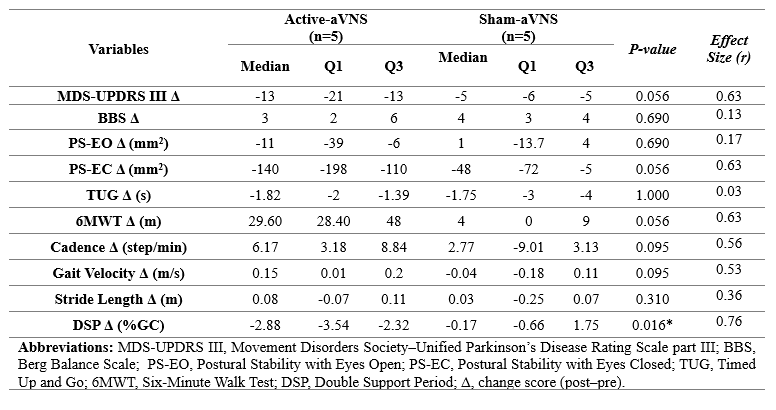
Between-group comparison of change scores
References: [1] Tomlinson, C. L., Patel, S., Meek, C., Herd, C. P., Clarke, C. E., Stowe, R., … & Ives, N. (2012). Physiotherapy intervention in Parkinson’s disease: systematic review and meta-analysis. Bmj, 345.
[2] Eissazade, N., Eghdami, S., Rohani, M., Ajdari, A., Fereshtehnejad, S. M., Fasano, A., & Khoeini, T. (2025). Noninvasive vagus nerve stimulation in Parkinson’s disease: a systematic review. Neuromodulation: Technology at the Neural Interface, 28(4), 641-651.
[3] Engineer, N. D., Kimberley, T. J., Prudente, C. N., Dawson, J., Tarver, W. B., & Hays, S. A. (2019). Targeted vagus nerve stimulation for rehabilitation after stroke. Frontiers in neuroscience, 13, 280.
To cite this abstract in AMA style:
M. Salamci, A. Guclu-Gunduz, M. Akbostanci. Effects of Auricular Vagus Nerve Stimulation Combined with Neurorehabilitation on Motor Symptoms, Balance, and Gait in People with Parkinson’s Disease: Preliminary Results of a Prospective Study [abstract]. Mov Disord. 2026; 41 (suppl 1). https://www.mdsabstracts.org/abstract/effects-of-auricular-vagus-nerve-stimulation-combined-with-neurorehabilitation-on-motor-symptoms-balance-and-gait-in-people-with-parkinsons-disease-preliminary-results-of-a-prospective-stu/. Accessed October 1, 2026.« Back to 2026 International Congress
MDS Abstracts - https://www.mdsabstracts.org/abstract/effects-of-auricular-vagus-nerve-stimulation-combined-with-neurorehabilitation-on-motor-symptoms-balance-and-gait-in-people-with-parkinsons-disease-preliminary-results-of-a-prospective-stu/