
Objective: To determine the efficacy and safety of modafinil on motor and non-motor outcomes in Parkinson’s disease (PD) using evidence exclusively from randomized placebo‑controlled clinical trials (RCTs).
Background: Modafinil, a wakefulness-promoting agent with dopaminergic and non-dopaminergic mechanisms, is used to treat excessive daytime sleepiness (EDS) and fatigue in PD. However, clinical trial results have yielded inconsistent results, and its effects on motor and non‑motor outcomes remains unclear.
Method: A systematic review and meta-analysis of PubMed‑indexed RCTs evaluating modafinil in idiopathic PD were performed. Extracted outcomes included EDS (Epworth Sleepiness Scale – ESS), fatigue (Fatigue Severity Scale – FSS), motor function (MDS-UPDRS III and total scores), and depressive symptoms (Beck & Hamilton depression scales). Effect estimates were pooled using fixed and random‑effects models with REML, as appropriate. Standardized mean differences (SMD) and mean differences (MD) were applied. Adverse events were analyzed using relative risks (RR).
Results: Eight trials including 216 participants (modafinil = 113, placebo = 103) met inclusion criteria. Modafinil significantly improved EDS compared with placebo (MD −2.12 points; 95% CI −3.64 to −0.60; I² = 65%) [Figure 1], though meta‑regression showed no association between treatment duration and response. No significant differences were observed in motor outcomes (SMD = 0.20; 95% CI −0.23 to 0.63) [Figure 2]. Modafinil did not significantly improve fatigue (MD = −0.17; 95% CI −1.12 to 0.79) or depressive symptoms (MD = 1.51; 95% CI −0.10 to 3.11) [Figure 3]. Adverse events, including insomnia (RR 0.72; 0.17–3.10), headache (RR 0.73; 0.21–2.50), dizziness (RR 1.69; 0.36–7.96), and gastrointestinal symptoms (RR 2.57; 0.53–12.48), were infrequent and did not differ significantly from placebo.
Conclusion: In RCTs involving PD patients, modafinil is associated with a modest improvement in EDS without significant effects on motor function, fatigue, or mood. The absence of motor worsening or significant adverse events supports short-term tolerability. However, heterogeneity across studies and limited sample sizes limit confidence in effect estimates. Larger, adequately powered trials are needed to clarify the clinical role of modafinil in PD.
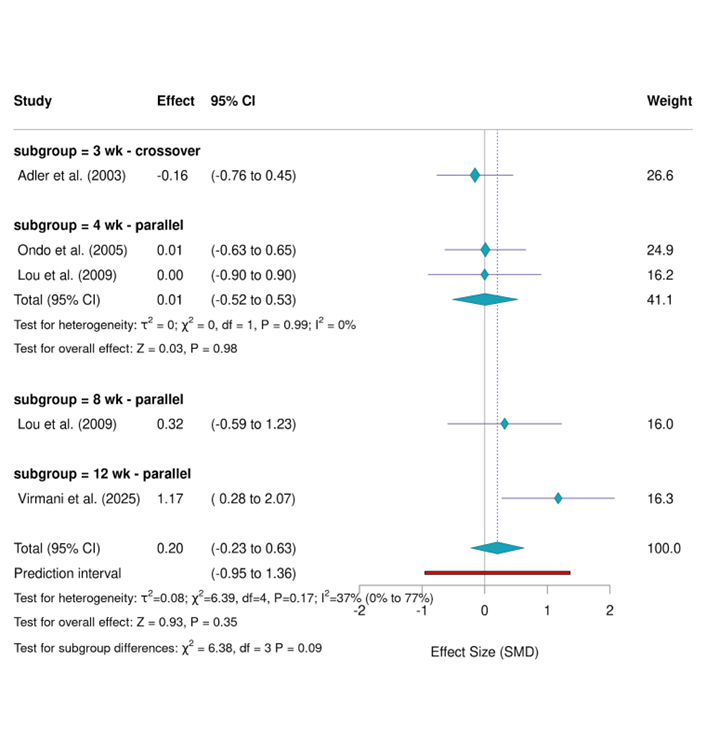
Forest plot of pooled SMD of motor outcomes
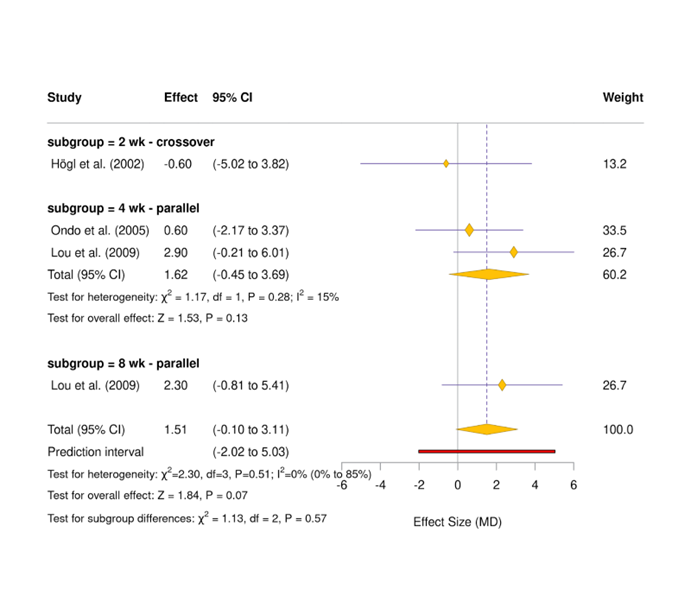
Forest plot of pooled MD of depressive outcomes
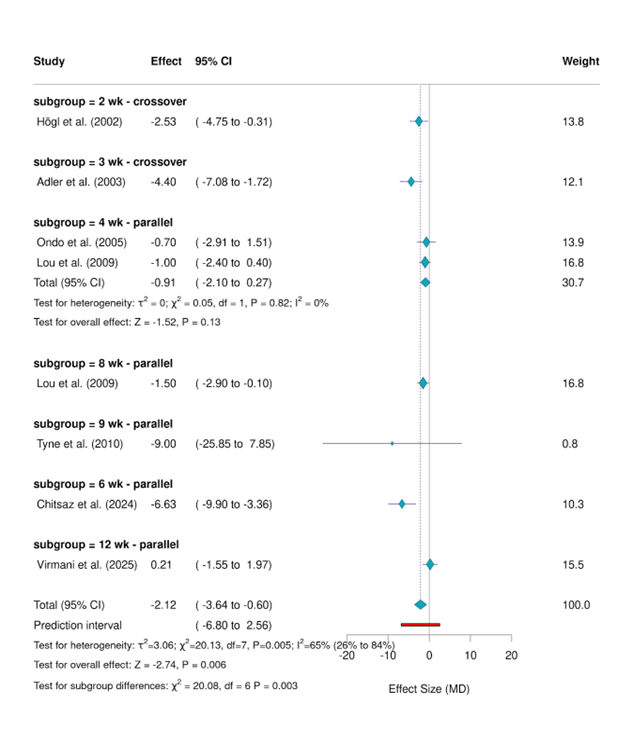
Forest plot of pooled MD of EDS
To cite this abstract in AMA style:
A. Lin, J. Rissardo, J. Patino, A. Caprara, A. Mcgarry, I. Walker. Effects of Modafinil on Motor and Non‑Motor Outcomes in Parkinson’s Disease: A Meta‑Analysis of Randomized, Placebo‑Controlled Trials [abstract]. Mov Disord. 2026; 41 (suppl 1). https://www.mdsabstracts.org/abstract/effects-of-modafinil-on-motor-and-non-motor-outcomes-in-parkinsons-disease-a-meta-analysis-of-randomized-placebo-controlled-trials/. Accessed October 1, 2026.« Back to 2026 International Congress
MDS Abstracts - https://www.mdsabstracts.org/abstract/effects-of-modafinil-on-motor-and-non-motor-outcomes-in-parkinsons-disease-a-meta-analysis-of-randomized-placebo-controlled-trials/