
Objective: The primary objective is to evaluate the efficacy of SPECT aided EMG guided Botulinum Toxin injection in patients with Writer’s cramp as compared to clinical and EMG based injection.
Background: Botulinum Toxin A injection can be used as a therapeutic option in focal hand dystonia like writers’ cramp, the efficacy of which has been variable from 60-70%.Pooled analysis (observational studies and RCTs) demonstrated a significant difference in the mean Writer’s cramp rating score (1). Accurate identification of muscles of interest can often be challenging and there’s significant compensatory action to dystonia, which makes even EMG ineffective. (2) Imaging methods like Ultrasonography/CT can only help to locate anatomical structures, but have nil aid in identifying the functional component of a dystonic muscle. FDG PET has been studied in identifying dystonic muscles in primary cervical dystonia patients, and when used as an aid to botulinum toxin injection, has been shown to increase the efficacy of injection (3-6) .
Method: This is single-centred prospective, randomized, open label, blinded end-point trial analysis (PROBE) study. Patients with writers’ cramp will be randomized into study group (SPECT +EMG) or control group (EMG) in a 1:1 allocation ratio, if they satisfy the inclusion criteria.The primary outcome would be difference in WCRS and UDRS scores at 3 weeks between the study and the control groups.
The sample size for this study was determined using data from a previous study by Kruisdijk et al. (2006) (7). Assuming an improvement of 2 additional units in the study arm (a total improvement of 4.3), a minimum sample size of 17 participants of Writer’s Cramp in each arm was deduced, to achieve 80% power with an alpha error of 0.05 (5%). Expecting a dropout rate of 20%, the final sample size was calculated to be 23 in each group, i.e, n = 23 * 2 = 46
Results: The data will be presented using mean (standard deviation) or median (range) for continuous variables, and frequency (%) for categorical variables, as appropriate.This is the protocol of the proposed study which has been registered in CTRI: CTRI/2025/04/083788 after it has been approved by the Institutional Ethics Committee.
Conclusion: This study may provide us an idea whether SPECT aided EMG guided BONT injections are better than only EMG and clinician judgement guided BONT injections in Writer’s cramp
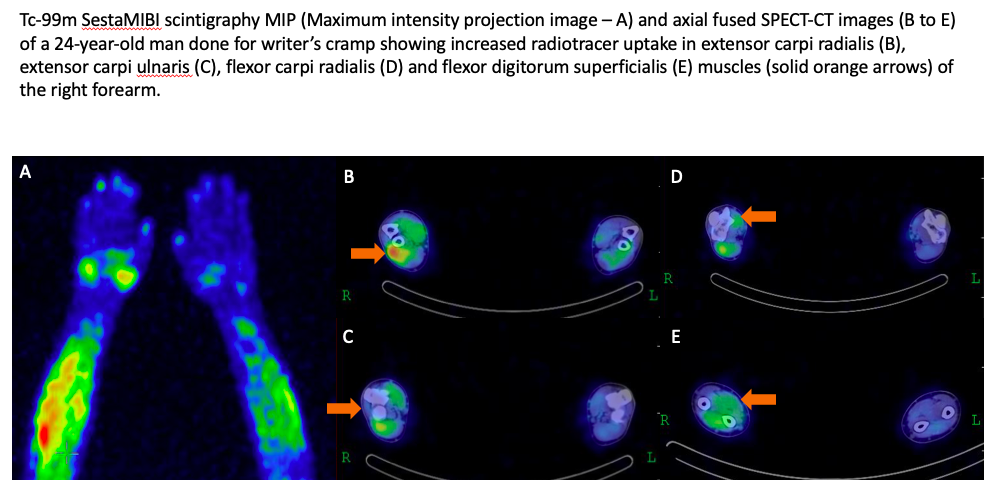
Image 1
References: 1. Patil et al. Egypt J Neurol Psychiatry Neurosurg (2022) 58:128
2. Karp BI, Alter K. Muscle Selection for Focal Limb Dystonia. Toxins (Basel). 2017 Dec 29;10(1):20.
3. Sung DH, Choi JY, Kim DH et al (2007) Localization of dystonic muscles with 18F-FDG PET/CT in idiopathic cervical dystonia. J Nucl Med 48:1790–1795
4. Jang SJ, Choi JY, Sung DH et al (2010) Comparison between 18F-FDG PET/CT and EMG mapping for identifying dystonic superficial muscles in primary cervical dystonia:preliminary results. Nucl Med Mol Imaging 44:33–38
5. Lee HB, An YS, Lee HY et al (2012) Usefulness of (18)f-fluorodeoxyglucose positron emission tomography/computed tomography in management of cervical dystonia. Ann Rehabil Med 36:745– 755
6. Lee HJ, An YS, Ahn YW, Yim SY (2013) Threshold of clinical severity of cervical dystonia for positive (18)F-FDG PET/CT. Ann Rehabil Med 37:777–784
7. Kruisdijk, J.J.M.; Koelman, J.H.T.M.; De Visser, B.O.; De Haan, R.J.; Speelman, J.D.Botulinum toxin for writer’s cramp: A randomised, placebo-controlled trial and 1-year follow-up. J. Neurol. Neurosurg. Psychiatry 2007, 78, 264–270
To cite this abstract in AMA style:
A. Das, T. Km, A. Elavarasi, R. Rajan, D. Radhakrishnan, M. Tripathi, M. Tripathi, A. Upadhyay. Efficacy and safety of single-photon emission computed tomography (SPECT) aided botulinum toxin injection in writers’ cramp: A PROBE Study [abstract]. Mov Disord. 2026; 41 (suppl 1). https://www.mdsabstracts.org/abstract/efficacy-and-safety-of-single-photon-emission-computed-tomography-spect-aided-botulinum-toxin-injection-in-writers-cramp-a-probe-study/. Accessed October 1, 2026.« Back to 2026 International Congress
MDS Abstracts - https://www.mdsabstracts.org/abstract/efficacy-and-safety-of-single-photon-emission-computed-tomography-spect-aided-botulinum-toxin-injection-in-writers-cramp-a-probe-study/