
Category: Parkinson's disease: Neuroimaging
Objective: To systematically map and quantitatively synthesize evidence on ECG-derived markers associated with autonomic dysfunction in PD and evaluate their ability to differentiate patients from healthy individuals.
Background: Parkinson’s disease (PD) is a progressive neurodegenerative disorder characterized by motor impairment and a wide spectrum of non-motor manifestations, including autonomic dysfunction. Cardiovascular autonomic impairment is increasingly recognized in PD and can be assessed non-invasively using electrocardiography (ECG). Alterations in heart rate variability, QT interval, and rhythm abnormalities have been reported in PD; however, the diagnostic and predictive utility of ECG features for identifying and classifying PD has not been comprehensively evaluated.
Method: A structured literature search was performed across PubMed, Scopus, Web of Science, and Cochrane Library databases from inception through October 2024. Studies comparing ECG parameters, particularly QTc and RR intervals, between PD patients and healthy controls were eligible. Two reviewers independently performed study selection and data extraction. Quantitative synthesis was conducted using RevMan 5.3.
Results: Fourteen studies comprising 2,083 PD patients and 2,043 controls were included. PD patients consistently demonstrated QTc prolongation and reduced heart rate variability, both associated with advancing disease severity. Reported sensitivity of ECG features for distinguishing PD ranged from 43% to 95%, with specificity between 67.2% and 96%. Meta-analysis showed significantly prolonged QTc intervals in PD (MD = 12.87 ms, 95% CI: 5.62–20.12) and reduced RR intervals (SMD = −0.48, 95% CI: −0.83 to −0.15). Pooled diagnostic performance yielded a sensitivity of 52.3% and specificity of 92.96%. Emerging studies integrating machine learning and deep learning with ECG data demonstrated additional diagnostic promise.
Conclusion: ECG-derived parameters, particularly QTc prolongation and reduced RR intervals, may serve as accessible markers of autonomic dysfunction in PD. Although diagnostic accuracy remains moderate, integration with computational models may enhance early detection and disease classification. Further validation studies are warranted before ECG can be adopted as a screening or diagnostic adjunct in PD.
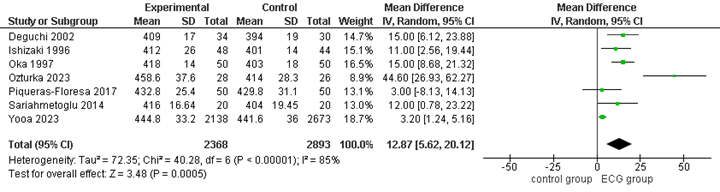
Mean Difference of QTc interval

Standardized Mean Difference of RR interval

Sensitivity & Specificity for Accuracy of ECG
To cite this abstract in AMA style:
I. Serag, A. Negida. Electrocardiographic Indicators of Autonomic Dysfunction in Parkinson’s Disease: A Scoping Review and Meta-analysis [abstract]. Mov Disord. 2026; 41 (suppl 1). https://www.mdsabstracts.org/abstract/electrocardiographic-indicators-of-autonomic-dysfunction-in-parkinsons-disease-a-scoping-review-and-meta-analysis/. Accessed October 1, 2026.« Back to 2026 International Congress
MDS Abstracts - https://www.mdsabstracts.org/abstract/electrocardiographic-indicators-of-autonomic-dysfunction-in-parkinsons-disease-a-scoping-review-and-meta-analysis/