
Objective: To evaluate whether South Asian individuals with Parkinson’s disease (PD) demonstrate differences in cognitive performance compared with White Americans.
Background: South Asians represent one of the fastest-growing ethnic populations globally yet remain underrepresented in PD research. Most studies of PD clinical and cognitive features have focused primarily on populations of European ancestry. Understanding potential differences in cognitive phenotypes across ethnic groups may help inform more personalized approaches to PD evaluation and management.
Method: We evaluated 40 individuals with PD at a tertiary movement disorders center and categorized participants as South Asian (SA) or White Americans. Demographic and clinical variables included age at onset, age at diagnosis, sex, disease duration, family history of PD, and levodopa equivalent daily dose (LEDD). Motor severity was assessed using the Unified Parkinson’s Disease Rating Scale (UPDRS) and the Kinesia One system. Cognitive performance was evaluated using the Montreal Cognitive Assessment (MoCA) and the NIH Toolbox cognitive battery, with episodic memory assessed using the Picture Sequence Memory Test. Vascular and metabolic risk factors were extracted from the electronic medical record.
Results: Forty participants were included (11 SA, 29 White Americans). Groups were similar with respect to age, disease duration, sex distribution, motor severity, LEDD, and vascular risk factors [Table 1] [Table 2]. Global cognitive performance, as measured by the MoCA, did not differ between groups [Table 1]. However, SA participants demonstrated lower episodic memory performance on the NIH Toolbox Picture Sequence Memory Test compared with White American participants (mean T-score 39±8.3 vs 47.4±10.8, p=0.03; Cohen’s d=0.82), representing a large effect size [Table 3].
Conclusion: South Asian individuals with PD demonstrated greater episodic memory impairment despite similar motor severity, global cognition, and vascular risk profiles. The magnitude of this difference suggests a potentially distinct cognitive phenotype in this underrepresented population. These findings highlight the importance of studying diverse populations in PD research. Larger studies are needed to confirm these findings and investigate potential biological, genetic, and sociocultural factors contributing to cognitive variability in PD.
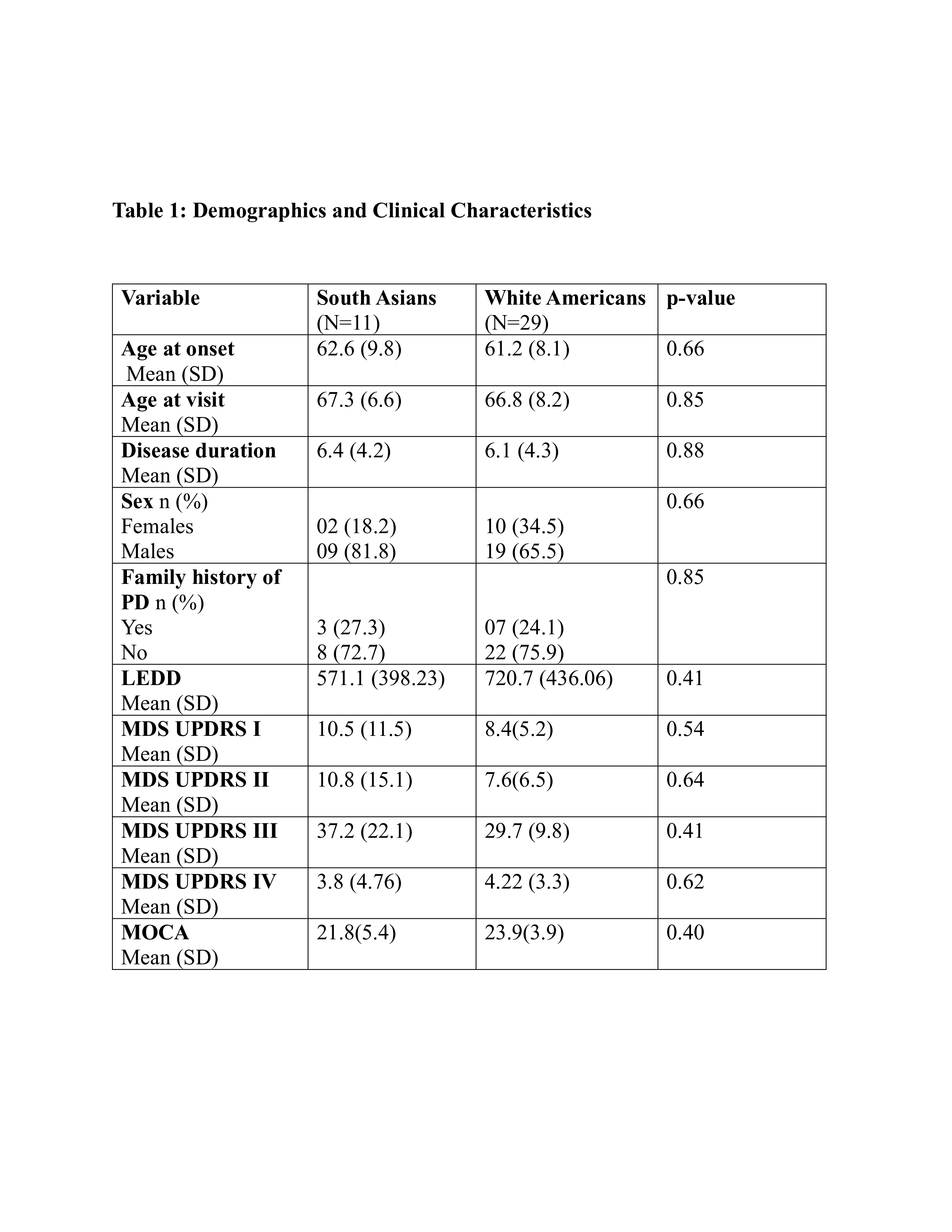
Table 1
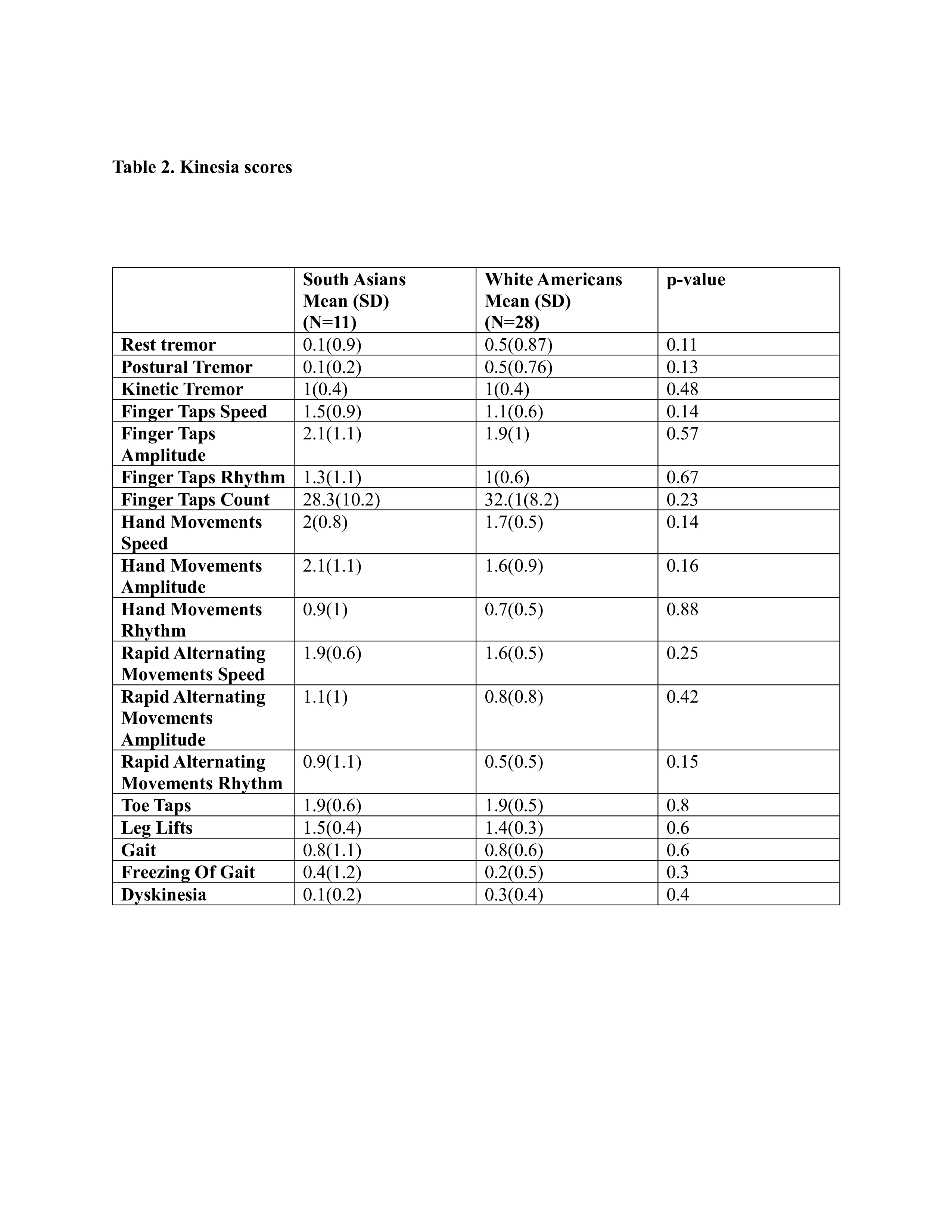
Table 2
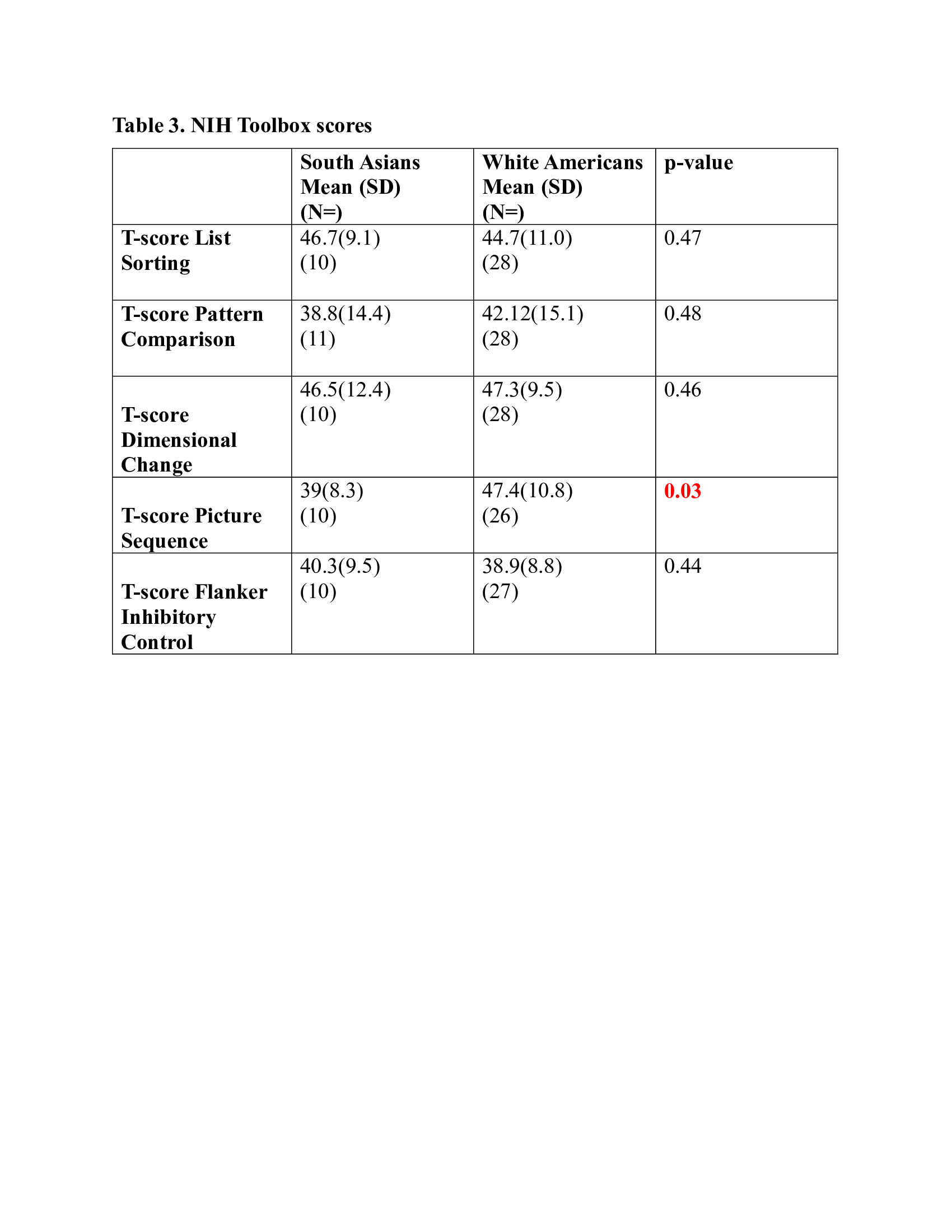
Table 3
To cite this abstract in AMA style:
A. Oberoi, B. Riad, E. Stenroos, G. Pal. Episodic Memory Impairment in South Asian Individuals with Parkinson’s Disease: A Pilot Comparative Study [abstract]. Mov Disord. 2026; 41 (suppl 1). https://www.mdsabstracts.org/abstract/episodic-memory-impairment-in-south-asian-individuals-with-parkinsons-disease-a-pilot-comparative-study/. Accessed October 1, 2026.« Back to 2026 International Congress
MDS Abstracts - https://www.mdsabstracts.org/abstract/episodic-memory-impairment-in-south-asian-individuals-with-parkinsons-disease-a-pilot-comparative-study/