
Session Information
Date: Monday, June 5, 2017
Session Title: Surgical Therapy: Other Movement Disorders
Session Time: 1:45pm-3:15pm
Location: Exhibit Hall C
Objective: To evaluate the evolution of GPi DBS targeting over time in a large single center cohort.
Background: Deep brain stimulation (DBS) targeting the globus pallidus internus (GPi) is an effective therapy for treatment of motor symptoms in Parkinson’s disease and dystonia. Accurate targeting is the primary determinant of outcome for these patients and the evolution of improved direct targeting techniques over the last two decades has enabled more effective stimulation with fewer side effects.
Methods: A retrospective single-center study identified 451 GPi DBS leads in 299 patients. Lead locations in AC-PC space (Cartesian coordinates using a mid-commissural point origin) were evaluated by year from 2002 to 2016. Data analysis employed robust regression and linear slope statistical models. A-P, Lateral, and axial coordinates were measured for each lead, comparing the post-op lead location to the intra-operatively chosen final target. Weighted annual mean errors were calculated and compared to annual mean errors predicted by regression models. Scatter plots of the original observed errors and estimated trend lines with 95% confidence intervals were generated.
Results: Each x, y, z coordinate set was analyzed and the progression of the mean value was revealed in scatter plots separated by year. The lateral location (x) of the lead demonstrated a significant increase (p<0.0001) in its value over the years [figure 1]. The axial location (z) exhibited a significant increase (p=0.024) in the negative value, meaning that the lead position was more ventral (deeper) [Figure 2]. The A-P location (y) did not change significantly. The 3-D, lateral, A-P and axial error analyses revealed a significant decrease in predicted error which evolved over time.
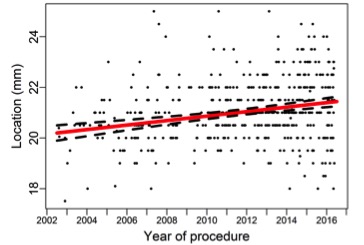
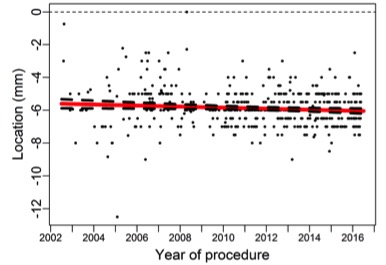
Conclusions: The addition of direct targeting techniques based on high resolution magnetic resonance imaging coupled with a deformable atlas might explain our progression to a more lateral and slightly deeper GPi target. The evolution to a more lateral target may be the result of clinical feedback: lateral placement decreases the likelihood of inadvertent internal capsule stimulation and widens the therapeutic window for DBS programming. The trend toward more ventral placement may have reflected a bias to avoid loss of efficacy in the event of dorsal lead migration. A multi-center dataset could potentially answer many unresolved questions.
To cite this abstract in AMA style:
V. Holanda, L. Almeida, M. Okun, A. Patterson, W. Deeb, A. Shukla, K. Foote. Evolution of Globus Pallidus Internus (GPi) Deep Brain Stimulation Targeting Over 15 Years [abstract]. Mov Disord. 2017; 32 (suppl 2). https://www.mdsabstracts.org/abstract/evolution-of-globus-pallidus-internus-gpi-deep-brain-stimulation-targeting-over-15-years/. Accessed October 2, 2026.« Back to 2017 International Congress
MDS Abstracts - https://www.mdsabstracts.org/abstract/evolution-of-globus-pallidus-internus-gpi-deep-brain-stimulation-targeting-over-15-years/