
Category: Paroxysmal Movement Disorders
Objective: To assess the frequency and pathogenic role of FGF14 GAA repeat expansion in paroxysmal kinesigenic dyskinesia (PKD).
Background: FGF14 GAA repeat expansion causes spinocerebellar ataxia type 27B (SCA27B), characterized by episodic vestibulocerebellar attacks reflecting neuronal hyperexcitability. FGF14 encodes an intracellular regulator of voltage-gated sodium channels (Nav1.6) at the axon initial segment of cerebellar Purkinje neurons. PKD is defined by brief, movement-triggered dyskinetic episodes, typically responsive to sodium channel blockers. While PRRT2 variants account for most cases, one-third of typical PKD remains unexplained. Fgf14 knockout mice exhibit both ataxia and movement-triggered paroxysmal dyskinesia, supporting a mechanistic link.
Method: We screened 141 PKD probands from 9 European centers for FGF14 GAA expansions using long-range and repeat-primed PCR. All patients fulfilled established PKD diagnostic criteria. Targeted long-read sequencing (lrS) using Oxford Nanopore technology was performed in 23 patients with possibly-pathogenic (≥180 repeats) or ambiguous alleles. Results were compared to 802 published controls.
Results: Among 141 probands, 47 had an established molecular diagnosis (39 PRRT2, 6 KCNJ10, 1 TMEM151A, 1 KCNA1); 94 remained genetically undiagnosed. Ordinal regression confirmed a dose-response relationship between FGF14 expansion size and PKD risk in undiagnosed patients (β=0.895; p=0.022), maintained across all probands (β=0.751; p=0.031) [figure1]. Expansions >180 repeats were enriched in undiagnosed PKD (9.6%) versus controls (4.2%; OR=2.42; 95% CI: 1.06–5.02; p=0.04). Targeted lrS showed excellent concordance with Sanger sequencing (ICC=0.915), reclassified two patients upward, and revealed critical allelic heterogeneity including identical GAAGAAGAAA decameric expansions in two related patients [figure1]. Protein-protein interaction analysis positioned FGF14 in the PKD gene network via SCN8A, with convergence on voltage-gated ion channel pathways (p<0.001).
Conclusion: FGF14 GAA expansions are enriched in PKD, suggesting FGF14 as an independent monogenic cause with incomplete penetrance, while a subtle oligogenic contribution cannot be excluded, reinforcing the ataxia–dyskinesia continuum. These findings support integrating FGF14 GAA screening in the workup of PRRT2-negative PKD, especially in patients with atypical or mixed paroxysmal phenotypes.
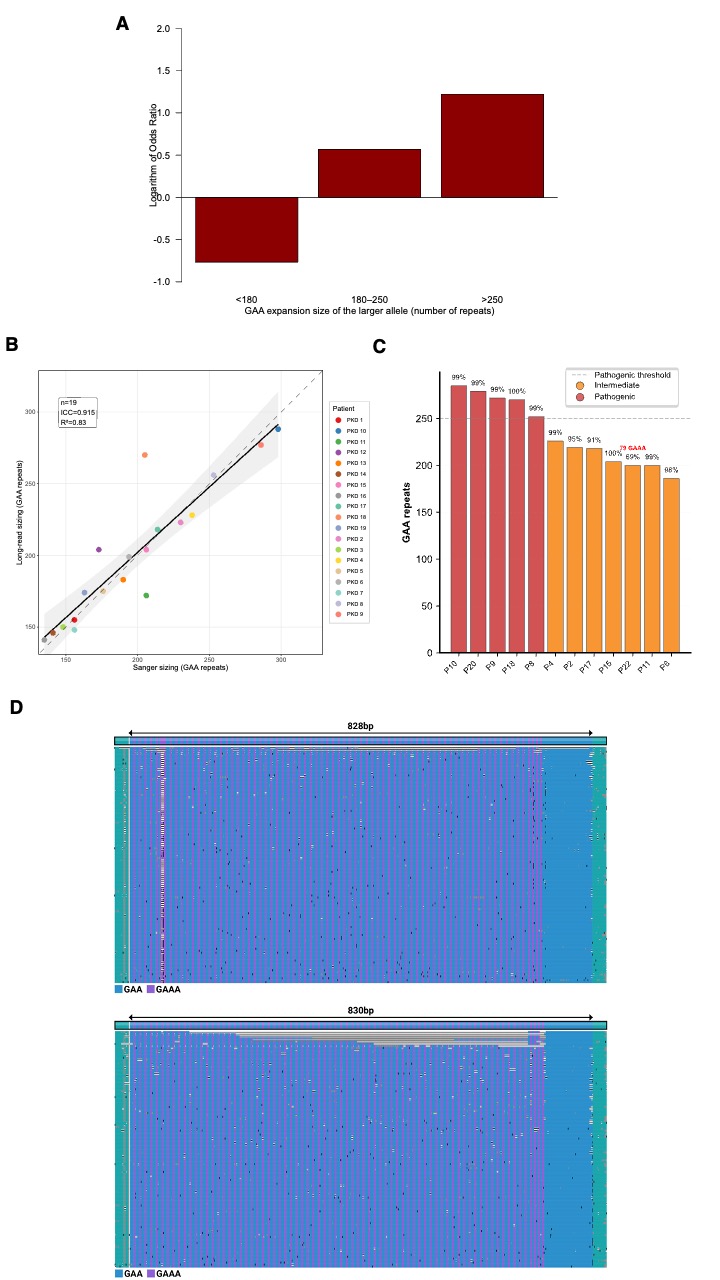
FGF14 GAA expansions in PKD: size and structure
To cite this abstract in AMA style:
C. Desjardins, A. Méneret, C. Delvallée, E. Leitão, M. Anheim, C. Depienne, E. Roze, T. Wirth. Expanding the phenotypic spectrum of FGF14 GAA repeat expansion to paroxysmal kinesigenic dyskinesia [abstract]. Mov Disord. 2026; 41 (suppl 1). https://www.mdsabstracts.org/abstract/expanding-the-phenotypic-spectrum-of-fgf14-gaa-repeat-expansion-to-paroxysmal-kinesigenic-dyskinesia/. Accessed October 1, 2026.« Back to 2026 International Congress
MDS Abstracts - https://www.mdsabstracts.org/abstract/expanding-the-phenotypic-spectrum-of-fgf14-gaa-repeat-expansion-to-paroxysmal-kinesigenic-dyskinesia/