
Objective: To investigate feasibility of home-based assessments in GNAO1-related dystonia, using wearable sensors and home-videos.
Background: Movement disorders in GNAO1-associated disorder are common, with dystonia being the most prevalent. Dystonia is characterized by involuntary movements and/or postural changes. Currently, clinical scales are used to monitor dystonia. However, this approach lacks objectivity. Assessments using wearable technology show promising results, but are scarcely tested in children.
Method: Children with GNAO1-related dystonia wore five sensors (inertial measurement units) around the wrists, ankles and head. They were filmed by parents/caregivers performing standardized tasks in their natural environment using the MODYS@home app, which synchronizes video and sensor data [figure1]. An online survey was distributed to parents/caregivers for evaluation. Answers were given using a 5-points Likert scale for satisfaction and difficulty levels. All videos were scored for dystonia severity in five-seconds time-windows by three examinators, using the Burke-Fahn-Marsden-Dystonia-Rating-Scale and Barry-Albright-Dystonia-Scale. Inter-rater reliability (IRR) was calculated using the intraclass correlation coefficient (ICC).
Results: Three girls and four boys were included. Median age was 11 years (range: 10-14 years). All participants completed the survey (n=6) [figure2]. Two participants were satisfied with the overall experience of home-based assessments, four voted neutral. Difficulty levels of tasks varied amongst participants (very difficult, n=1; difficult, n=2; neutral, n=2; easy, n=1). In total, 538 videos were collected: 402 were eligible for scoring; 136 were excluded due to technical issues. Scoring and IRR are currently being finalized.
Conclusion: Preliminary results show that caregivers deem home-based assessments feasible. Our results contribute to developing an objective and reliable measure to monitor GNAO1-RMD. Home-based assessments provide physicians with valuable real-life information, to track disease progression accurately and adjust treatment strategies timely. Ultimately, we aim to develop automated prediction models to monitor paediatric dystonia; bringing care closer to home.
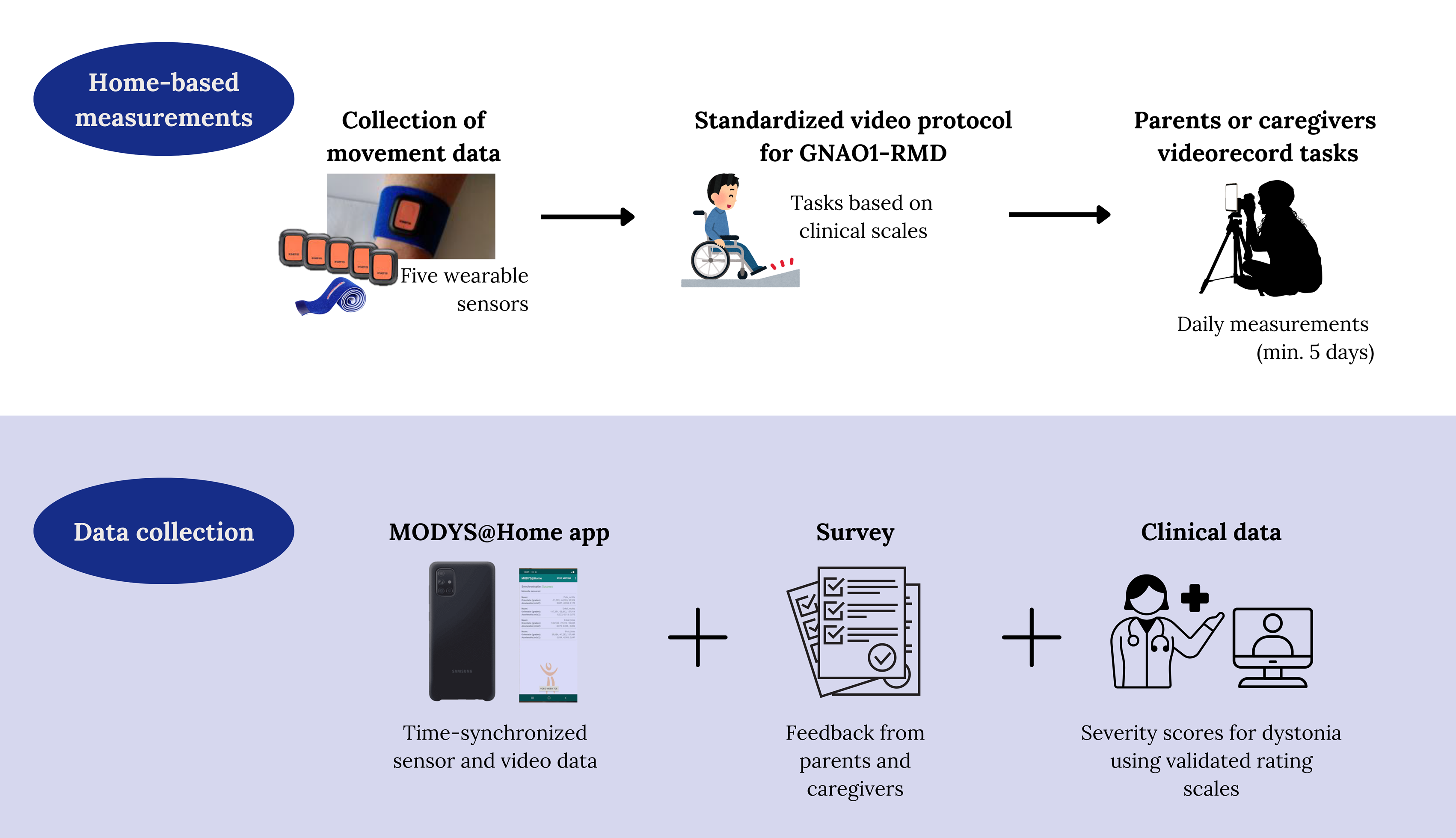
Flowchart of the home-based measurements
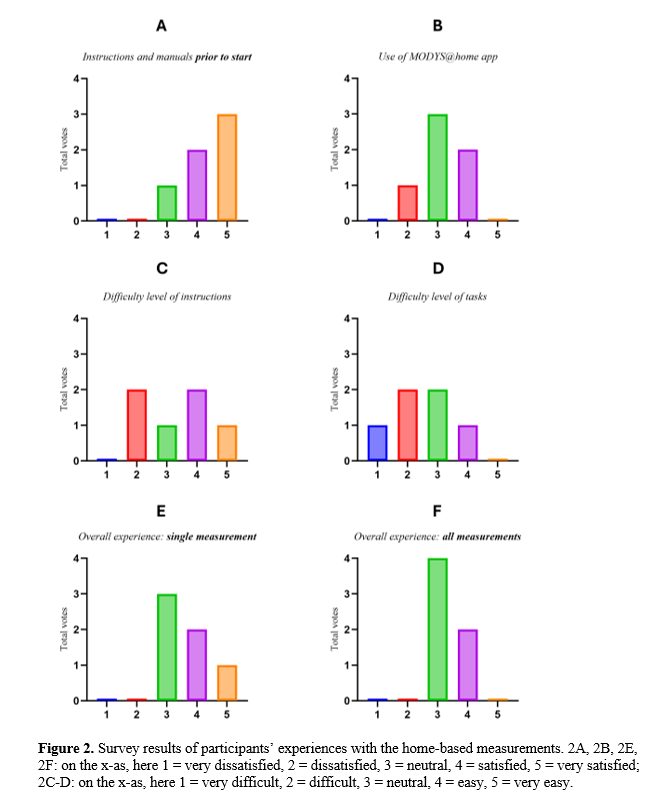
Survey results
To cite this abstract in AMA style:
L. Heideman, J. Boor, L. Al-Bawi, N. Wolf, A. Buizer, H. Haberfehlner, L. Vande Pol. Feasibility of home-based assessments using wearable sensors and videos in children with GNAO1-related movement disorders: A pilot study [abstract]. Mov Disord. 2026; 41 (suppl 1). https://www.mdsabstracts.org/abstract/feasibility-of-home-based-assessments-using-wearable-sensors-and-videos-in-children-with-gnao1-related-movement-disorders-a-pilot-study/. Accessed October 1, 2026.« Back to 2026 International Congress
MDS Abstracts - https://www.mdsabstracts.org/abstract/feasibility-of-home-based-assessments-using-wearable-sensors-and-videos-in-children-with-gnao1-related-movement-disorders-a-pilot-study/