
Category: Other
Objective: To highlight unilateral slow dystonic tremor as an uncommon presentation of frontal cavernoma.
Background: Acquired dystonia, results from injury to the brain, poisoning or certain types of drug exposure. Dystonic features with cavernous angioma (cavernoma) is rare and few case reports are available in literature. We are reporting two cases of dystonic tremor caused by frontal cavernoma.
Method: Case Reports
Patient 1: 33 years old man presented with persistent, slow, writhing adduction abduction movements of his right thumb and index finger that had progressed over a number of years (video to be shown). No other abnormality was noted on physical examination. Magnetic Resonance Imaging (MRI) revealed 2 left frontal and 1 parietal cavernoma. It was unclear if the tremor was epilepsy partialis continua (EPC) or basal ganglia derived slow dystonic tremor. He was trailed on Levetiracetam, Lamotrigine, Clonazepam etc. with no benefit and EEG was normal. A diagnosis of slow dystonic tremor was made.
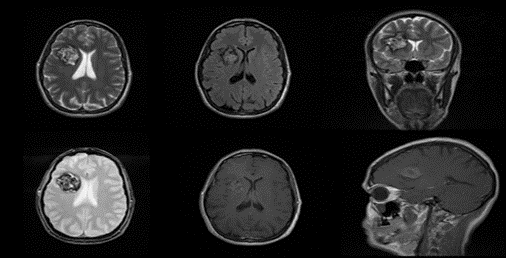
Patient 2: 29 years old woman presented 3 years ago with persistent adduction abduction movements of her left 4th and 5th fingers with lesser extent of index finger and thumb. She also has left foot dystonic posture when walking (video to be shown). MRI revealed 3.8cm×3.5cm right frontal cavernoma (Image1). She was also treated with Eslicarbazepine, Levetiracetam for suspected EPC, thereafter with Trihexyphenidyl with no improvement. EEG was normal. Patient refused further medication trial.
Results: Both patients developed unusual unilateral tremor likely due to the contralateral frontal cavernoma which abutting the basal ganglia. Patients were closely monitored in the clinic, as they declined surgery. We have followed them up in our clinic for number of years and no progression observed.
Conclusion: Our two atypical cases strengthen our knowledge about slow dystonic tremor as an uncommon feature of frontal cavernoma.
To cite this abstract in AMA style:
D. Chaity. Frontal Cavernous angioma manifested as acquired dystonic tremor: Two case reports [abstract]. Mov Disord. 2020; 35 (suppl 1). https://www.mdsabstracts.org/abstract/frontal-cavernous-angioma-manifested-as-acquired-dystonic-tremor-two-case-reports/. Accessed October 15, 2026.« Back to MDS Virtual Congress 2020
MDS Abstracts - https://www.mdsabstracts.org/abstract/frontal-cavernous-angioma-manifested-as-acquired-dystonic-tremor-two-case-reports/