
Category: Ataxia
Objective: To determine fall prevalence and identify predictors of fall risk across SCA1, SCA2, SCA3, and SCA6.
Background: Falls represent a major source of morbidity in spinocerebellar ataxia (SCA). This study examined baseline data, fall frequency, and independent risk factors for falls across the most common polyglutamine SCAs (SCA1, SCA2, SCA3, SCA6) in a cohort of 615 patients.
Method: Cross-sectional analysis of 615 genetically confirmed SCA patients (SCA1 n=104, SCA2 n=147, SCA3 n=235, SCA6 n=129). Fallers were defined as those who fell at least once in the past year, with frequent fallers as those who fell at least once a month. Variables included age, disease duration, sex, total Scale for the Assessment and Rating of Ataxia score (SARA), and a fall questionnaire assessing frequency, injury consequences, prevention tools, functional status, and balance confidence. Multivariate logistic regression identified independent predictors of faller status including age, sex, total SARA score, and SCA subtype (SCA1 as reference).
Results: 387 SCA patients (63%) reported at least one fall in the past year. Faller prevalence was highest in SCA3 (70%), followed by SCA1 (62%), SCA6 (60%), and SCA2 (55%). Fallers exhibited significantly higher total SARA scores (12.68 ± 6.81 vs 8.45 ± 7.52, p<0.001), worse functional stage (2.68 ± 1.08 vs 1.91 ± 1.38, p<0.001), longer disease duration (10.09 ± 7.57 vs 7.40 ± 6.34 years, p=0.001), and earlier age of onset (41.14 ± 13.57 vs 44.63 ± 12.04 years, p=0.010). Among fallers, frequent fallers (n=81) had significantly higher total SARA scores (14.41 vs 12.19, p=0.013), worse subscore in gait, stance, speech, and finger chase, and lower balance confidence. Multivariate logistic regression showed SARA score was the strongest predictor (OR 1.12 per point increase, p<0.001). SCA3 patients had significantly higher odds of falling compared with SCA1 (OR 1.79, p=0.020). No significant independent differences were found for SCA2 or SCA6 versus SCA1.
Conclusion: Faller status was associated with greater disease severity, worse functional stage, longer disease duration, and earlier age of onset. Frequent fallers showed significantly higher total SARA scores, worse performance in gait, stance, speech disturbance, and finger chase, and lower balance confidence. Identifying fall risk factors in SCAs is a step toward developing targeted fall prevention strategies.
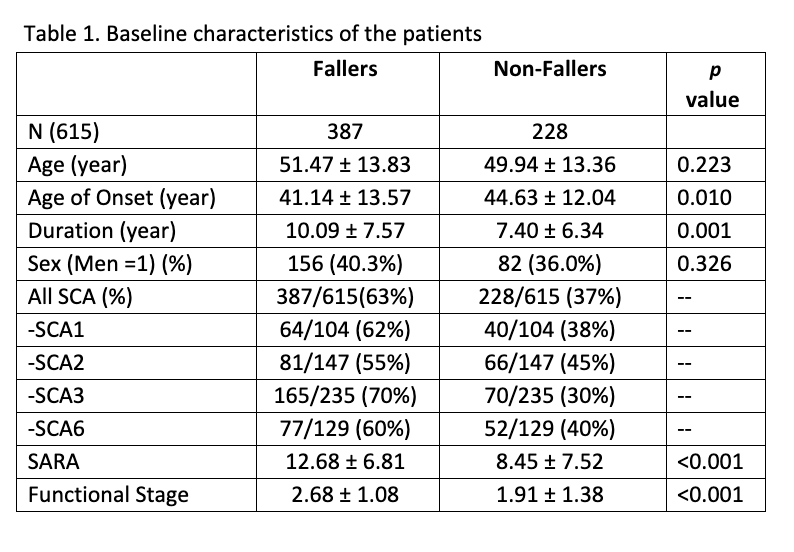
Table 1
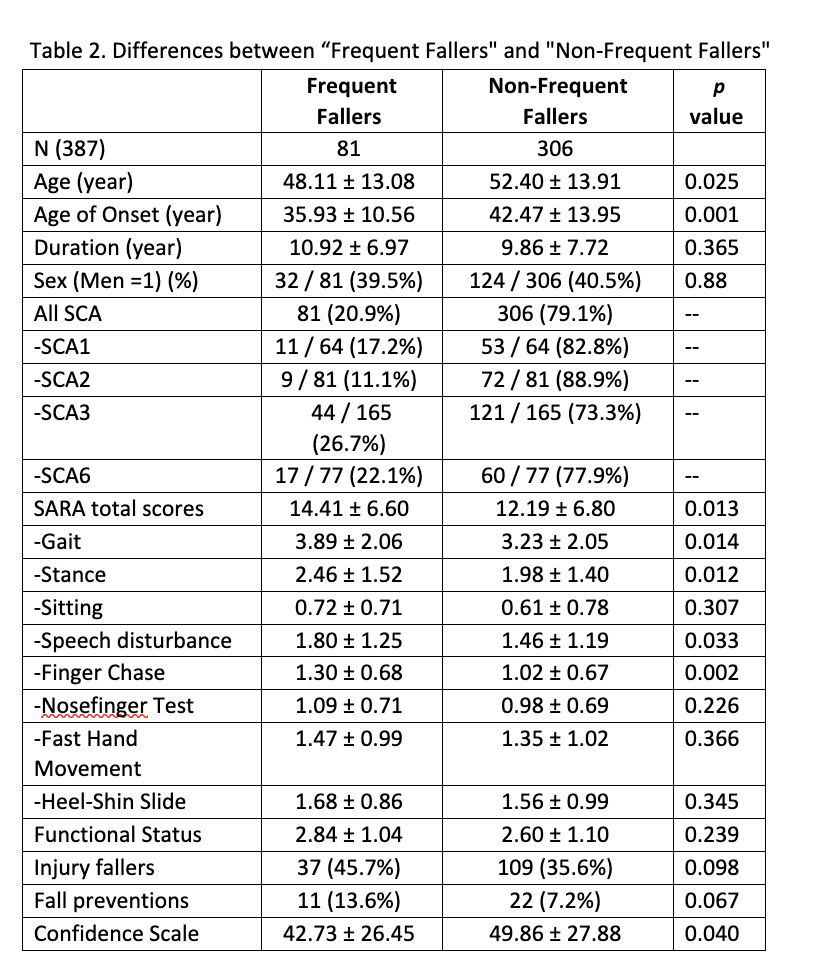
Table 2
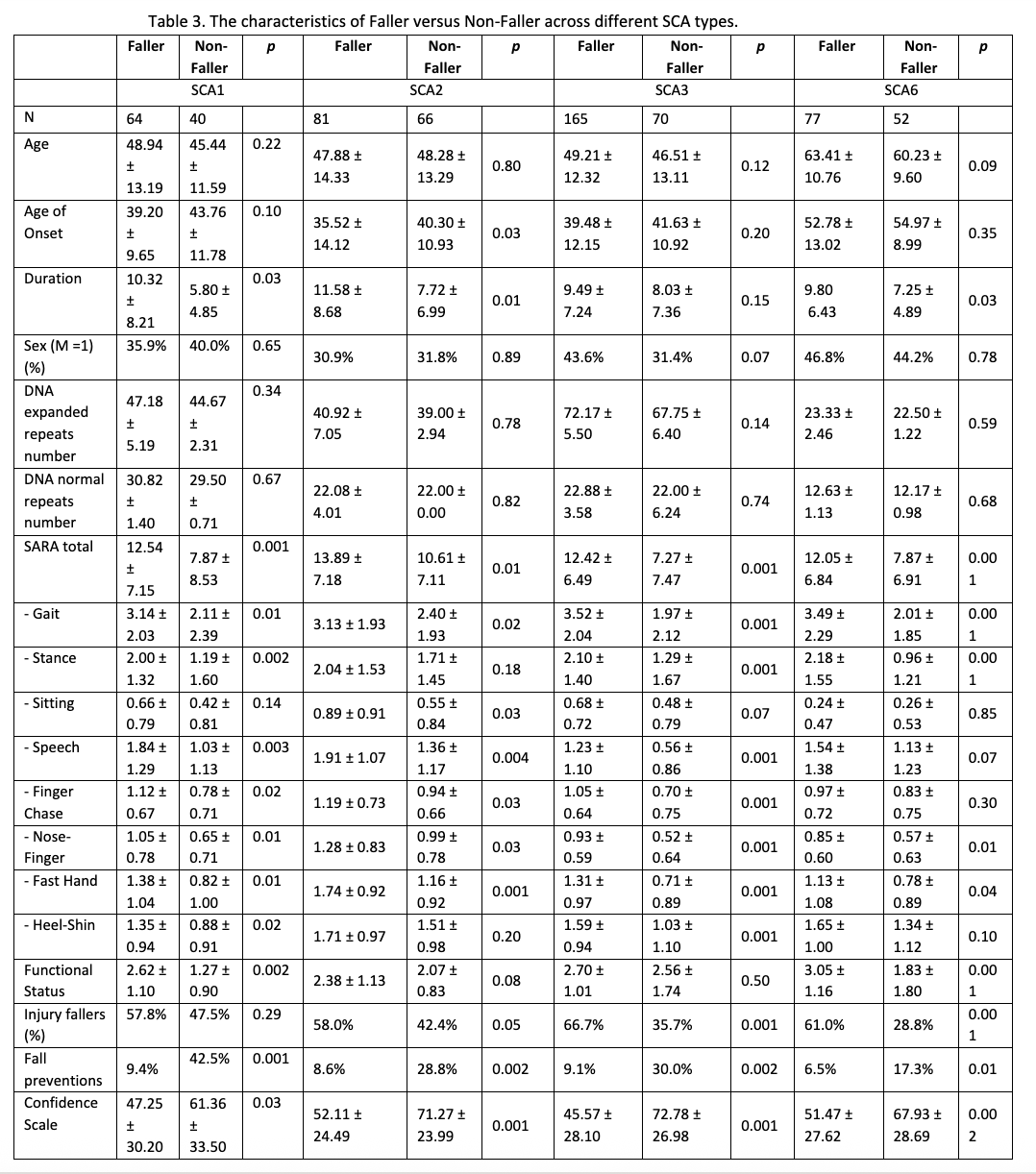
Table 3
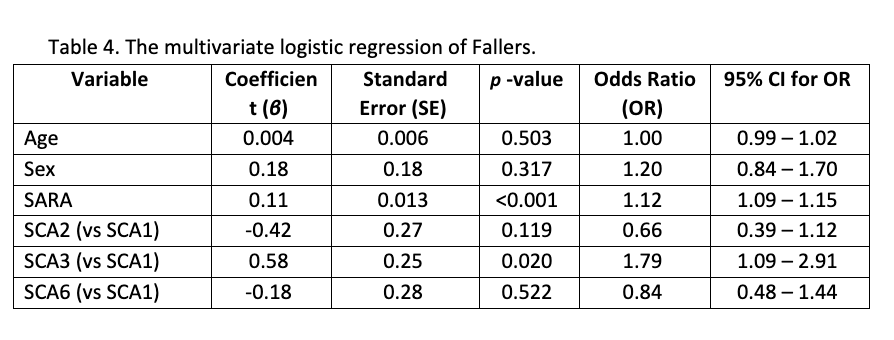
Table 4
To cite this abstract in AMA style:
S. Kakde, Y. Lin, S. Kuo. Genotype-Specific Risk Factors for Falls in Spinocerebellar Ataxia: A Cross-Sectional Analysis of SCA1, SCA2, SCA3, and SCA6 [abstract]. Mov Disord. 2026; 41 (suppl 1). https://www.mdsabstracts.org/abstract/genotype-specific-risk-factors-for-falls-in-spinocerebellar-ataxia-a-cross-sectional-analysis-of-sca1-sca2-sca3-and-sca6/. Accessed October 1, 2026.« Back to 2026 International Congress
MDS Abstracts - https://www.mdsabstracts.org/abstract/genotype-specific-risk-factors-for-falls-in-spinocerebellar-ataxia-a-cross-sectional-analysis-of-sca1-sca2-sca3-and-sca6/