
Objective:
To evaluate whether image-based analysis of handwriting drawing tasks can distinguish Parkinson’s disease from healthy controls.
Background: Fine motor impairment is a core feature of Parkinson’s disease and may appear as an early symptom. Drawing tasks such as spirals and meanders are already used clinically to assess tremor, micrographia, and motor control abnormalities. Prior work suggests that quantitative handwriting analysis may yield a scalable digital biomarker, particularly in settings where access to neurologists is limited.
Method: De-identified publicly available handwriting datasets were assembled for spiral (N=216, balanced), meander (N=368, 72 healthy/296 Parkinson’s), and wave (N=360, balanced) drawing tasks. Given limited publicly available data and meander class imbalance, class weights were applied during training. Images were resized and standardized prior to training. A convolutional neural network with a pretrained EfficientNet backbone was fine-tuned separately for each task to classify Parkinson’s disease versus healthy controls. Performance was evaluated on held-out test images using classification accuracy and confusion matrices. Gradient-weighted class activation mapping was used to identify image regions most influential in model predictions.
Results: Task-specific models demonstrated strong discrimination between Parkinson’s disease and healthy controls. Held-out accuracy was approximately 0.94 for meander, 0.90 for spiral, and 0.93 for wave drawings. Saliency maps showed that predictions were driven primarily by localized stroke irregularities, curvature instability, and distortions in drawing trajectories. Misclassifications were more common in drawings with borderline abnormalities.
Conclusion: Image-based analysis of simple drawing tasks captures motor abnormalities relevant to Parkinson’s disease screening. Because these tasks are inexpensive and easy to administer, they may support scalable screening in primary care, telehealth, or underserved settings where expertise in movement disorders is not readily available. Future work should test these models in longitudinal and earlier-stage cohorts to determine whether handwriting biomarkers can help identify Parkinson’s disease before clinical diagnosis is firmly established and evaluate robustness across larger and more diverse patient populations, including individuals with mild or ambiguous motor symptoms.
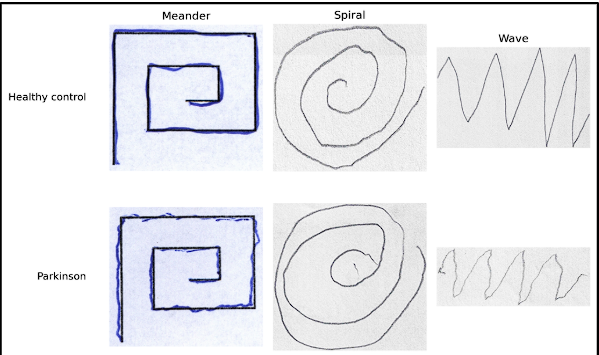
Example meander, spiral, and wave drawings.
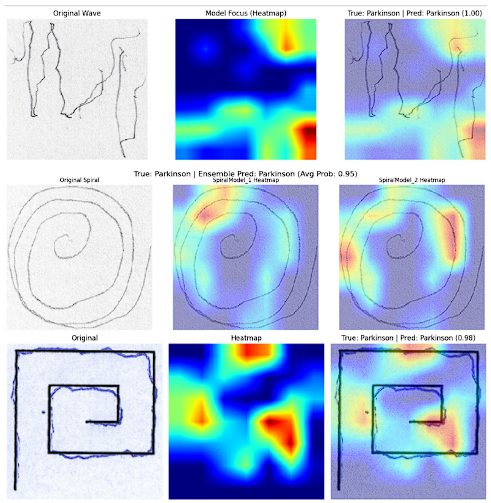
Grad-CAM visualizations of handwriting models.
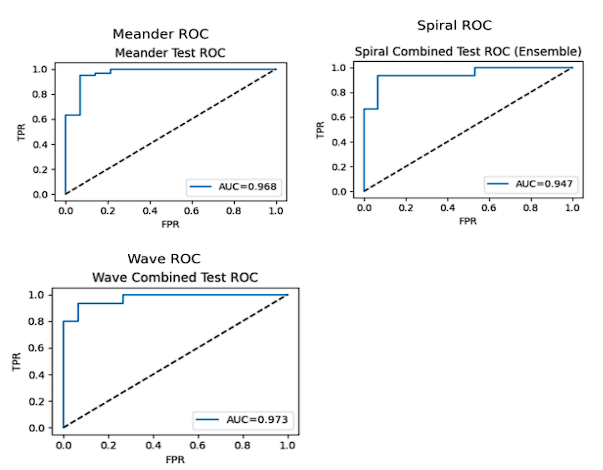
ROC curves for PD vs HC handwriting models.
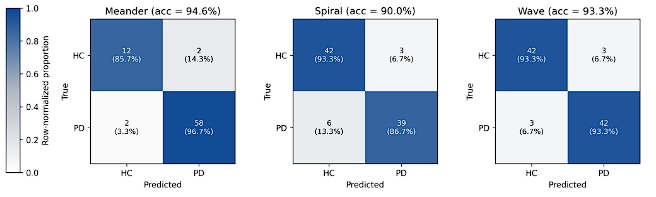
Confusion matrices for handwriting models.
To cite this abstract in AMA style:
A. Shih, L. Cruz-Mondragon, V. Santini, S. Panchawagh. Handwriting Based Screening of Parkinson’s Disease Using Image Analysis of Drawing Tasks [abstract]. Mov Disord. 2026; 41 (suppl 1). https://www.mdsabstracts.org/abstract/handwriting-based-screening-of-parkinsons-disease-using-image-analysis-of-drawing-tasks/. Accessed October 1, 2026.« Back to 2026 International Congress
MDS Abstracts - https://www.mdsabstracts.org/abstract/handwriting-based-screening-of-parkinsons-disease-using-image-analysis-of-drawing-tasks/