
Category: Tremor
Objective: To prospectively evaluate the presence of neurological soft signs in essential tremor (ET)
Background: The presence of neurological signs of unclear significance (soft signs) in addition to upper limb action tremor defines the syndrome of ET plus (ET+), recognizing the clinical heterogeneity of ET. However, prospective studies comprehensively evaluating ET patients for the presence of soft signs remain scarce.
Method: Between March 2024 & February 2026, consecutive patients with a clinical diagnosis of ET were prospectively evaluated for the presence of soft signs, incl. rest tremor, impaired tandem gait, subtle dystonia, questionable bradykinesia, other mild parkinsonian signs (hypomimia, reduced arm swing) & marked action tremor asymmetry. Clinical assessment included rating of tremor severity (The Tremor Research Group Essential Tremor Rating Scale, TETRAS), cognitive dysfunction (Montreal Cognitive Assessment, MoCA), & non-motor symptoms (Non-Motor Symptoms Scale, NMSS). Mann-Whitney U & chi-square tests were used for group comparisons, Spearman’s coefficient for correlation analyses & partial rank correlation to adjust for age.
Results: 110 ET patients were included (47 female). 95 (86.4%) had one or more soft sign and were consequently classified as ET+, while 15 (13.6%) retained a diagnosis of pure ET. ET+ patients were older at baseline & tremor onset [table 1]. Rest tremor was detectable in 90.5% of ET+ patients representing the most common soft sign, followed by subtle dystonia (51.6%), questionable bradykinesia (31.6%), mild parkinsonian signs (29.5%), impaired tandem gait (27.4%), & marked action tremor asymmetry (17.9%). 70 of 95 (73.7%) ET+ patients had more than one soft sign in various combinations [figure 1]. Number of soft signs correlated with higher age at baseline and tremor onset, tremor severity, cognitive dysfunction & non-motor symptom burden (all p<0.05), but none of the correlations survived accounting for age.
Conclusion: Neurological soft signs are found almost invariably in prospectively evaluated ET patients, & the syndrome of ET+ in itself carries high clinical heterogeneity. Subtle rest tremor constitutes a part of the ET syndrome, particularly in elderly individuals. Neurological soft signs as a general concept may rather represent a proxy of advanced age than a true underlying biological process. Stratification based on clinical clusters of soft signs is warranted.
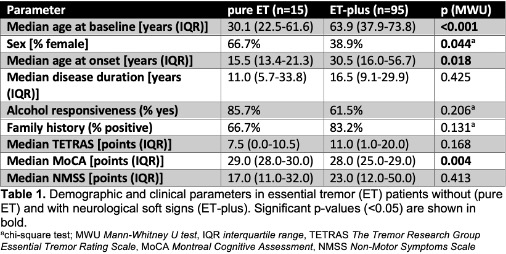
Table 1
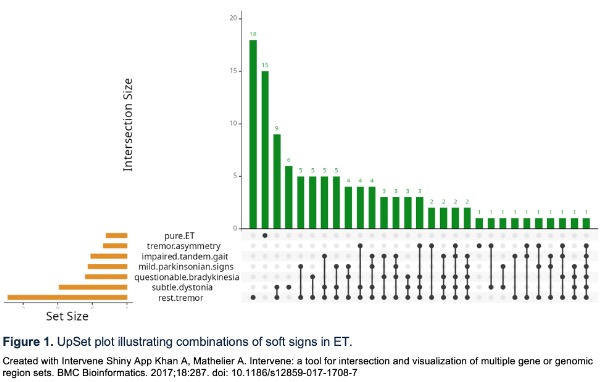
Figure 1
To cite this abstract in AMA style:
L. Gattermeyer-Kell, M. Suette, M. Zangl, P. Schwingenschuh. High Frequency of Neurological Soft Signs in Prospectively Evaluated Essential Tremor Patients [abstract]. Mov Disord. 2026; 41 (suppl 1). https://www.mdsabstracts.org/abstract/high-frequency-of-neurological-soft-signs-in-prospectively-evaluated-essential-tremor-patients/. Accessed October 1, 2026.« Back to 2026 International Congress
MDS Abstracts - https://www.mdsabstracts.org/abstract/high-frequency-of-neurological-soft-signs-in-prospectively-evaluated-essential-tremor-patients/