
Objective: To evaluate the impact of a structured patient education program on knowledge and goal attainment, measured by the structured Goal Attainment Scale (GAS), following BoNT-A injection in CD.
Background: Botulinum toxin injection type A (BoNT-A) is the established first-line treatment for CD. However, suboptimal outcomes and premature treatment discontinuation remain prevalent. The education module aimed to improve patients’ understanding of CD and treatment expectations, which may influence patient-defined treatment goals.
Method: This randomized controlled pilot study enrolled adult patients with primary cervical dystonia receiving BoNT-A injections. Participants were randomized to receive either a structured patient education module or usual care before BoNT-A injection. The education module was a short video addressing disease mechanisms, treatment expectations, and self-care before and after injection. Outcomes included patient knowledge (pre- and post-education questionnaire), GAS T score with 3 main domains of CD: head and neck movement, pain, and tremor (Figure 1), and symptom severity using the Toronto Western Spasmodic Torticollis Rating Scale. GAS T-scores were assessed at baseline, 2, and 6 weeks after treatment
Results: Thirteen patients (the intervention (n=7) and control (n=6) groups) were recruited with comparable baseline characteristics, with torticollis concomitant with tremor being the most common subtype (Table 1). Knowledge scores improved significantly after education in the intervention group (p = 0.046). GAS T-scores significantly improved at both 2 weeks (p = 0.007) and 6 weeks (p = 0.001) compared with baseline. However, the GAS T-scores did not differ significantly between the intervention and control groups at 2 (p = 1.000) and 6 weeks (p = 0.181), but the GAS T-score was higher in the intervention (64.37 ± 2.53) than in the control group (58.38 ± 3.21).
Conclusion: Our preliminary findings showed that structured patient education improved disease-related knowledge. Because GAS reflects patient-defined treatment goals and perceived improvement, improved patient understanding may facilitate more appropriate goal setting and engagement with treatment, contributing to better goal attainment. Larger studies are needed to confirm whether education translates into measurable improvements in treatment outcomes.
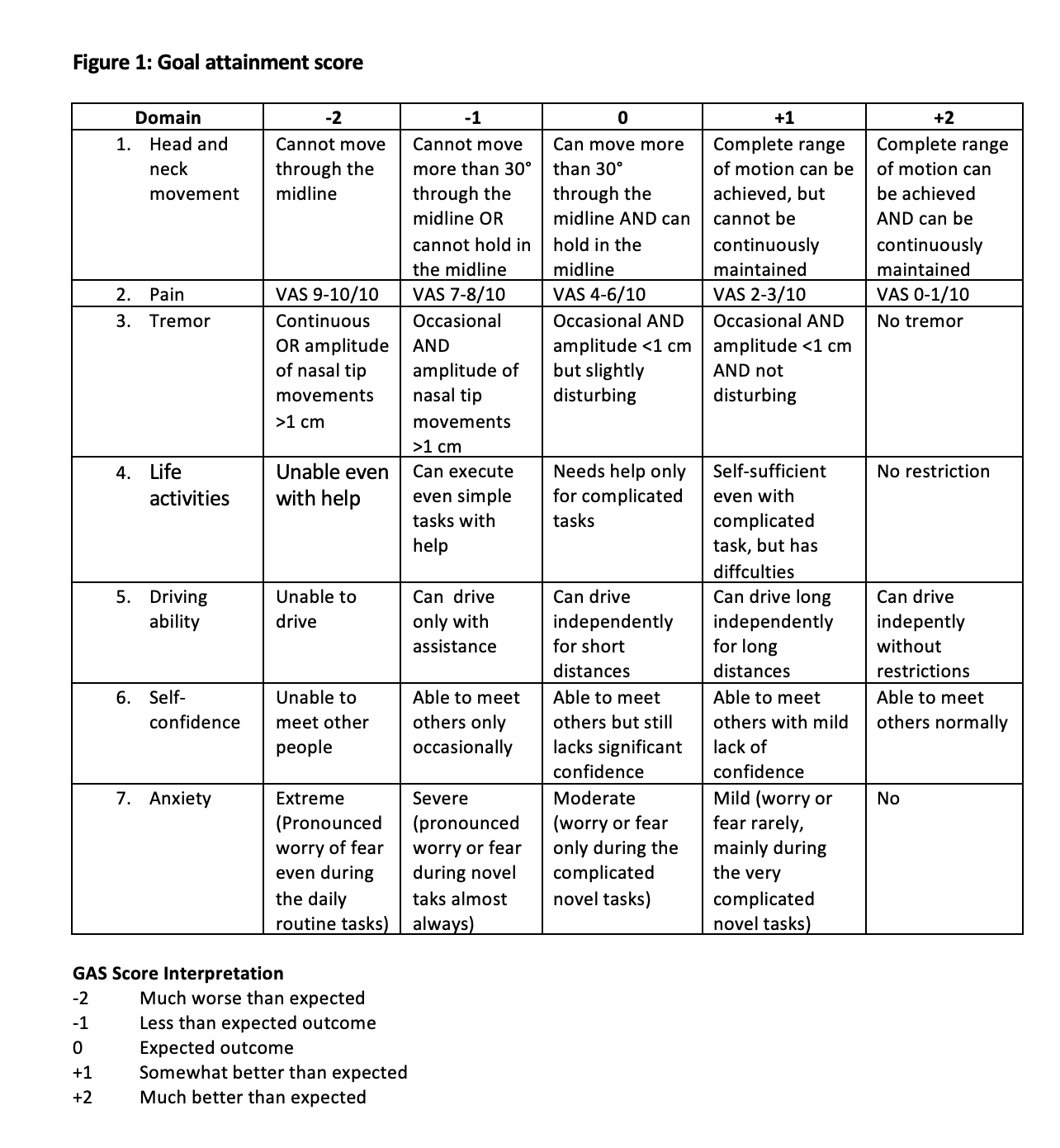
Figure 1
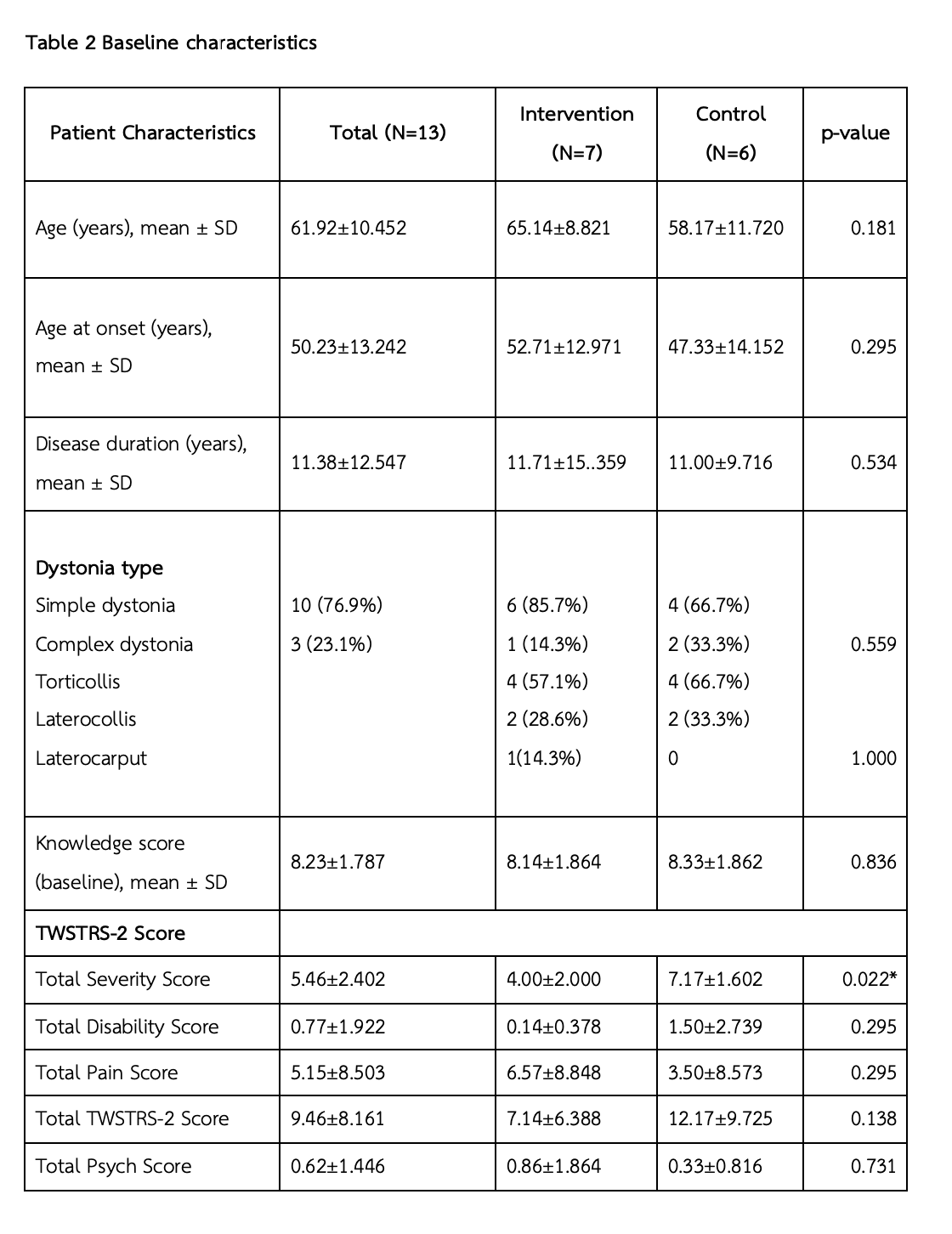
Table1
To cite this abstract in AMA style:
K. Katawatee, R. Bhidayasiri, P. Panyakaew. Impact of a Structured Patient Education Module on Knowledge of Botulinum Toxin Therapy, Goal Attainment, and Treatment Satisfaction in Cervical Dystonia [abstract]. Mov Disord. 2026; 41 (suppl 1). https://www.mdsabstracts.org/abstract/impact-of-a-structured-patient-education-module-on-knowledge-of-botulinum-toxin-therapy-goal-attainment-and-treatment-satisfaction-in-cervical-dystonia/. Accessed October 1, 2026.« Back to 2026 International Congress
MDS Abstracts - https://www.mdsabstracts.org/abstract/impact-of-a-structured-patient-education-module-on-knowledge-of-botulinum-toxin-therapy-goal-attainment-and-treatment-satisfaction-in-cervical-dystonia/