
Objective: We investigated the frequency and phenomenology of groaning in progressive supranuclear palsy (PSP), and its association with disease parameters and caregiver burden.
Background: “Purposeless” groaning is regularly encountered in patients with PSP, yet there has been no systematic study of its prevalence, phenomenology and clinical impact [1-3].
Method: Patients with PSP at the Universiti Malaya Medical Centre were diagnosed and classified by movement disorder neurologists using MDS-PSP criteria [4,5]. Groaning was identified through physician observation and caregiver report. A specially-designed questionnaire captured groaning characteristics (intensity, frequency, triggers, and bothersomeness). Scores for the PSP Clinical Deficits Scale (PSP-CDS), Barthel Index (BI), Short Cognitive and Neuropsychiatric Assessment (ShoCo) scale, and modified Zarit Burden Interview (ZBI); and whole-exome sequencing (WES) data, were extracted from our research database.
Results: Of 180 patients studied, 29 (16.1%) exhibited groaning. Most patients with groaning (79.3%; p=0.021) had Richardson syndrome (PSP-RS), with only a few affected patients in those with predominant parkinsonism (PSP-P, n=3) or gait freezing (PSP-PGF, n=2) (Table 1, Figure 1). Compared to non-groaners, these patients had significantly worse PSP-CDS (12.0[IQR 9.5–16.0] vs 9.0[7.0–12.0], p=0.001), Barthel Index (27.5[15.0–48.8] vs 65.0[35.0–85.0], p<0.001), ZBI (37.0[30.0-51.0] vs 29.5[22.8-41.3], p=0.012) and ShoCo scores (10.0[6.5–13.0] vs 6.0[4.0–10.0], p=0.02) (Table 1, Figure 2 and 3), indicating associations with greater overall disease severity, functional disability, and cognitive-behavioural and caregiver burden. In most cases, groaning was moderate or loud and the majority of patients and/or carers found it “troublesome”. There was heterogeneity in groaning phenomenology, for example regarding underlying triggers (identified in most, with pain in 14.3%) (Table 2, Figures 3-6). WES found no carriers of NEFHp.Ile245Met, previously linked to familial vocalizations [6].
Conclusion: In this large PSP cohort, groaning occurred in ~1/6 patients, was strongly associated with the PSP-RS subtype, and had heterogeneous phenomenology. Our findings highlight this important but understudied symptom, and suggest that although pain is indeed rarely a trigger, the term “purposeless” should be dropped.
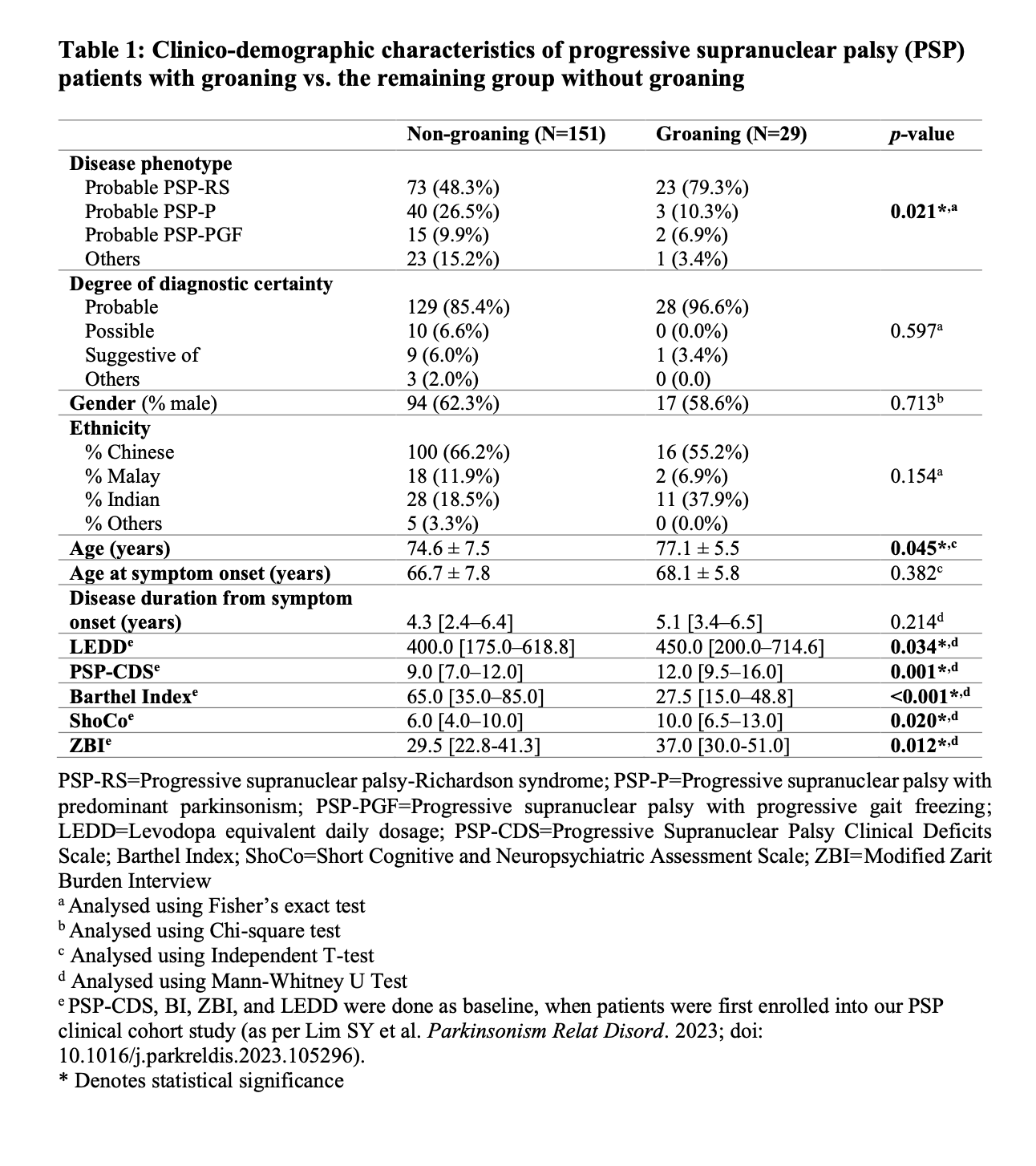
Table 1
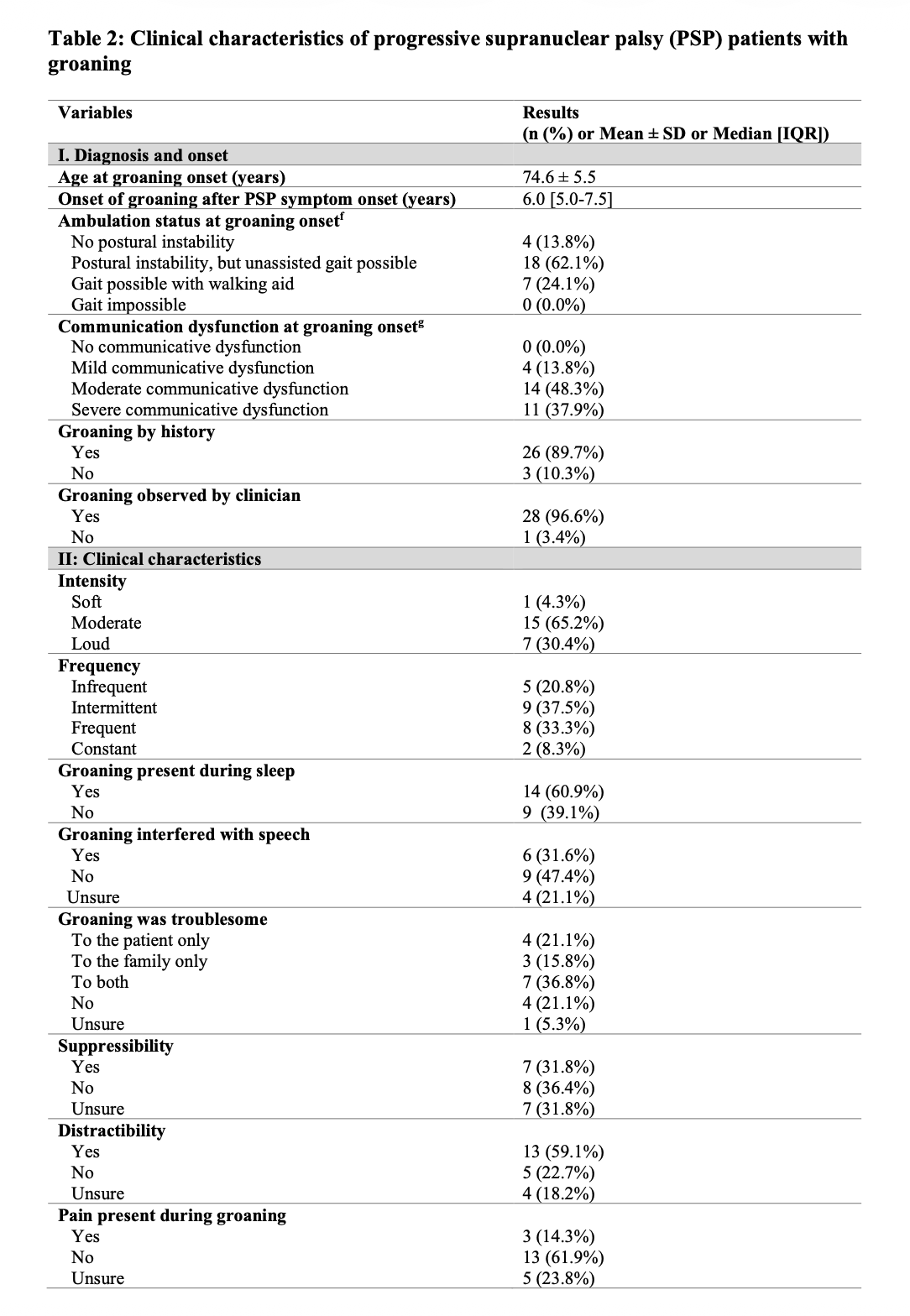
Table 2
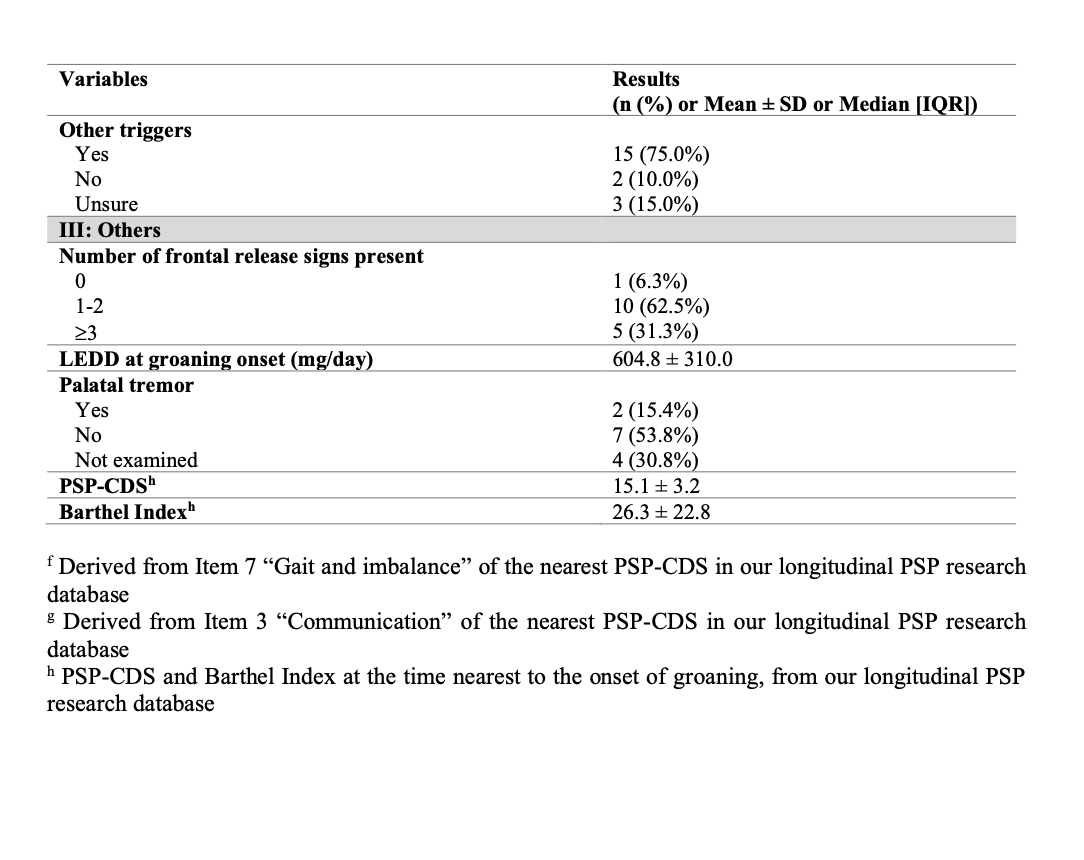
(continued) Table 2
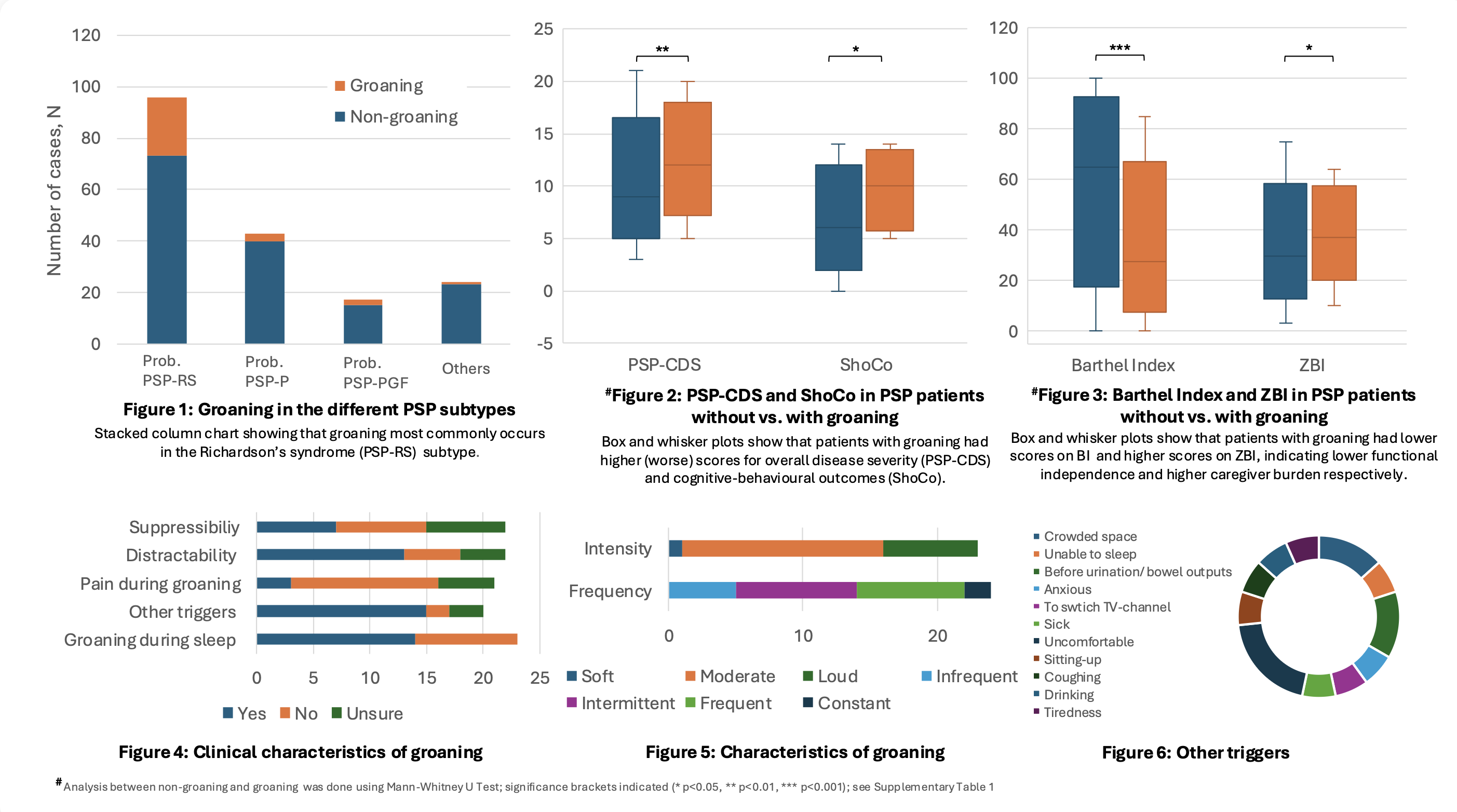
Figure 1-6
References: 1. Stamelou M, Rubio-Agusti I, Quinn N, Bhatia K. Characteristic constant groaning in late stage progressive supranuclear palsy: a case report. Parkinsonism Relat Disord. 2011;17(7):575-576. doi:10.1016/j.parkreldis.2011.04.015.
2. Low SC, Tan AH, Lim SY. Teaching Video NeuroImages: Purposeless groaning in progressive supranuclear palsy. Neurology. 2017;88(1):e9. doi:10.1212/WNL.0000000000003465.
3. Mainka T, Hidding U, Buhmann C, Haggard P, Ganos C. Voluntary Inhibition of Involuntary Groaning in Progressive Supranuclear Palsy. Mov Disord Clin Pract. 2018 Mar 23;5(3):325-326. doi: 10.1002/mdc3.12598.
4. Lim SY, Dy Closas AMF, Tan AH, et al. New insights from a multi-ethnic Asian progressive supranuclear palsy cohort. Parkinsonism Relat Disord. 2023;108:105296. doi:10.1016/j.parkreldis.2023.105296.
5. Höglinger GU, Respondek G, Stamelou M, et al. Clinical diagnosis of progressive supranuclear palsy: The movement disorder society criteria. Mov Disord. 2017;32(6):853-864. doi:10.1002/mds.26987.
6. Gisatulin M, Rossi M, Perandones C, Klein C, Lohmann K, Merello M. Involuntary moaning in a Hispanic family with eight affected members. Parkinsonism Relat Disord. 2021;89:206-208. doi:10.1016/j.parkreldis.2021.03.023
To cite this abstract in AMA style:
TQ. Lim, LY. Tan, KN. Chen, WP. Lim, YX. Tee, A. Lee, WY. Tee, SY. Wong, YZ. Lim, JC. Fernandiz, AN. Khairul Anuar, KS. Lim, YW. Tay, TS. Toh, HX. Ding, WH. Han, C. Ganos, AH. Tan, SY. Lim. Insights on the Groaning Phenomenon from a Large Asian Progressive Supranuclear Palsy Cohort [abstract]. Mov Disord. 2026; 41 (suppl 1). https://www.mdsabstracts.org/abstract/insights-on-the-groaning-phenomenon-from-a-large-asian-progressive-supranuclear-palsy-cohort/. Accessed October 1, 2026.« Back to 2026 International Congress
MDS Abstracts - https://www.mdsabstracts.org/abstract/insights-on-the-groaning-phenomenon-from-a-large-asian-progressive-supranuclear-palsy-cohort/