
Objective: Our study aims to quantify the relative expression of plasma SIRT3 and SYT11 in PD patients and to evaluate their combined diagnostic potential as non-invasive biomarkers.
Background: Mitochondrial dysfunction and impaired vesicular trafficking are well-established central features in the pathogenesis of Parkinson’s disease (PD). Sirtuin-3 (SIRT3) , a mitochondrial deacetylase, is essential for maintaining cellular antioxidant capacity and has been identified as a candidate for neuroprotection.Synaptotagmin 11 (SYT11), a regulator of endocytosis implicated in parkin-associated pathways, is also involved in PD pathogenesis. Given the involvement of multiple pathways in PD, we hypothesized that combined analysis of proteins from these pathways would serve as more effective indicators for PD.
Method: We recruited 122 PD patients (diagnosed by MDS clinical criteria) and 58 age- and gender-matched healthy controls (CON). Plasma samples were subjected to ultrasonic lysis to ensure the release of intra-vesicular cargo. Relative protein levels were quantified via Western blot, utilizing Transferrin as a stable internal loading control for the plasma matrix. Statistical differences were evaluated using the Mann-Whitney U test, and a diagnostic model was constructed using logistic regression.
Results: The demographic characteristics of the PD and CON groups were comparable (age: 62.65±8.79 vs. 62.28± 8.21 years, P=0.787; gender). Relative SIRT3 expression was significantly downregulated in PD patients compared to controls Median: 0.291 vs. 0.504 AU, P< 0.001, whereas SYT11 expression was significantly elevated in the PD group Median: 1.234 vs. 0.979 AU, P< 0.001. Furthermore, SIRT3 levels exhibited a moderate negative correlation with disease severity, as assessed by the Hoehn-Yahr stage (r = -0.317, P < 0.001). Logistic regression analysis further revealed that the combination of SIRT3 and SYT11 yielded a robust diagnostic performance, achieving an Area Under the Curve (AUC) of 0.827.
Conclusion: This study provides initial clinical evidence that the dysregulation of SIRT3 and SYT11—representing mitochondrial and vesicular axes—is detectable in peripheral plasma. While these findings are exploratory, the consistent trends observed in our cohort suggest that these proteins may serve as valuable candidates for future biomarker research.
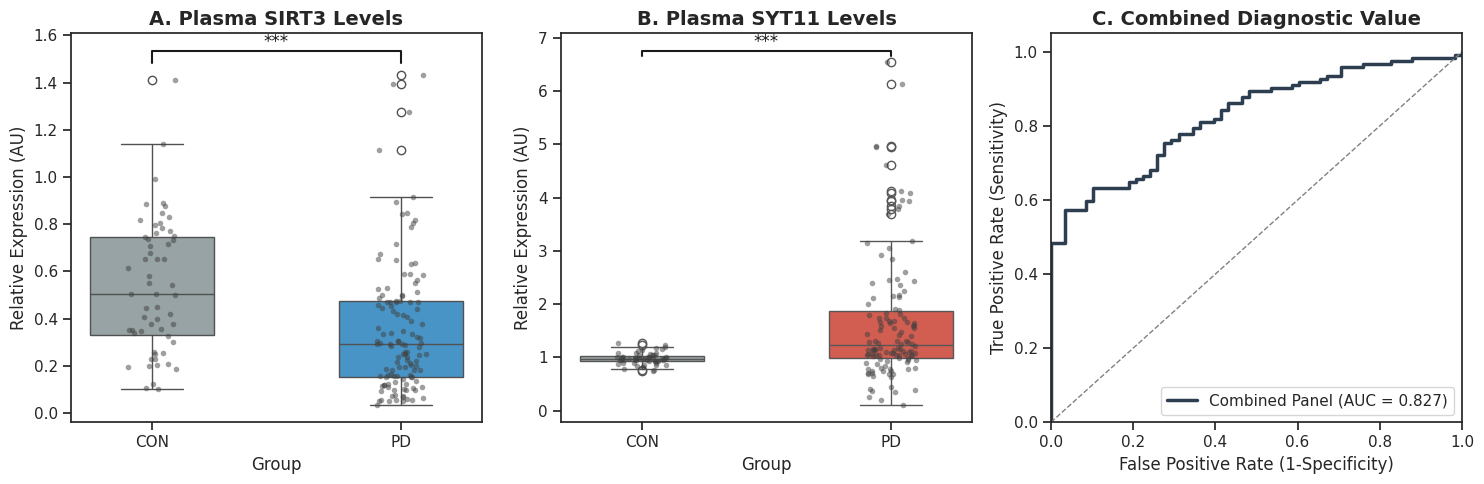
Figure1
References: Salvatori I, Valle C, Ferri A, et al. SIRT3 and mitochondrial metabolism in neurodegenerative diseases[J]. Neurochem Int, 2017, 109: 184-192.
Dong N, Xie Z, Wei A, et al. Compensatory synaptotagmin-11 expression conceals parkinson’s disease-like phenotypes in parkin knockout mice[J]. Cell Commun Signal, 2025, 23(1): 61.
To cite this abstract in AMA style:
Y. Deng, H. Cao, Q. Qu, Y. Wang. Investigating Plasma SIRT3 and SYT11 as Potential Indicators in Parkinson’s Disease: A Preliminary Exploratory Study [abstract]. Mov Disord. 2026; 41 (suppl 1). https://www.mdsabstracts.org/abstract/investigating-plasma-sirt3-and-syt11-as-potential-indicators-in-parkinsons-disease-a-preliminary-exploratory-study/. Accessed October 1, 2026.« Back to 2026 International Congress
MDS Abstracts - https://www.mdsabstracts.org/abstract/investigating-plasma-sirt3-and-syt11-as-potential-indicators-in-parkinsons-disease-a-preliminary-exploratory-study/