
Objective: To integrate mechanistic evidence delineating irisin mediated molecular pathways relevant to Parkinson’s disease (PD) pathogenesis and neuroprotection, focusing on α-syn clearance, autophagy–lysosomal function, mitochondrial dynamics, oxidative stress, apoptosis, neuroinflammation, and integrin/Akt/extracellular signal–regulated kinase (ERK) signaling.
Background: PD is characterized by progressive loss of dopaminergic neurons in the substantia nigra and accumulation of misfolded α-synuclein (α-syn). Beyond motor impairments, PD involves oxidative stress, mitochondrial dysfunction, apoptosis, and neuroinflammation. Exercise is a well-established neuroprotective intervention, and the exercise-induced myokine irisin has emerged as a key mediator of these effects. Irisin, cleaved from fibronectin type III domain–containing protein 5 (FNDC5), crosses the blood–brain barrier and promotes neuronal survival, synaptic plasticity, and energy metabolism.
Method: Mechanistic evidence was systematically integrated from preclinical, clinical, and translational studies identified through PubMed and ScienceDirect using targeted keywords (“irisin,” “Parkinson’s disease,” “α-synuclein,” “autophagy,” “mitochondria,” “NLRP3 inflammasome,” “oxidative stress,” “integrin signaling”). Eligible studies included in vitro, in vivo, clinical, and review papers addressing irisin’s molecular or therapeutic roles in PD. Data were extracted on model type, signaling pathways, mediators, and outcomes.
Results: Across preclinical models irisin consistently mitigates α-syn pathology through multiple mechanisms. It enhances autophagic–lysosomal degradation, suppresses nucleotide-binding oligomerization domain-like (NOD) receptor family pyrin domain–containing 3 (NLRP3) inflammasome activation, improves mitochondrial biogenesis and function, augments antioxidant and neurotrophic signaling, and inhibits apoptosis. These pathways collectively reduce oxidative stress, neuroinflammation, and neuronal loss. Clinical data suggest that exercise-induced increases in circulating irisin correlate with improved motor performance and may serve as a biomarker of neuroprotection. A summary of these mechanisms and mediators is presented in Table 1.
Conclusion: Irisin modulates PD pathology via α-synuclein clearance and mitochondrial protection, supporting its role as a biomarker for stratification of disease progression.
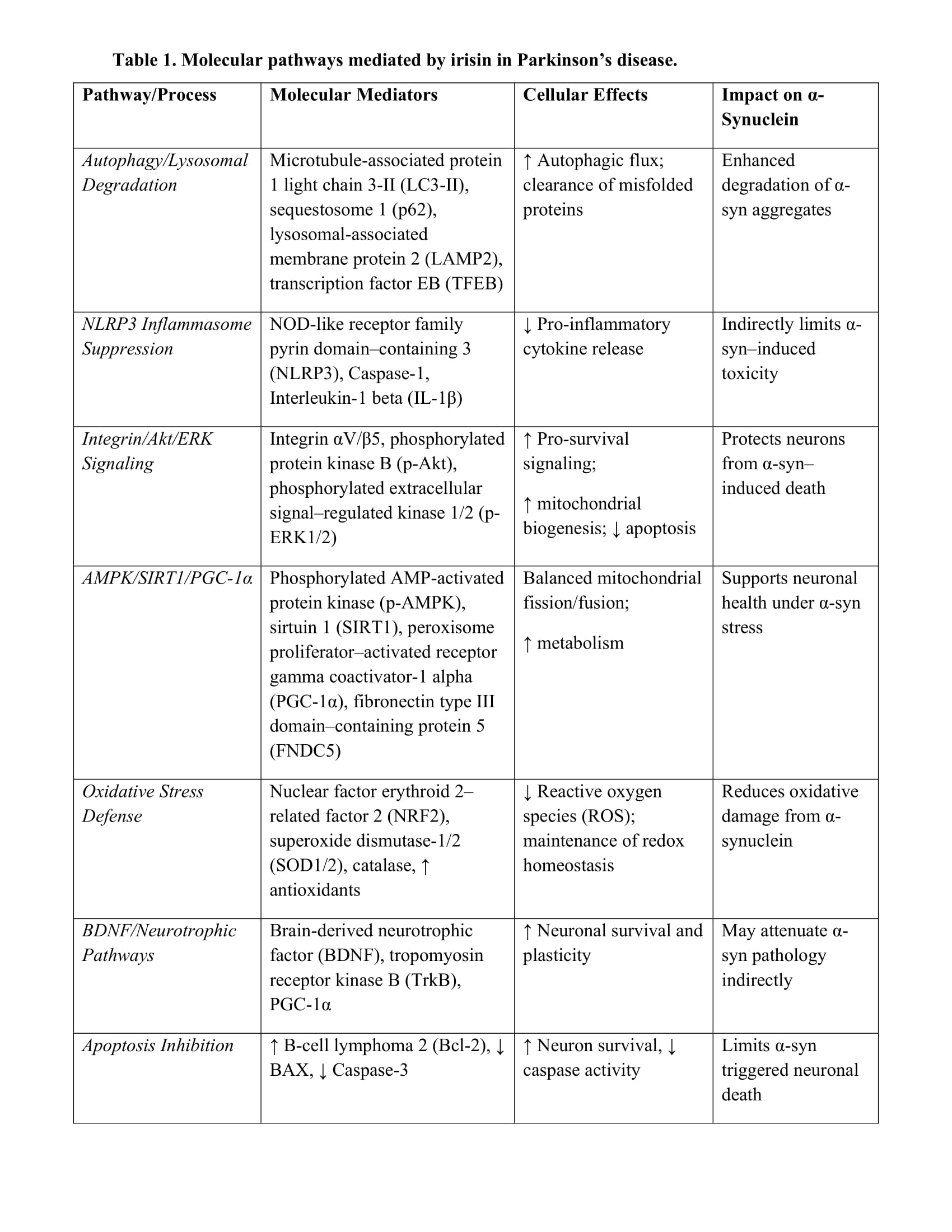
Table 1
To cite this abstract in AMA style:
NIK. Choudhary. Irisin as a Molecular Mediator of Exercise Induced Neuroprotection and Disease Modification in Parkinson’s Disease [abstract]. Mov Disord. 2026; 41 (suppl 1). https://www.mdsabstracts.org/abstract/irisin-as-a-molecular-mediator-of-exercise-induced-neuroprotection-and-disease-modification-in-parkinsons-disease/. Accessed October 1, 2026.« Back to 2026 International Congress
MDS Abstracts - https://www.mdsabstracts.org/abstract/irisin-as-a-molecular-mediator-of-exercise-induced-neuroprotection-and-disease-modification-in-parkinsons-disease/