
Objective: Develop and validate a video-based biomarker for Parkinson’s disease (PD) that provides an interpretable, and clinically relevant measure of motor severity sensitive to medication, DBS treatment and disease evolution.
Background: The clinical assessment of motor severity relies heavily on rating scales like the Unified Parkinson’s Disease Rating Scale (UPDRS), which are known to be subjective and suffer from inter-rater variability. While recent approaches using video have attempted to automate UPDRS scoring, they are often trained using these same subjective clinical scores as target labels. Such models inherit biases of the clinicians who provided the original ratings, failing to produce a truly objective measure. There remains a need for a biomarker derived directly from kinematic data independent of subjective labels.
Method: We analyzed video kinematics from a cohort of PD patients and healthy controls performing finger tapping and hand grasping tasks. Participants with PD were assessed in different medication states, as well as DBS “ON” and “OFF”. A classifier was trained to distinguish between PD and healthy states based on kinematic data. Using AI techniques, we identified a single, stable latent dimension the KDC. We evaluated its consistency across two different tasks: finger tapping and hand grasping, its sensitivity to medication and DBS. Longitudinal data was used to assess the KDC’s capacity to forecast the disease evolution.
Results: The classifier distinguished PD patients from healthy controls, and the underlying KDC was robustly identified across both tasks. Progression along this single dimension corresponded to coordinated changes in interpretable kinematic features. As illustrated in the latent space scatter plot [figure1], the KDC provides a clear separation between the two groups. The KDC demonstrated a significant shift towards a healthier state with both medication and DBS. Longitudinal analysis showed that changes in the KDC can capture the disease progression.
Conclusion: We have developed a novel, video derived biomarker, the KDC, which offers an interpretable measure of Parkinsonian motor severity. Its consistency across tasks, sensitivity to therapeutic interventions, and predictive validity for diagnostic purposes suggest its potential to enhance patient management and enable remote monitoring.
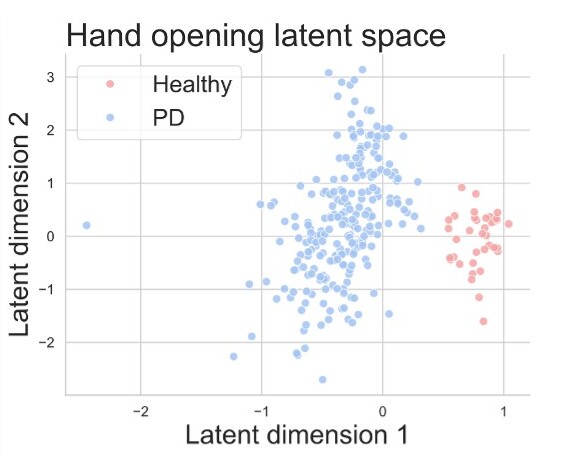
KDC scatter plot
To cite this abstract in AMA style:
M. Perales, T. Sil, F. Lange, M. Reich, R. Peach. Kinematic Discriminative Component (KDC) a New Biomarker to Measure Parkinson’s Disease Severity [abstract]. Mov Disord. 2026; 41 (suppl 1). https://www.mdsabstracts.org/abstract/kinematic-discriminative-component-kdc-a-new-biomarker-to-measure-parkinsons-disease-severity/. Accessed October 1, 2026.« Back to 2026 International Congress
MDS Abstracts - https://www.mdsabstracts.org/abstract/kinematic-discriminative-component-kdc-a-new-biomarker-to-measure-parkinsons-disease-severity/