
Category: Parkinson's Disease: Surgical Therapy
Objective: evaluate the long-term outcomes of levodopa-carbidopa intestinal gel (LCIG) infusion in patients with advanced PD with motor fluctuation in one centre
Background: Levodopa-carbidopa intestinal gel (LCIG) is an established device-aided therapy that improves symptoms of advanced Parkinson’s disease (PD) with motor fluctuations. (1) Complications due to LCIG infusion therapy are common. (2) This study summarizes our long-term experience with LCIG therapy, focusing on treatment-related complications.
Method: We conducted a retrospective study to assess the efficacy, safety, and long-term outcomes of advanced PD patients treated with LCIG at King Faisal Specialist Hospital and Research Centre, in Riyadh, from 2007 to 2022. Data were analysed using SPSS, with a significance threshold set at p < 0.05.
Results: We included sixty-two patients, with a mean age of 63.53 years and a disease duration of 9 years at the time of LCIG initiation. A continuous 24-hour LCIG infusion was used in 43 patients (69%) (see Table 1). Over the follow-up period, complications occurred in 40 patients. The most common complications were stoma infections (n=11) and tube malfunctions (n=13). Less frequent complications included buried bumper syndrome (n=2) and gastrointestinal bleeding requiring surgical intervention (n=1), intra-abdominal infections (n=1), in addition to other LCIG-related complications (n=12). Twenty patients were hospitalized due to these complications (see Table 2). Univariate logistic regression identified pre-LCIG UPDRS-III scores and continuous 24-hour LCIG dosing as the only potential predictors of therapy-related complications.
Conclusion: Our cohort showed that LCIG provided sustained benefit beyond 10 years for motor fluctuation in PD patients. Two-thirds of our patients experienced complications with varying severity. One-third of complications led to hospitalization. Three patients faced severe complications such as GI bleeding and buried bumper syndrome requiring surgical intervention. Higher baseline UPDRS-III scores and continuous 24-hour LCIG infusion were associated with an increased risk of complications. Regular monitoring and integrated care are essential for managing complications and ensuring ongoing patient benefit and safety. We recommend careful patient selection and multidisciplinary management to optimize long-term outcomes
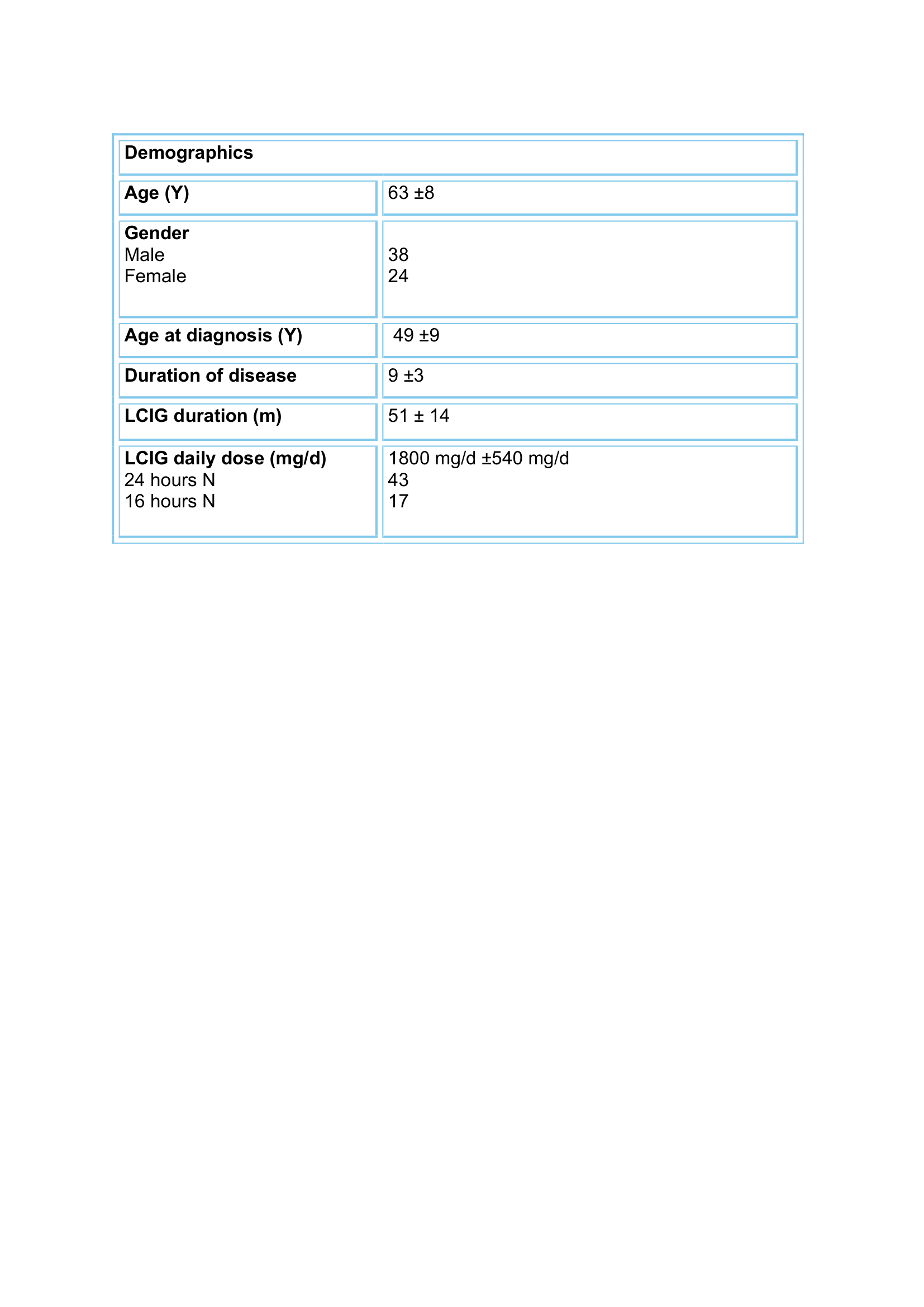
Table 1: Patient demographics
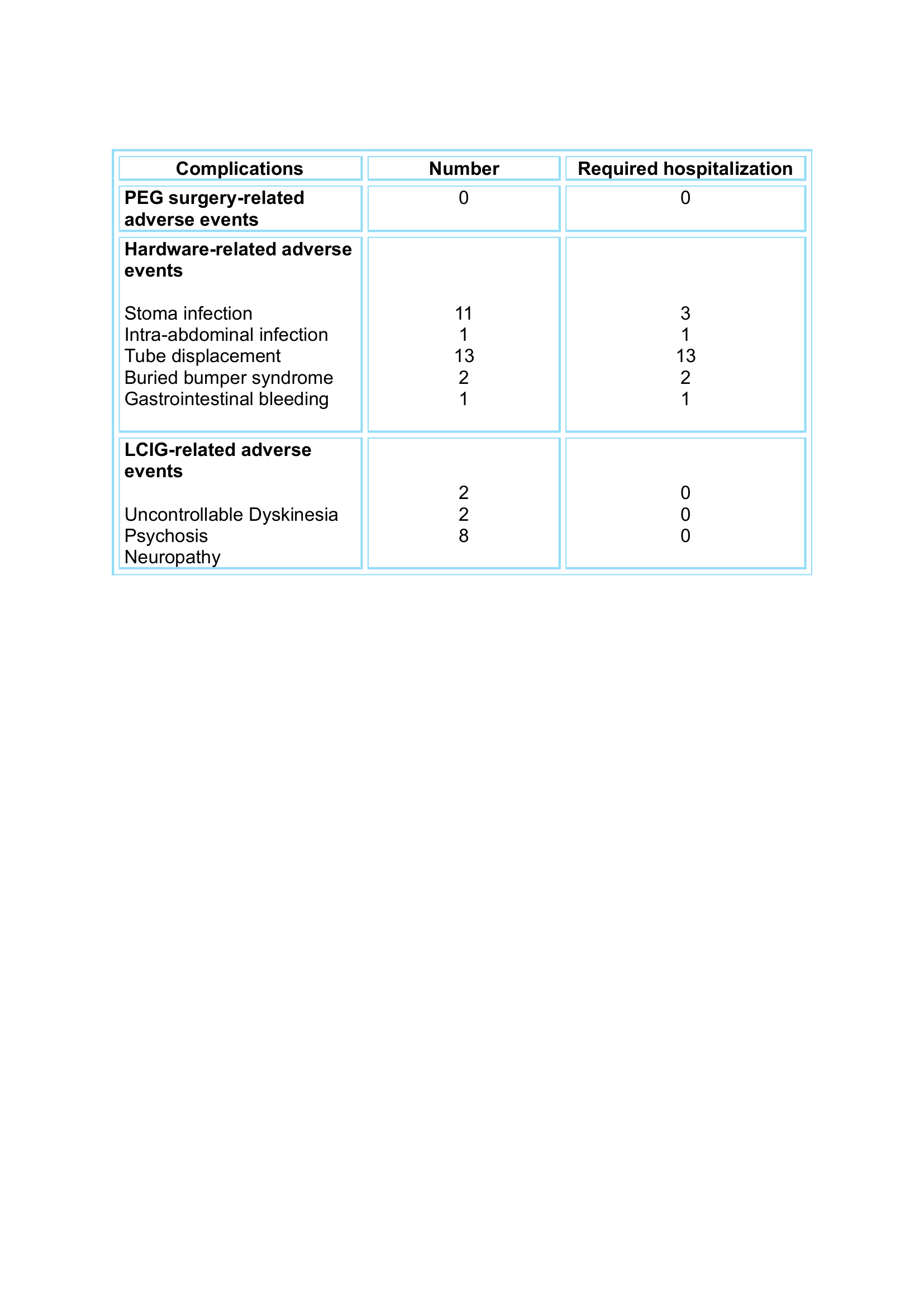
Table 2: LCIG pump complications
References: 1. Deuschl G, et al. E. European Academy of Neurology/Movement Disorder Society-European Section Guideline on the Treatment of Parkinson’s Disease: I. Invasive Therapies. Mov Disord. 2022 Jul;37(7):1360-1374. doi: 10.1002/mds.29066. Epub 2022 Jul 6. PMID: 35791767.
2. Bohlega S,et al. Levodopa-Carbidopa Intestinal Gel Infusion Therapy in Advanced Parkinson’s Disease: Single Middle Eastern Center Experience. Eur Neurol. 2015;74(5-6):227-36. doi: 10.1159/000442151. Epub 2015 Dec 1. PMID: 26618531.
To cite this abstract in AMA style:
H. Alhodaif, Y. Alkhodair, S. Alqahtani, B. Bohlega, A. Aldakheel. Levodopa-Carbidopa Intestinal Gel Infusion Therapy in Advanced Parkinson’s Disease: Extension Study of Long-term outcomes of Single Centre experience [abstract]. Mov Disord. 2026; 41 (suppl 1). https://www.mdsabstracts.org/abstract/levodopa-carbidopa-intestinal-gel-infusion-therapy-in-advanced-parkinsons-disease-extension-study-of-long-term-outcomes-of-single-centre-experience/. Accessed October 1, 2026.« Back to 2026 International Congress
MDS Abstracts - https://www.mdsabstracts.org/abstract/levodopa-carbidopa-intestinal-gel-infusion-therapy-in-advanced-parkinsons-disease-extension-study-of-long-term-outcomes-of-single-centre-experience/