
Objective:
To determine clinical predictors of longitudinal cognitive decline and dementia conversion in a real-world Parkinson’s disease (PD) cohort.
Background:
Cognitive impairment is one of the most disabling non-motor features of PD. Mild cognitive impairment in PD (PD-MCI) is considered a transitional state toward Parkinson’s disease dementia (PDD), yet individual trajectories are heterogeneous and predictors of progression remain insufficiently characterized in real-world settings.
Method: We performed a longitudinal analysis of the ReMePARK cohort including participants with ≥3 visits and valid cognitive evaluations. Global cognition was assessed using the Montreal Cognitive Assessment (MoCA), and screening-based classifications (normal cognition, probable PD-MCI, probable PDD) were defined using operational cutoffs. Motor severity was measured with MDS-UPDRS Part III. Non-motor burden was evaluated using harmonized NMS domains, and dopaminergic exposure was quantified as levodopa equivalent daily dose (LEDD). The primary outcome was the annualized change in MoCA relative to the previous visit, capturing short-term cognitive trajectory. Multivariable models were adjusted for age, sex, education, and disease duration.
Results: A total of 382 individuals (186 women) were followed for a mean of 7.3±3.3 visits across 36 months. Mean age was 63±12.7 years and baseline MoCA 20.7±5.9. Cognitive stability was the predominant trajectory. Among transitions reflecting deterioration, PD-MCI→PDD (n=94) and Normal→PD-MCI (n=74) were most frequent, underscoring PD-MCI as a critical intermediate stage. The regression model demonstrated low explanatory power (R²=0.03) but overall statistical significance (p=0.02). After mitigating multicollinearity, only MDS-UPDRS Part III independently predicted faster cognitive decline. Classification performance for predicting PDD conversion was limited, likely reflecting class imbalance and insufficiently discriminative features.
Conclusion:
While cognitive stability predominates, progression from PD-MCI to PDD is common. Greater motor severity independently predicts accelerated cognitive decline, highlighting motor burden as a clinically meaningful marker of dementia risk. Enhanced biomarkers and refined predictive modeling are needed to improve individualized risk stratification in PD.
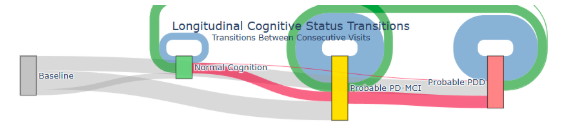
Cognitive transitions in Parkinsons
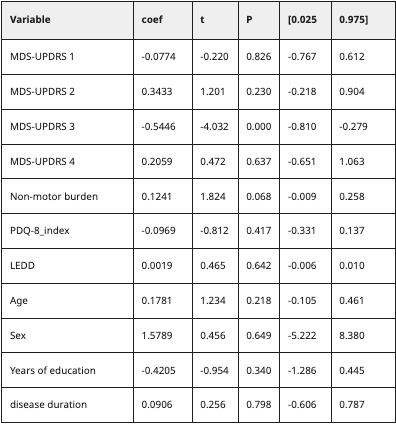
Multivariable model predicting annual MoCA change
To cite this abstract in AMA style:
N. Sánchez-Lorenzo, K. Sánchez-Ramírez, M. Rocha-de-León, A. Beltrán-Torres, E. Ramírez-Benitez, A. Cervantes-Arriaga, M. Rodríguez-Violante. Longitudinal cognitive trajectories and predictors of dementia conversion in Parkinson’s disease [abstract]. Mov Disord. 2026; 41 (suppl 1). https://www.mdsabstracts.org/abstract/longitudinal-cognitive-trajectories-and-predictors-of-dementia-conversion-in-parkinsons-disease/. Accessed October 1, 2026.« Back to 2026 International Congress
MDS Abstracts - https://www.mdsabstracts.org/abstract/longitudinal-cognitive-trajectories-and-predictors-of-dementia-conversion-in-parkinsons-disease/