
Category: Parkinson's Disease (Other)
Objective: To characterize longitudinal trajectories of impulsive-compulsive behaviors (ICD) in PD and to determine their prognostic value for quality of life and dopaminergic medication requirements over time. A secondary objective was to examine whether baseline cognitive function modifies longitudinal progression across ICD trajectory groups.
Background: ICDs are a frequent non-motor complication of PD and may fluctuate over time. However, the longitudinal evolution of ICD symptoms and their prognostic significance for patient-centered and treatment-related outcomes remain incompletely understood.
Method: Longitudinal mixed-effects models were used to evaluate the impact of ICD patterns. ICD trajectories were categorized as Always Low, Emerging, Fluctuating, and Persistent High. Time was modeled as years from baseline. Disease duration from symptom onset to baseline, age and sex were included as a covariate. An additional model examined the interaction between MoCA and time on PDQ-8 progression, including interaction terms, and a three-way interaction with ICD pattern.
Results: For PDQ-8, the Emerging ICD trajectory showed a significantly steeper increase over time versus Always Low (time×Emerging: p=0.032), indicating faster worsening of quality of life. Time interactions for other ICD patterns were not significant. Longer duration_base was independently associated with worse PDQ-8 (p=0.001). Baseline age and sex were not significant in this model. For LEDD, years from baseline was strongly associated with increasing dosage over time (p<0.001). The Emerging ICD trajectory had a significantly steeper LEDD increase than Always Low (time × Emerging: p=0.002), while Persistent High approached significance (p=0.056). Longer duration (p=0.001) and higher age (p=0.002) were associated with higher LEDD.
In the cognition model, baseline MoCA significantly moderated PDQ-8 progression (time×MoCA: p=0.002), with higher MoCA associated with slower PDQ-8 worsening. No three-way interactions were significant. Disease duration and age remained significant (p=0.002).
Conclusion: An Emerging ICD trajectory is associated with faster deterioration in quality of life and greater increases in dopaminergic medication over time. Baseline cognition protects against quality-of-life decline, independent of ICD trajectory. Disease duration is an adverse correlate, while age effects vary and sex shows no independent association.
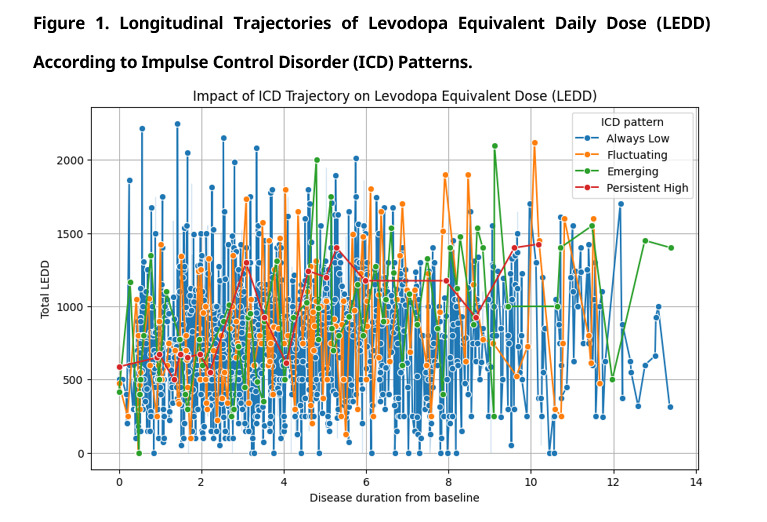
Figure 1.
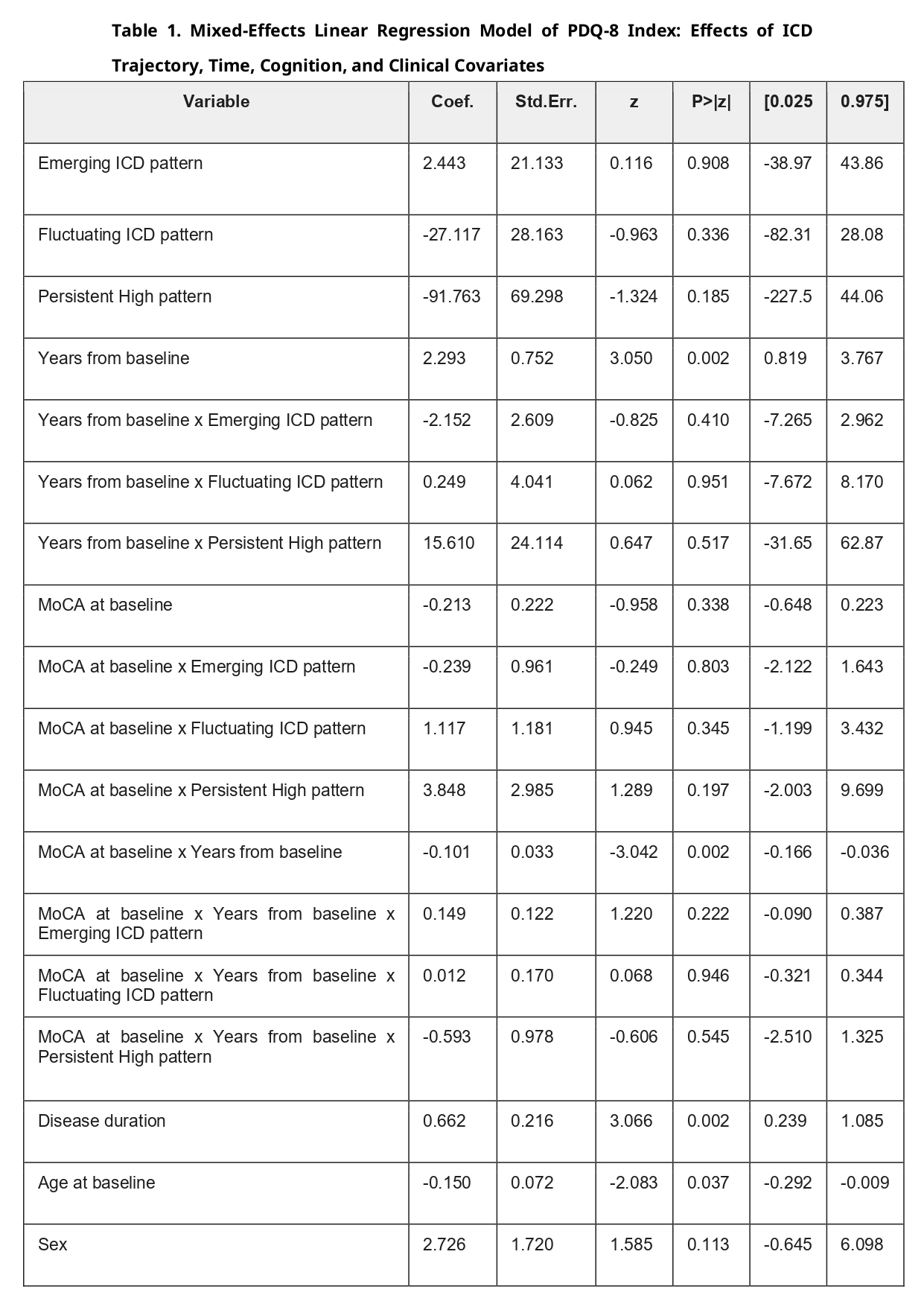
Table 1.
To cite this abstract in AMA style:
M. Rocha-de-León, A. Beltrán-Torres, N. Sánchez-Lorenzo, K. Sánchez-Ramírez, D. Nafate-Wences, A. Cervantes-Arriaga, M. Rodríguez-Violante. Longitudinal evolution of impulsive-compulsive behaviors and their prognostic value in Parkinson’s disease [abstract]. Mov Disord. 2026; 41 (suppl 1). https://www.mdsabstracts.org/abstract/longitudinal-evolution-of-impulsive-compulsive-behaviors-and-their-prognostic-value-in-parkinsons-disease/. Accessed October 1, 2026.« Back to 2026 International Congress
MDS Abstracts - https://www.mdsabstracts.org/abstract/longitudinal-evolution-of-impulsive-compulsive-behaviors-and-their-prognostic-value-in-parkinsons-disease/