
Category: Parkinson's Disease: Surgical Therapy
Objective: To evaluate longitudinal changes in gait parameters in patients with Parkinson’s disease (PD) treated with unilateral Magnetic Resonance-guided Focused Ultrasound (MRgFUS) targeting the ventralis intermedius nucleus (VIM) of the thalamus and the subthalamic nucleus (STN) during a 6-month follow-up. We also aimed to compare changes in gait parameters between the two targets.
Background: It has been demonstrated that MRgFUS thalamotomy in PD improves tremor whereas subthalamotomy improves tremor, rigidity and bradykinesia in the treated hemibody. Nonetheless, gait worsening has been observed in some patients, although the effects of these interventions on gait parameters remain unexplored.
Method: This prospective study included 18 PD patients treated with MRgFUS subthalamotomy and 9 patients with VIM thalamotomy, with evaluation up to 6 months.
Gait was assessed using accelerometry-derived parameters, including velocity, cadence, stride time and length, step and stride regularity, asymmetry, smoothness, acceleration peaks, and energy. Longitudinal changes from baseline levels at 1, 3 and 6 months were analyzed using paired t-tests. At each time point, difference in the longitudinal change among groups was assessed by means of an ANOVA test.
Results: At 6 months, PD patients treated with subthalamotomy showed a significant increase in acceleration peak on the treated side (p=0.025) [figure1] and a decrease in gait asymmetry (p=0.035) [figure2] compared to baseline. On the other hand, PD patients treated with thalamotomy, showed no significant differences between these two time points. No significant differences were observed at 1 and 3 months in either group.
At 6 months, PD patients treated with subthalamotomy showed increased acceleration peak in the treated side and decreased gait asymmetry compared to the group treated with thalamotomy.
Conclusion: These findings suggest that in PD patients, MRgFUS subthalamotomy leads to an improvement in gait, probably due to reduction of rigidity and bradykinesia on the treated hemibody, whereas VIM lesions do not modify gait parameters.
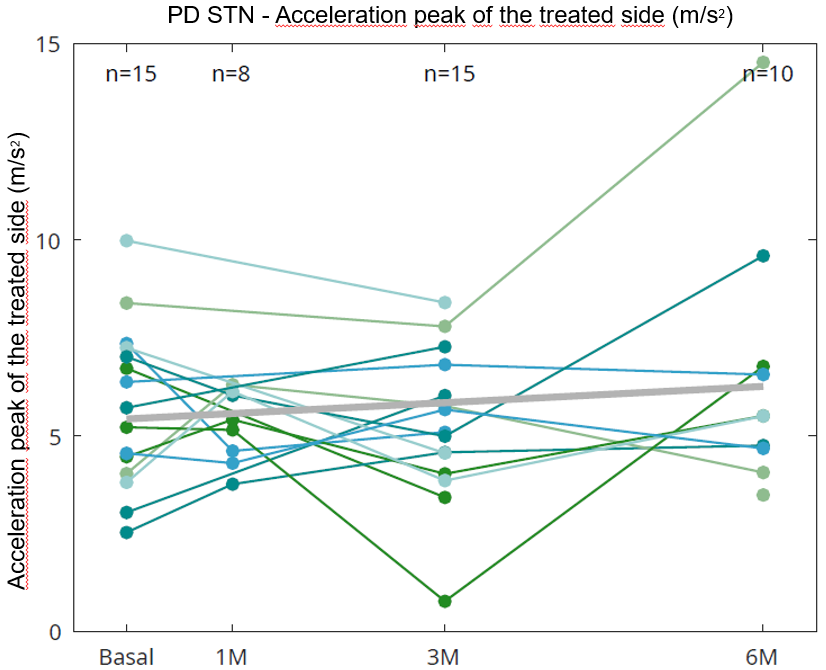
Accel. peak of the treated side of PD STN
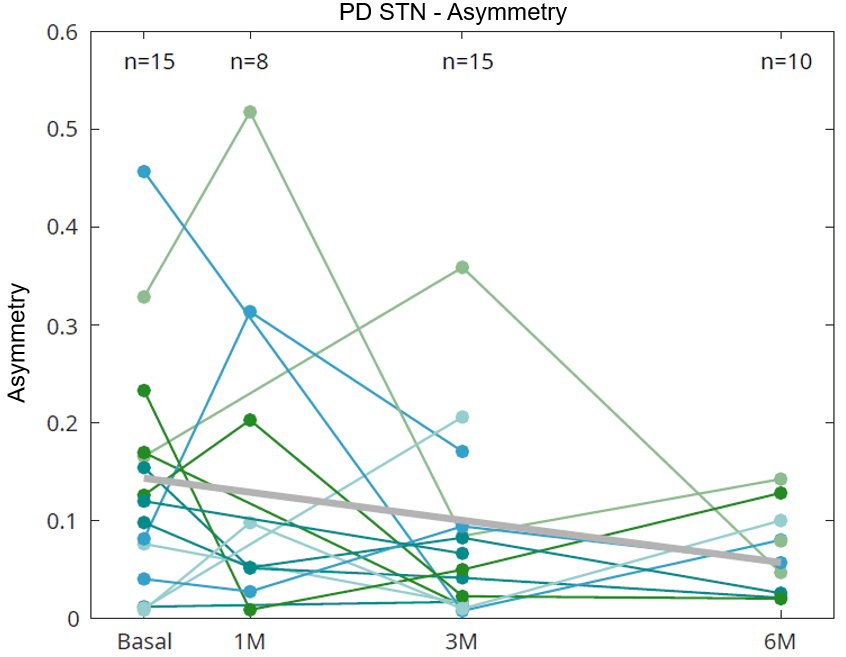
Gait asymmetry of PD STN
To cite this abstract in AMA style:
E. Salinas Jaime, G. Diaz-Taveras, P. Lecumberri Villamediana, E. Natera-Villalba, A. Martin-Bastida, L. Gonzalez-Quarante, A. Arcadi Da-Silva, P. Cortadi La-Villa, C. Sanchez-Catasus, M. Rodriguez-Oroz. Longitudinal gait change after unilateral MRgFUS thalamotomy or subthalamotomy in Parkinson’s disease [abstract]. Mov Disord. 2026; 41 (suppl 1). https://www.mdsabstracts.org/abstract/longitudinal-gait-change-after-unilateral-mrgfus-thalamotomy-or-subthalamotomy-in-parkinsons-disease/. Accessed October 1, 2026.« Back to 2026 International Congress
MDS Abstracts - https://www.mdsabstracts.org/abstract/longitudinal-gait-change-after-unilateral-mrgfus-thalamotomy-or-subthalamotomy-in-parkinsons-disease/