
Category: Tremor
Objective: To evaluate changes in gait parameters Essential Tremor (ET) patients treated with unilateral or bilateral Magnetic Resonance-guided Focused Ultrasound (MRgFUS) thalamotomy, and to assess whether the bilateral target is associated with greater gait alterations than the unilateral one.
Background: Although tremor improvement with MRgFUS thalamotomy in ET patients has been proved, gait side effects have been observed. These are usually mild and transient, but occasionally persistent, particularly after the second treatment. Objective studies evaluating gait changes after unilateral and bilateral thalamotomy remain limited.
Method: 27 patients with ET were evaluated at baseline and up to 6 months after receiving VIM thalamotomy: 17 unilaterally and 10 bilaterally.
Gait assessment was performed using accelerometry-derived parameters, including velocity, cadence, stride time and length, step and stride regularity, symmetry, smoothness, acceleration peaks and energy expenditure. Longitudinal changes at 1, 3 and 6 months were analyzed using paired t-tests. At each time point, difference in the longitudinal change among groups was assessed by means of an ANOVA test.
Results: Patients treated unilaterally, showed increased stride regularity (p=0.029) [figure1] and acceleration peak on both the treated (p=0.017) [figure2] and non-treated sides (p=0.014) [figure3] at 6 months respect to baseline. Acceleration peak on the treated side change was significant at 1 month (p=0.014) but did not reach statistical significance at 3 months (p=0.051) [figure4]. Stride regularity change at 1 month showed a non-significant tendency towards increase (p=0.053) that reached significancy at 3 months (p=0.043).
On the other hand, patients treated bilaterally exhibited an increase in acceleration peak on the treated side (p=0.047) and a decrease in stride regularity that did not reach statistical significance (p=0.052) at 6 months.
Change at 6 months respect to baseline in stride length (p=0.049) and regularity (p=0.003) was different between the two groups, being better in the unilateral treated patients.
Conclusion: These findings suggest that unilateral MRgFUS thalamotomy in ET patients may improve gait dynamics and that the second lesion does not induce worsening in any variable. Although the results suggest a different evolution, further studies with larger cohorts are required to confirm these findings.
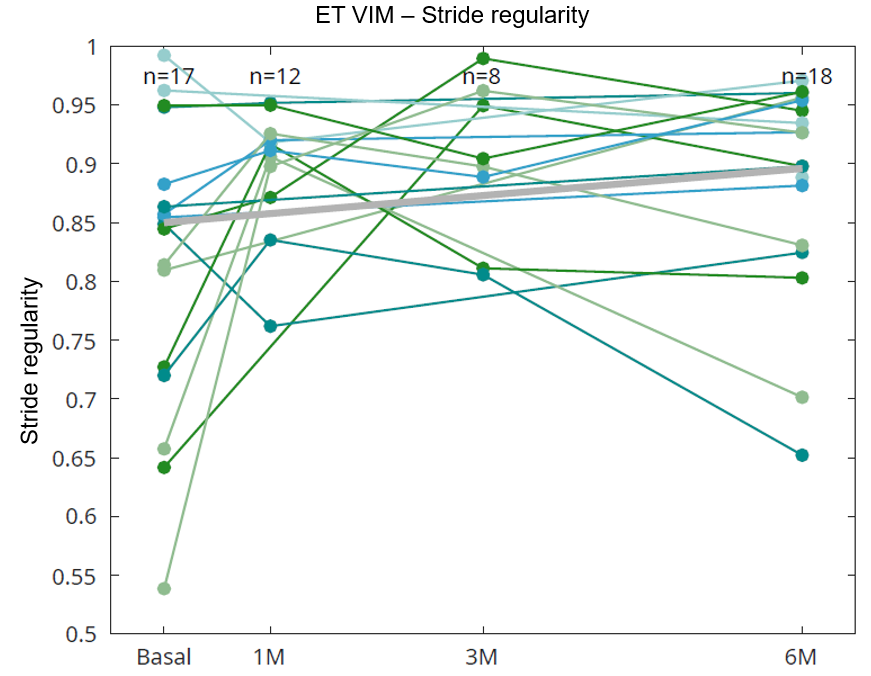
Stride regularity of unilateral TE
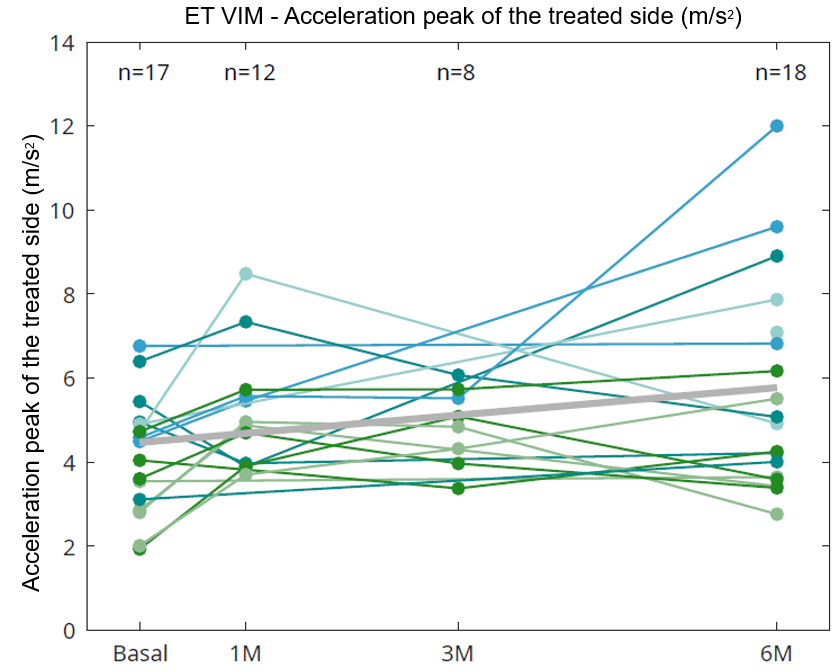
Accel. peak of the treated side of unilateral TE
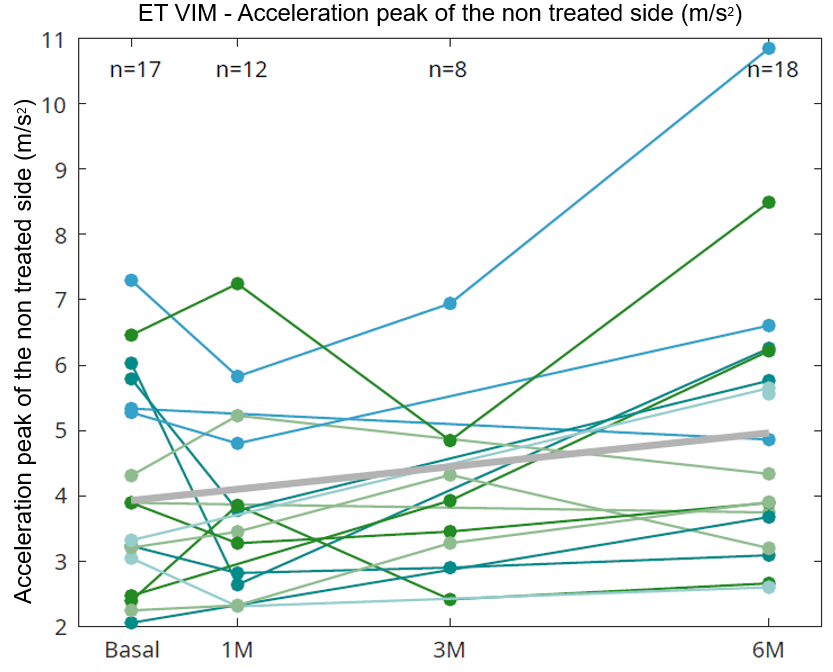
Accel. peak of the nontreated side of unilat. TE
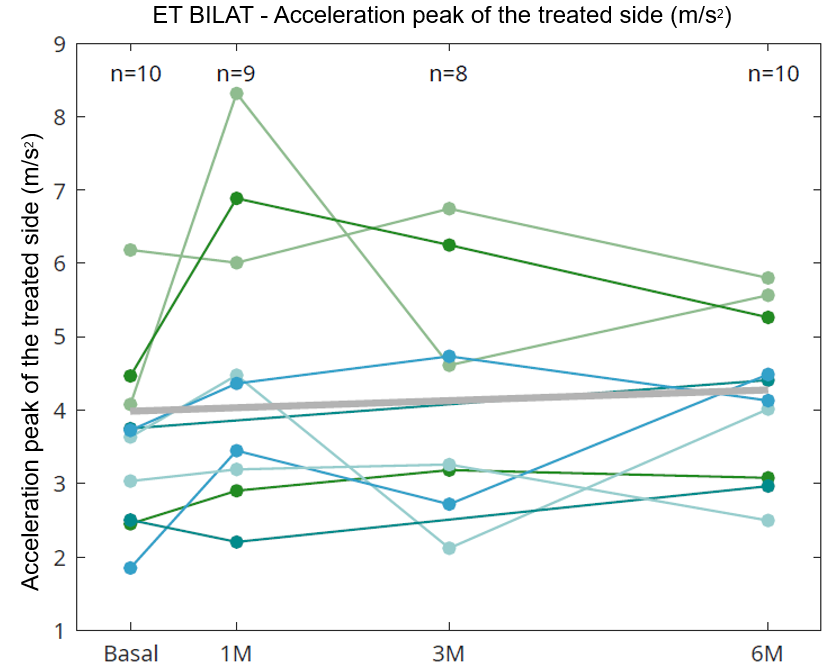
Accel. peak of the treated side of bilateral ET
To cite this abstract in AMA style:
E. Salinas Jaime, G. Diaz-Taveras, P. Lecumberri Villamediana, E. Natera-Villalba, A. Martin-Bastida, A. Arcadi Da-Silva, L. Gonzalez-Quarante, PM. Cortadi La-Villa, C. Sanchez-Catasus, M. Rodriguez-Oroz. Longitudinal gait changes after unilateral and bilateral MRgFUS thalamotomy in Essential Tremor [abstract]. Mov Disord. 2026; 41 (suppl 1). https://www.mdsabstracts.org/abstract/longitudinal-gait-changes-after-unilateral-and-bilateral-mrgfus-thalamotomy-in-essential-tremor/. Accessed October 1, 2026.« Back to 2026 International Congress
MDS Abstracts - https://www.mdsabstracts.org/abstract/longitudinal-gait-changes-after-unilateral-and-bilateral-mrgfus-thalamotomy-in-essential-tremor/