
Objective: To examine associations between military-related exposures and PD.
Background: The Millennium Cohort Study is a large prospective cohort of 260,228 US service members and veterans.1 At enrollment, participants completed a comprehensive survey on a wide range of occupational exposures and health factors, with follow-up surveys every 3 to 5 years. PD has not been previously investigated in this cohort.
Method: We conducted a nested case-control study among participants from the first four enrollment panels (2001–2013; n=201,619). We identified participants with a PD diagnosis through linkage with VA health records, Medicare (CMS), and the Military Health System Data Repository (MDR) using PD ICD codes (332.0, G20) and PD-associated medications, and self-report. We validated VA/CMS PD diagnoses by chart review and developed an algorithm for other data sources based on those with overlapping VA health data. Controls were matched 4:1 on sex, birth year, enrollment panel, year of entry into the military, and ascertainment source. We examined associations of PD with service branch and self-reported environmental exposures in conditional logistic regression models adjusted for race/ethnicity, smoking, and rank.
Results: We ascertained 342 veterans with PD, 116 from VA/CMS, 16 MDR, and 210 by self-report [table1]. Mean age at PD diagnosis was 52.5 (SD 12.9) overall and 57.7 (SD 10.3) among participants who enrolled in 2001-2003 (Panel 1). The odds of PD were significantly increased among Air Force veterans ascertained in VA/CMS (OR 1.94, 95%CI 1.18-3.19) [table2]. Among all participants, those who reported having been exposed to depleted uranium at baseline (OR 1.76, 95%CI 1.13-2.74) or who used topical pesticides (OR 1.29, 95%CI 1.01-1.67) had increased odds of PD. Magnitudes of association were stronger in Panel 1 participants.
Conclusion: Topical pesticide exposure may increase PD risk in this military cohort, consistent with the broader PD literature. Depleted uranium induced dopaminergic degeneration in a C elegans model2, but other toxicologic data are lacking, and this novel association in humans warrants further study. The elevated risk of PD observed in Air Force veterans in the VA/CMS cohort is also novel, though it parallels prior ALS observations and suggests a potential role for branch-specific toxicant exposures in neurodegeneration.3
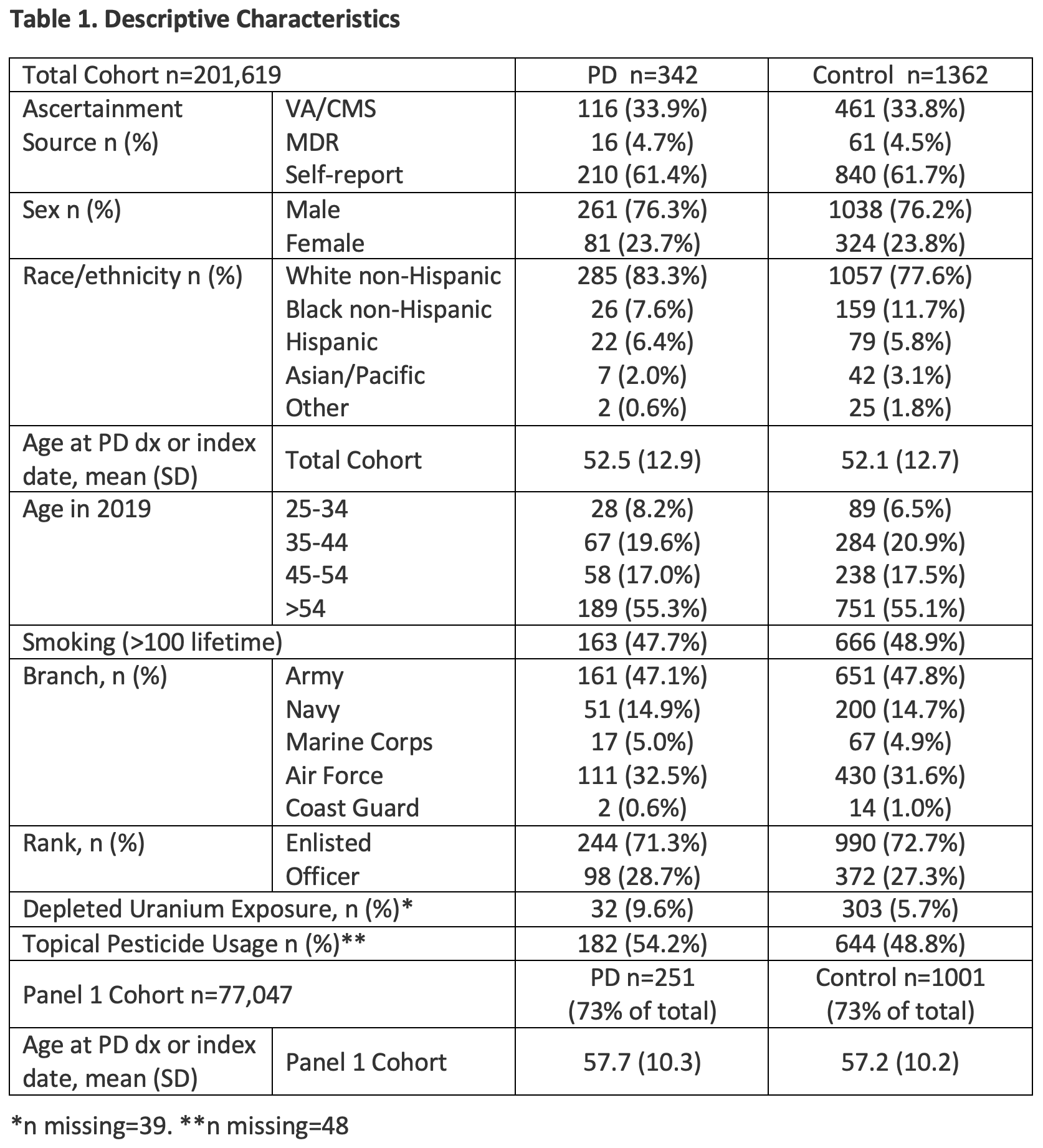
Table 1. Descriptive Characteristics
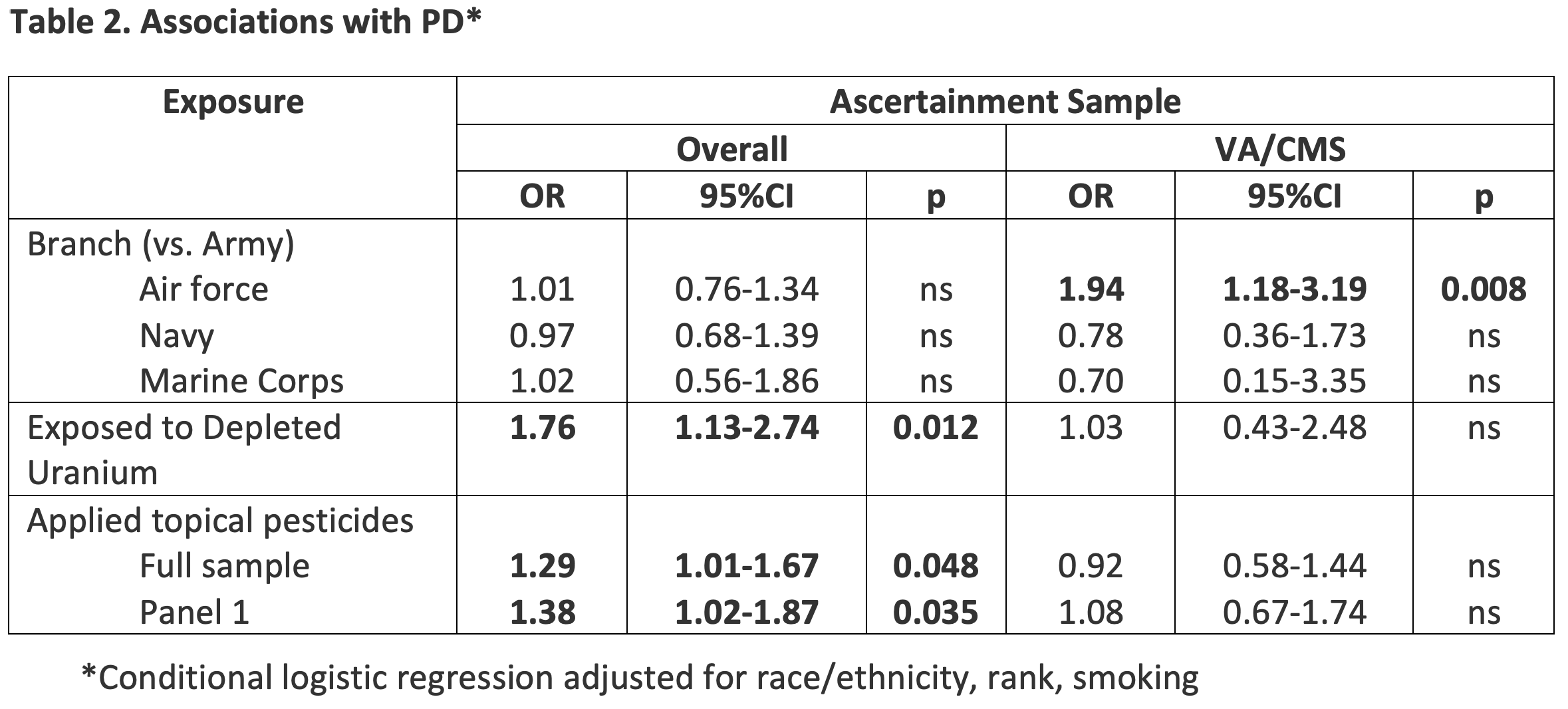
Table 2. Associations with PD
References: 1. Belding JN, Castaneda SF, Jacobson IG, LeardMann CA, Porter B, Powell TM, Kolaja CA, Seelig AD, Matsuno RK, Carey FR, Rivera AC, Trone DW, Sheppard BD, Walstrom JL, Boyko EJ, Rull RP, Millennium Cohort Study T. The Millennium Cohort Study: The first 20 years of research dedicated to understanding the long-term health of US Service Members and Veterans. Ann Epidemiol. 2022 Mar;67:61-72.
2. Lu M, Li H, Li Y, Lu Y, Wang H, Wang X. Exploring the Toxicology of Depleted Uranium with Caenorhabditis elegans. ACS Omega. 2020 Jun 2;5(21):12119-25.
3. Sagiraju HKR, Zivkovic S, VanCott AC, Patwa H, Gimeno Ruiz de Porras D, Amuan ME, Pugh MJV. Amyotrophic Lateral Sclerosis Among Veterans Deployed in Support of Post-9/11 U.S. Conflicts. Military medicine. 2020 Mar 2;185(3-4):e501-e9.
To cite this abstract in AMA style:
S. Goldman, E. Richard, R. Rull, E. Boyko, K. Friedl, E. Hu, L. Liu, S. Boparai, N. Riedel, K. Comyns, E. Brown, C. Tanner. Military-related associations with Parkinson’s disease (PD) in the Millenium Cohort Study [abstract]. Mov Disord. 2026; 41 (suppl 1). https://www.mdsabstracts.org/abstract/military-related-associations-with-parkinsons-disease-pd-in-the-millenium-cohort-study/. Accessed October 1, 2026.« Back to 2026 International Congress
MDS Abstracts - https://www.mdsabstracts.org/abstract/military-related-associations-with-parkinsons-disease-pd-in-the-millenium-cohort-study/