
Category: Ataxia
Objective: In the context of emerging gene-targeted therapies for polyglutamine spinocerebellar ataxias (SCAs), identifying predictive clinical markers of disease progression is becoming increasingly relevant. We therefore aimed to characterize determinants of progression across SCA types and to develop prediction models to inform type-specific monitoring and clinical trial design.
Background: The most common autosomal-dominant polyglutamine SCA1, SCA2, SCA3, and SCA6, account for more than half of all SCA families. Despite increasing interest in biomarkers, clinician-reported outcomes (ClinRO) remain central for monitoring disease progression. SCA1, SCA2, SCA3 and SCA6 are caused by CAG repeat expansions that result in elongated polyglutamine tracts in the respective proteins, leading to progressive ataxia which may be accompanied by additional neurological signs and symptoms.
Method: We analyzed three-year longitudinal clinical trajectories to investigate co-occurrence patterns of neurological deterioration. Progression was modeled using survival analysis, integrating genetic features, age, and baseline clinician reported outcomes, evaluated by concordance index in four-fold cross-validation.
Results: The dataset comprised 1,538 participants across five longitudinal cohorts and 3,802 visits. Patterns of neurological progression differed by SCA subtype. Survival forests outperformed the three alternative survival analysis methods. Data-driven analyses identified the Scale for the Assessment and Rating of Ataxia (SARA) sum score as the most representative indicator of disease progression, reflecting deterioration across multiple neurological domains. Predictive models for symptom progression highlighted the SARA score, gait impairment, and CAG repeat length as key predictors. For major disease milestones – (i) the need for walking aids and (ii) wheelchair dependence – both shared and subtype-specific predictors were identified. A decision-tree model provided clinically interpretable estimates of three-year progression risk.
Conclusion: Data-driven modeling enables robust identification of key determinants of progression in the most common polyglutamine SCAs. Baseline neurological status strongly predicted disease-stage deterioration. While a limited set of features, particularly gait and SARA sum score, showed broad predictive relevance, subtype-specific patterns underline the need for tailored models in clinical monitoring and trial design.
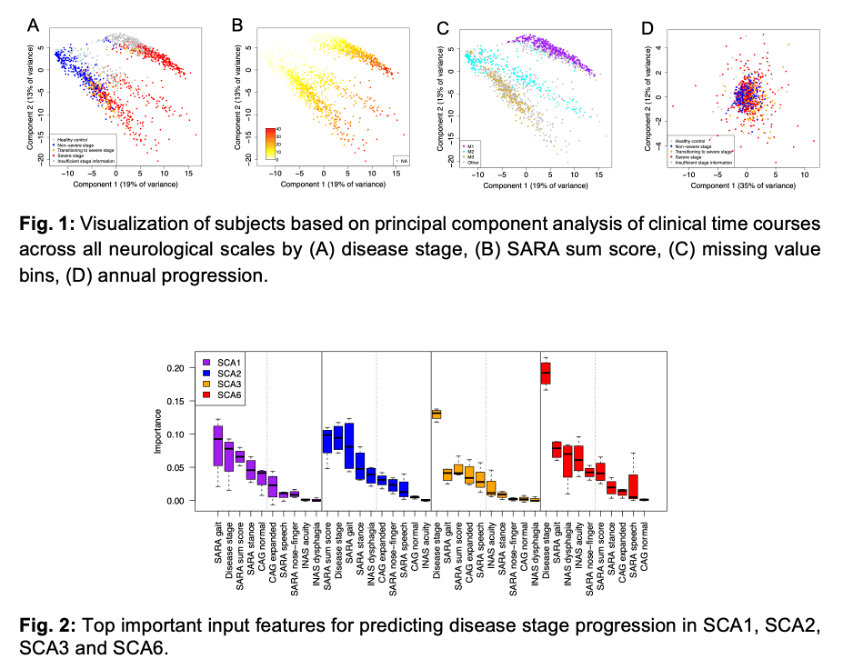
Fig1 and Fig2
To cite this abstract in AMA style:
J. Faber, E. Georgii, T. Klockgether, T. Ashizawa, K. Sheng-Han, H. Jacobi, M. Piraud. Modeling disease progression in spinocerebellar ataxias [abstract]. Mov Disord. 2026; 41 (suppl 1). https://www.mdsabstracts.org/abstract/modeling-disease-progression-in-spinocerebellar-ataxias/. Accessed October 1, 2026.« Back to 2026 International Congress
MDS Abstracts - https://www.mdsabstracts.org/abstract/modeling-disease-progression-in-spinocerebellar-ataxias/