
Objective: To compare the differences in motor and non-motor symptoms assessed with the Movement Disorders Society Unified Parkinson Disease Rating Scale (MDS-UPDRS) among the different psychiatric profiles clusters using the Symptom Checklist-90-Revised (SCL-90-R) in patients with Parkinson.
Background: Psychiatric symptoms in Parkinson’s correlate positively with higher severity scores across the Movement Disorders Society Unified Parkinson Disease Rating Scale (MDS-UPDRS). While the impact of isolated psychological features on specific domains is recognized [2], the influence of multidimensional psychiatric profiles on the full spectrum of clinician-assessed motor and non-motor burden remains largely unexplored.
Method: A cross-sectional study was conducted from June 2022 to February 2026 through clinical evaluation and application of the SCL-90-R and MDS-UPDRS. Using JASP, hierarchical clusters were created using Euclidean distance, Ward.D2 linkage, Z-standardization, and optimized to the Bayesian Information Criterion (BIC) from the 9 domains of the SCL-90-R. The scores for each part of the MDS-UPDRS were compared across clusters using the Kruskal-Wallis test.
Results: We included 179 patients and identified five clusters: C1 (Asymptomatic, n=50, 27.9%), C2 (Subclinical/mild, n=58, 32.4%), C3 (Anxious-Somatic, n=39, 21.8%), C4 (Depressive-Suspicious, n=16, 8.9%), and C5 (Severe Psychological Distress, n=16, 8.9%). In Parts I and II, significant differences were found between C1 and C3, C4, and C5 (with C1 exhibiting lower mean scores), as well as between C2 and C5 (with lower scores in C2). In Part III, only between C1 and C4, with higher mean scores in C4. In Part IV, between C1 and C3, with lower scores in the asymptomatic C1 cluster. Descriptive scores in Figure 1 and Table 1.
Conclusion: Psychiatric profiles in Parkinson’s significantly influence the clinician-assessed burden of daily living, as evidenced by Parts I and II. Part III differs solely between the Asymptomatic and Depressive-Suspicious profiles. Additionally, Part IV are significantly higher in the Anxious-Somatic profile compared to asymptomatic patients. These findings suggest that higher psychiatric burden heavily amplifies daily functional disability and objective motor severity, highlighting the critical need for targeted psychiatric phenotyping alongside standard motor evaluations.
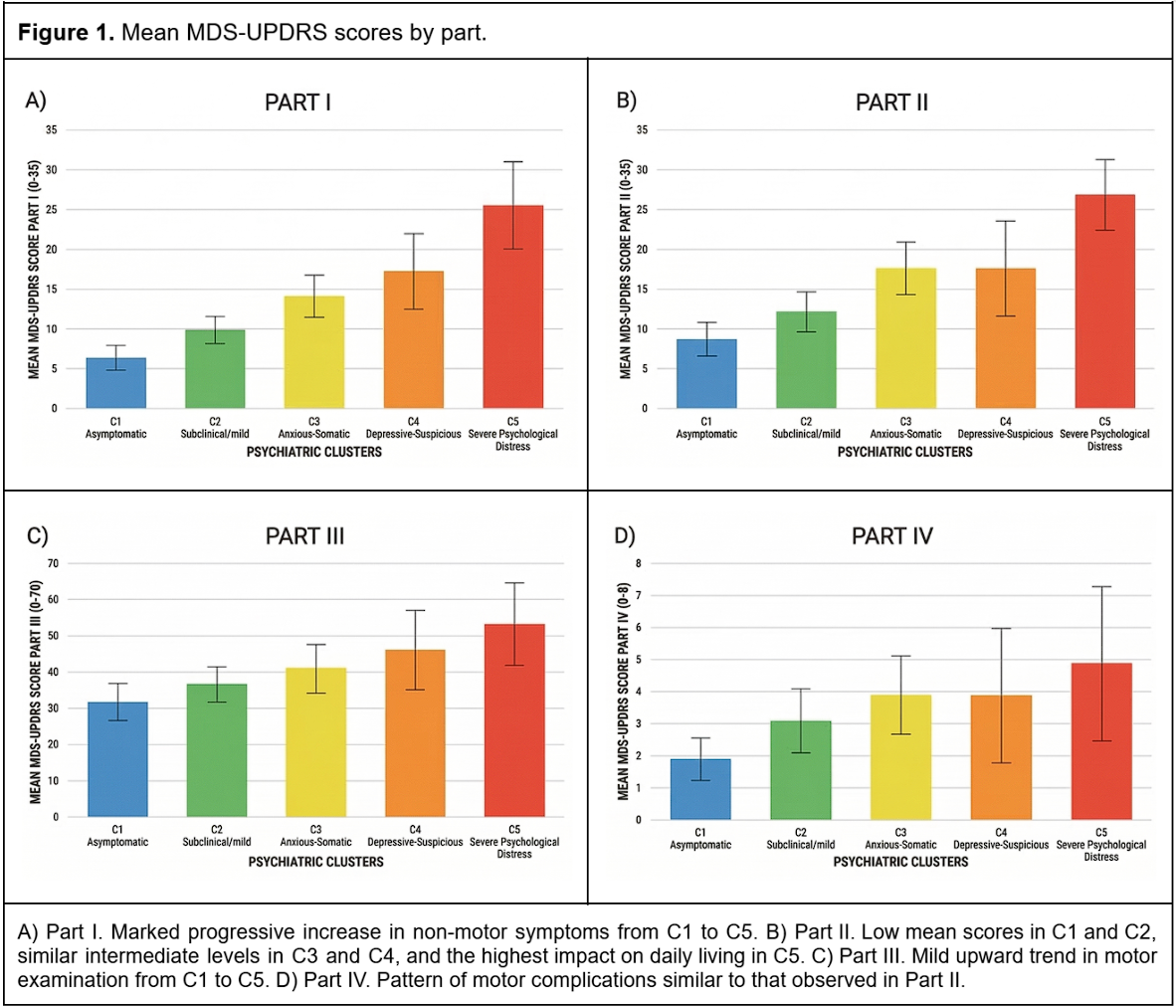
FIGURE 1. MEAN MDS-UPDRS SCORE
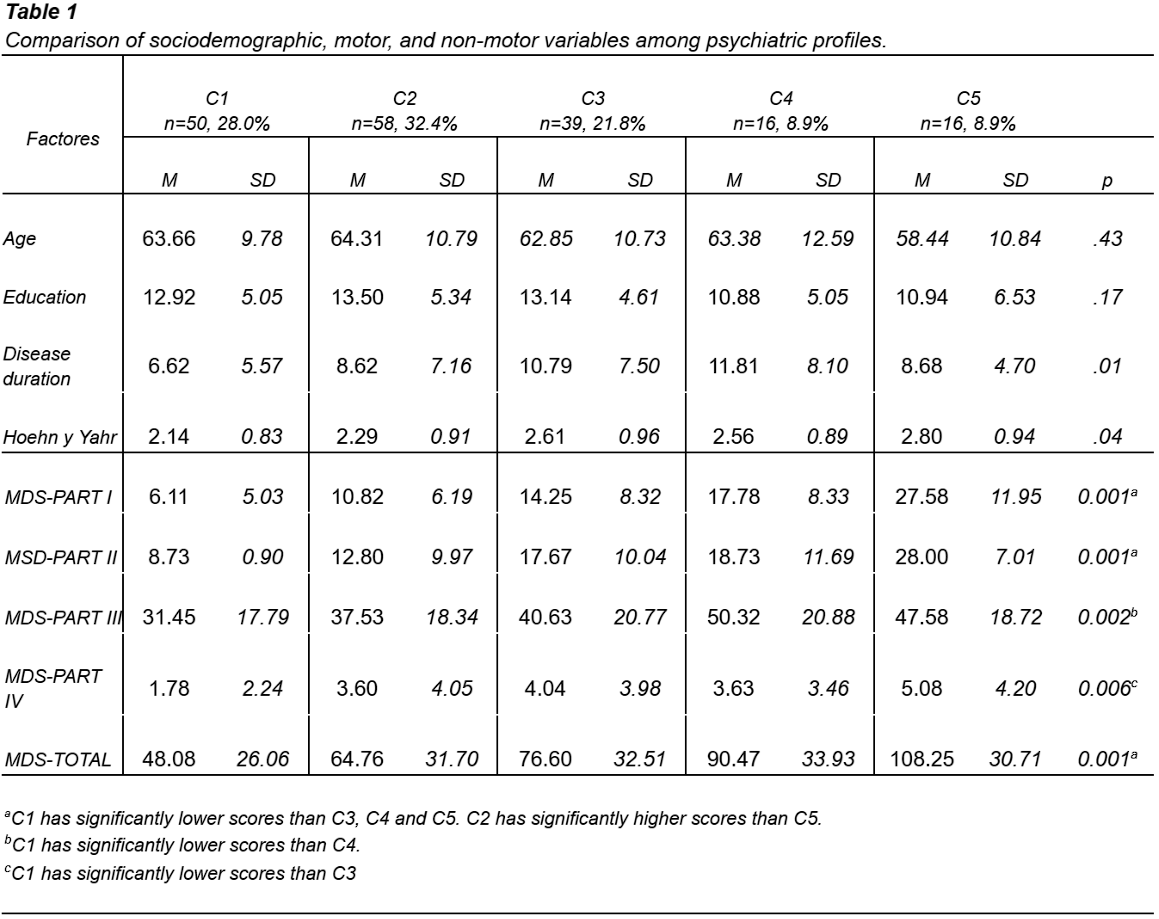
TABLE 1 Comparison of sociodemographic, motor
References: 1.- Driver-Dunckley ED, Zhang N, Shill HA, Mehta SH, Belden CM, Zamrini EY, et al. Correlation between the Movement Disorder Society’s Unified Parkinson’s disease rating scale and nonmotor scales in patients with Parkinson’s disease. Innov Clin Neurosci. 2019 Sep 1;16(9-10):27-9. PMID: 32082946; PMCID: PMC7009327.
2.- Simuni T, Caspell-Garcia C, Coffey C, Lasch S, Tanner C, Marek K, et al. Baseline prevalence and longitudinal evolution of non-motor symptoms in early Parkinson ‘s disease: the PPMI cohort. J Neurol Neurosurg Psychiatry. 2018;89(1):78-88. doi:10.1136/jnnp-2017-316213.
To cite this abstract in AMA style:
R. Trejo-Ayala, H. Trujillo-Guerra, R. Enriquez-Menchaca, A. Trejo-Ayala, B. Chávez-Luévanos, X. Ortiz-Jiménez, I. Estrada-Bellmann. Motor and Non-Motor Symptoms Across Psychiatric Profiles in Parkinson’s: A Cluster Analysis [abstract]. Mov Disord. 2026; 41 (suppl 1). https://www.mdsabstracts.org/abstract/motor-and-non-motor-symptoms-across-psychiatric-profiles-in-parkinsons-a-cluster-analysis/. Accessed October 1, 2026.« Back to 2026 International Congress
MDS Abstracts - https://www.mdsabstracts.org/abstract/motor-and-non-motor-symptoms-across-psychiatric-profiles-in-parkinsons-a-cluster-analysis/