
Objective: To determine the nationwide prevalence of Parkinson’s disease (PD) in Slovakia at the level of individual municipalities, with the aim of identifying potential local causative factors.
Background: Environmental factors are believed to substantially influence PD risk and prevalence at the local geographic level. Identifying such local factors is essential to inform future public health policy and reduce the burden of the disease.
Method: Two composite prevalence algorithms were used to estimate the prevalence of PD in 2025 by combining evidence from dispensed antiparkinsonian medication and specialist ambulatory care records at the individual level. Available administrative data, using a unique patient identifier, covered the period 2023–2025. For ambulatory records, each visit contributed 1 point for the prevalence algorithm. Medication contributed 2 points. Prevalent cases in 2025 were defined as unique individuals whose cumulative score reached or exceeded a prespecified threshold. In the first “relaxed” prevalence algorithm, a minimum cumulative score of 4 points was required for cases to be prevalent with PD. In the second “conservative” prevalence algorithm, a threshold of 8 cumulative points was applied within the same scoring framework. Age-standardised prevalence of PD in 2025 was estimated using the midpoint across these two administrative algorithms.
Results: We identified 18,810 prevalent PD cases using the relaxed algorithm and 14,743 PD cases using the conservative algorithm. The nationwide age-standardised midpoint prevalence of PD reached 318.4 per 100,000 population. Substantial geographic variation was observed across districts. The lowest midpoint prevalence estimates were observed in northern districts, including Cadca (151.7 per 100k population, 95% CI 128.8–174.6) and Kysucke Nove Mesto (165.0, 127.1–203.0), while the highest prevalence estimates were recorded in districts Detva (555.7 per 100k, 468.3–643.0) and Puchov (554.0, 485.8–622.1). These differences were consistent across both case-identification algorithms, suggesting that the observed regional variation was not solely driven by the choice of case definition but likely reflects true differences in disease burden and healthcare utilization.
Conclusion: Our results represent an important first step toward identifying local risk factors and supporting tailored future public health policy and disease management strategies in Slovakia.
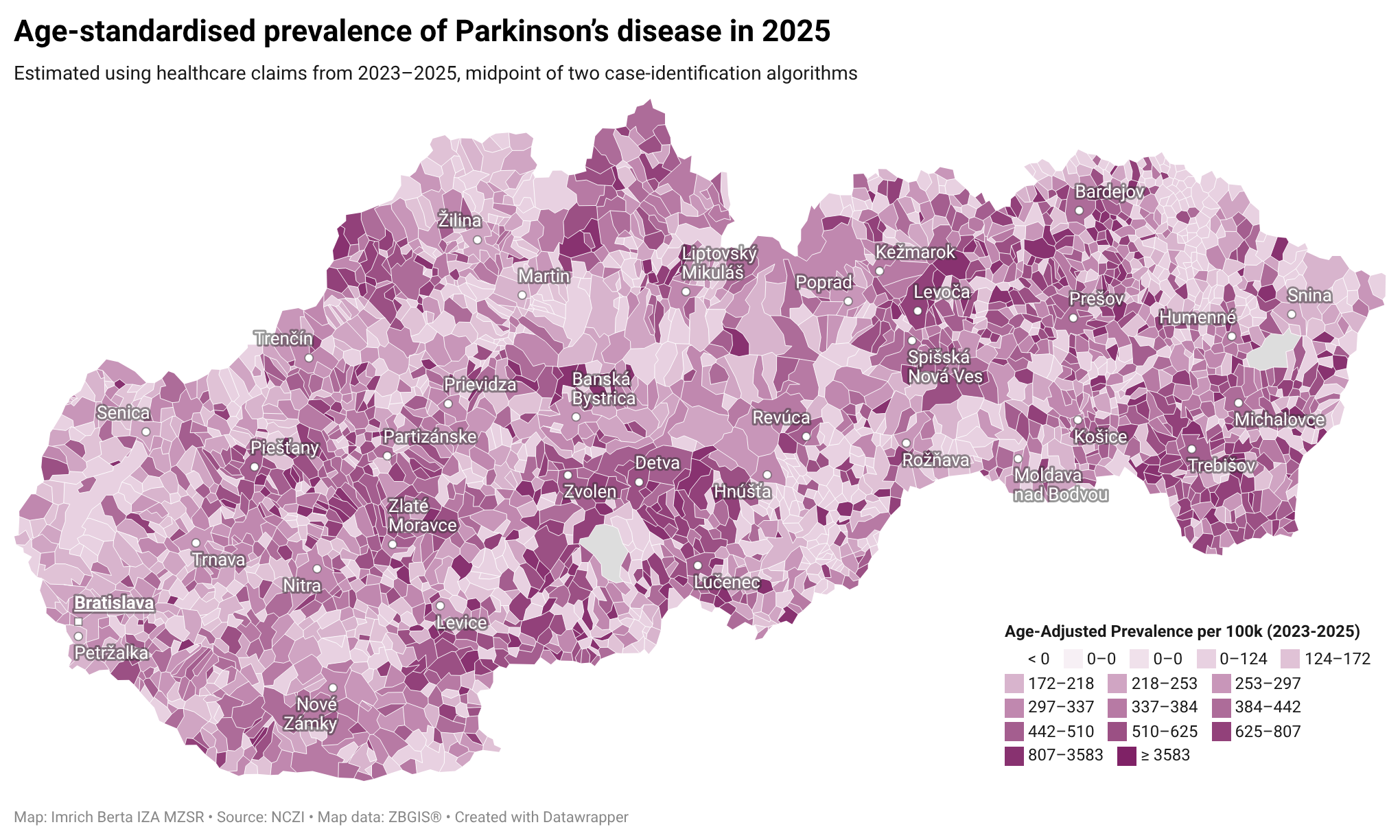
Age-standardized prevalence of PD in Slovakia
To cite this abstract in AMA style:
M. Skorvanek, Z. Kosutzka, I. Berta. Nationwide Prevalence of Parkinson’s Disease in Slovakia: A Municipality-Level Analysis [abstract]. Mov Disord. 2026; 41 (suppl 1). https://www.mdsabstracts.org/abstract/nationwide-prevalence-of-parkinsons-disease-in-slovakia-a-municipality-level-analysis/. Accessed October 1, 2026.« Back to 2026 International Congress
MDS Abstracts - https://www.mdsabstracts.org/abstract/nationwide-prevalence-of-parkinsons-disease-in-slovakia-a-municipality-level-analysis/