
Objective: To examine the presence of apathy self-awareness in PD patients using a dimensional approach
Background: Apathy, or loss of motivation, is a common neuropsychiatric symptom that causes significant morbidity and mortality among PD patients. Impaired self-awareness (ISA) of motor and non-motor deficits, such as apathy, is also common among PD patients and has a profound impact on patient’s quality of life and self-advocacy. ISA of apathy (ISA-a) can be appropriately assessed by comparing caregiver (informant) and patient reports. While ISA of motor deficits has been associated with reduced functional connectivity (FC) within cingulo-frontal and cingulo-opercular pathways, less is known about the neural underpinnings of apathy in PD.
Method: PD patients (N=52; mean age=63.2; 25% F) were prospectively recruited at BCM under an IRB approved protocol. Participants underwent motor and neuropsychiatric assessments and brain MRI. Apathy was assessed using the Dimensional Apathy Scale (DAS) and defined as informant-reported DAS>28.5. ISA-a was defined as DAS(informant)–DAS(patient); higher score indicates more ISA-a. MRI acquired T1-weighted MP-RAGE and T2*-weighted BOLD sequences during rest. FC coefficients between selected pairs of ROIs were extracted using fMRIPrep (Figure 1). A linear mixed model was used to examine the relationship between FC, apathy, and ISA-a.
Results: Forty-eight percent of patients had apathy. For the full PD cohort, there was no significant difference in DAS scores between patients and informants. However, there was a significant correlation between apathy severity and the degree of ISA-a (r=0.593 p<0.001, Figure 2) with apathetic patients significantly under-reporting their apathy severity compared to informants (p=0.006). More apathetic patients had reduced FC between the left NAcc and ACC (b=-7.81, t(28)=2.15, p<0.05). ISA-a was associated with FC between the left NAcc and OFC (b=7.24, t(27)=2.19, p<0.05). There was also a trend-level association between ISA-a and FC between the right AIC and ACC (b=7.87, t(27)=2.03, p=0.05).
Conclusion: Apathetic PD patients had higher rates of ISA-a compared with non-apathetic patients. Consistent with prior work, apathetic patients had reduced FC between the left NAcc and ACC. Notably, despite the strong association between apathy and ISA-a, our findings suggest that the neural substrate of ISA-a may be distinct, involving cingulo-opercular and orbito-frontal networks.
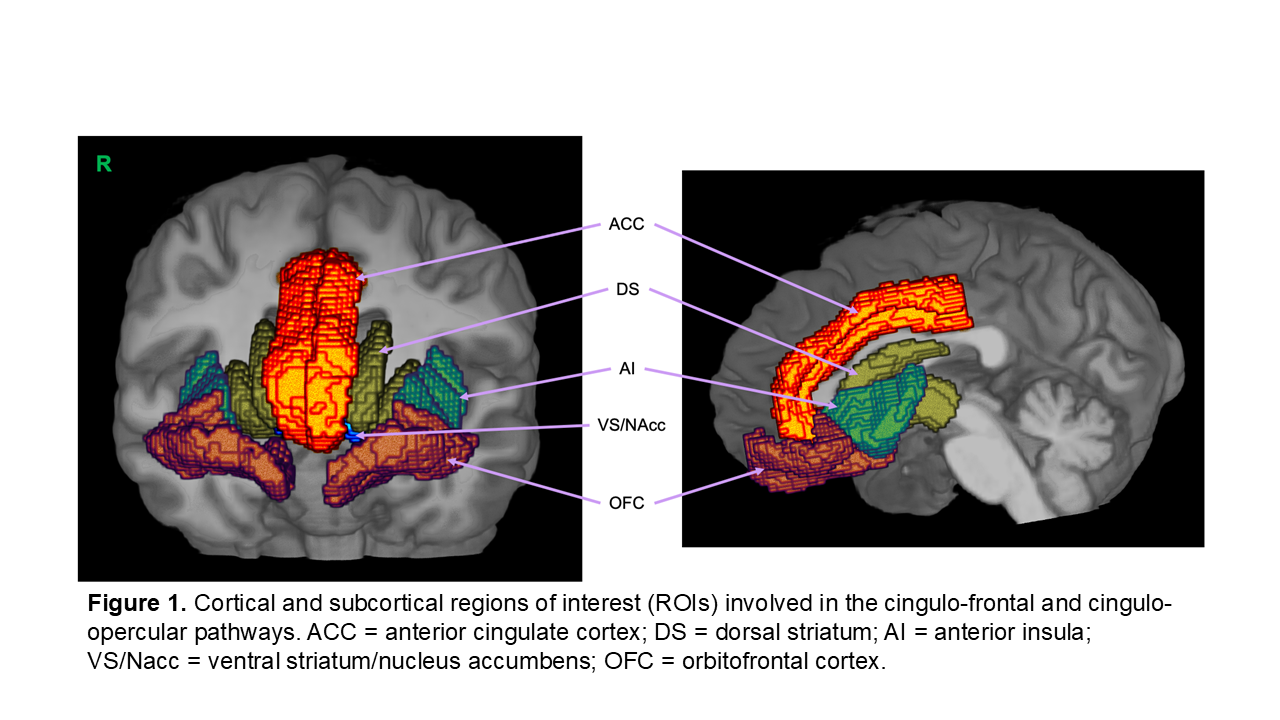
Figure 1
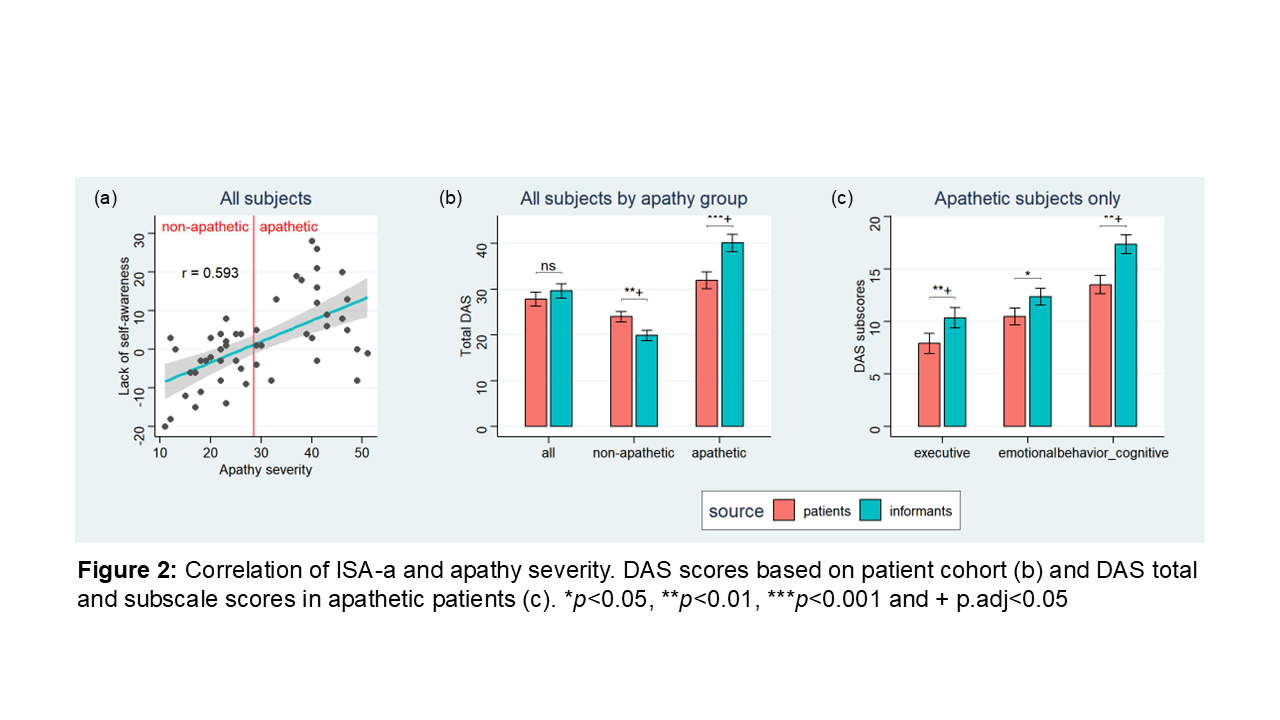
Figure 2
To cite this abstract in AMA style:
H. Conn, H. Suzuki, Z. Jin, A. Marin, Y. Gazes, S. Lee, S. Heilbronner, N. Vanegas-Arroyave. Neural Correlates of Impaired Apathy Self-awareness in Parkinson’s Disease [abstract]. Mov Disord. 2025; 40 (suppl 1). https://www.mdsabstracts.org/abstract/neural-correlates-of-impaired-apathy-self-awareness-in-parkinsons-disease/. Accessed October 14, 2026.« Back to 2025 International Congress
MDS Abstracts - https://www.mdsabstracts.org/abstract/neural-correlates-of-impaired-apathy-self-awareness-in-parkinsons-disease/