
Objective: To characterise NREM sleep neurophysiology across multiple domains in Lewy body disorders (LBDs) relative to healthy controls.
Background: Sleep disturbances are highly prevalent in LBDs, yet their neurophysiological basis remains poorly understood. NREM sleep offers an objective window into cortical and subcortical circuit integrity, free from waking confounds such as motor symptoms or fluctuating cognition. Slow oscillations (SOs) and sleep spindles in NREM reflect function of distinct thalamocortical circuits known to be disrupted in these disorders and may serve as objective biomarkers to aid diagnosis and treatment stratification across the heterogeneous LBD spectrum.
Method: We studied 110 participants: 24 with DLB (74.7±6.1 years), 32 with PD (63.4±8.9 years), and 54 controls (66.7±7.5 years). All underwent overnight polysomnography with EEG from frontal (F3,Fz,F4), central (C3,Cz,C4), parietal (Pz), and occipital (O1,O2) derivations. EEG was processed using Luna, v0.25.5. Spectral power was estimated via Welch’s method, spindles (slow: 11 Hz; fast: 15 Hz) via complex Morlet wavelet convolution, and SOs via zero-crossing with amplitude thresholding. Spindle–SO coupling was quantified as mean SO phase angle at spindle peak. Directional connectivity was assessed using the phase slope index (PSI). Group differences in NREM sleep microarchitecture were assessed using permutation-based general linear models adjusted for age and sex.
Results: DLB showed elevated frontal beta power relative to PD and controls (padj=0.004). Slow spindle density was reduced in DLB (padj<0.05, all channels); fast spindle density was reduced in both DLB and PD (padj<0.05, frontal and central channels). No differences were found in spindle amplitude or duration. SO density was decreased at central derivations in both patient groups (padj<0.05). Mean SO phase angle of spindle–SO coupling differed significantly across groups for both slow and fast spindles (padj<0.05). Frontal net PSI was increased in DLB at the slow oscillation frequency (padj<0.05) and decreased at sigma relative to PD and controls (padj<0.05).
Conclusion: NREM microarchitecture is distinctly disrupted in LBDs, with oscillatory and connectivity signatures differentiating DLB from PD. These findings implicate thalamocortical network dysfunction and support NREM sleep EEG as a non-invasive biomarker with potential for disease monitoring and clinical trial stratification.
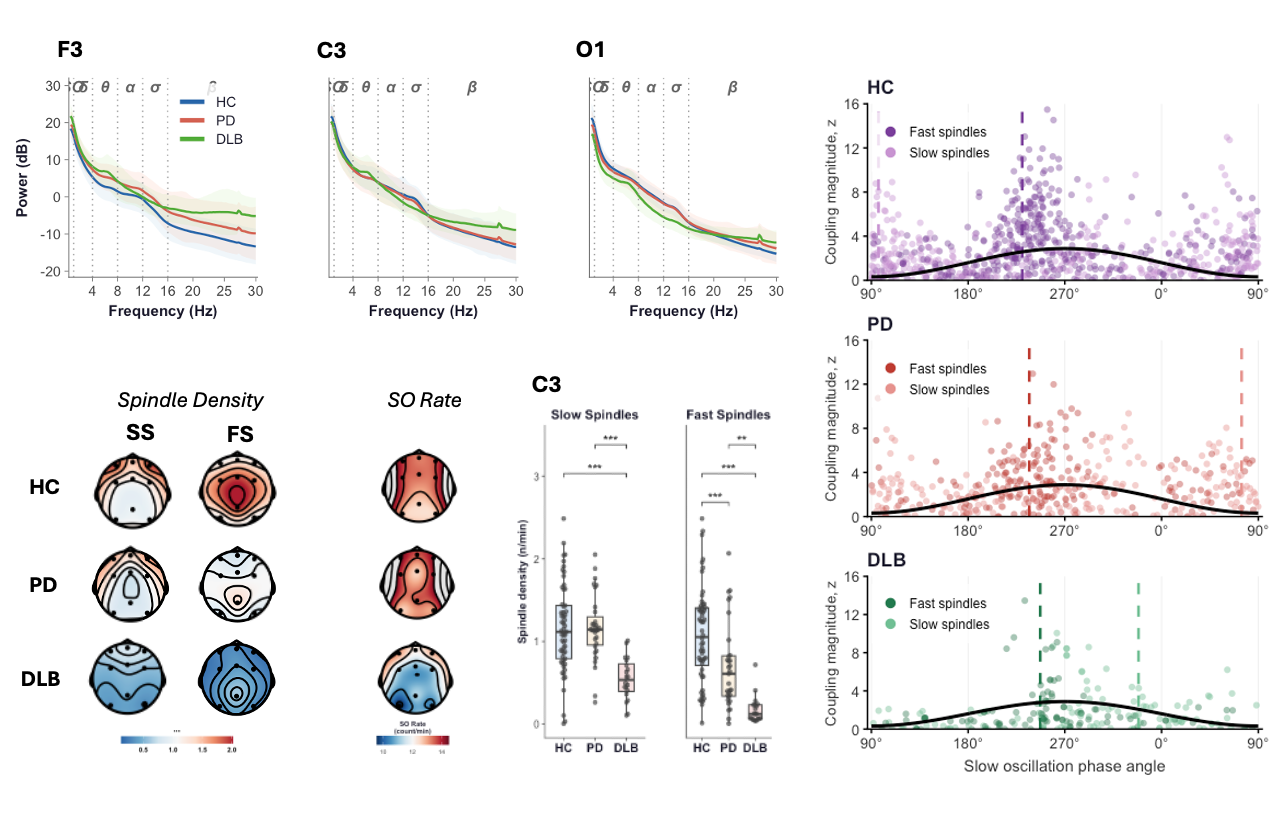
NREM EEG Alterations During NREM Sleep in LBD
To cite this abstract in AMA style:
J. Anderson, L. Churchill, A. Konuri, A. Ignatavicius, G. Cho, A. Lam, S. Naismith, R. Grunstein, S. Lewis, E. Matar. Non-Rapid Eye Movement Sleep Neurophysiological Alterations in Lewy Body Disorders [abstract]. Mov Disord. 2026; 41 (suppl 1). https://www.mdsabstracts.org/abstract/non-rapid-eye-movement-sleep-neurophysiological-alterations-in-lewy-body-disorders/. Accessed October 1, 2026.« Back to 2026 International Congress
MDS Abstracts - https://www.mdsabstracts.org/abstract/non-rapid-eye-movement-sleep-neurophysiological-alterations-in-lewy-body-disorders/