
Objective: This study aims to establish Ethiopian normative data for IDEA in healthy older adults and People with Parkinson’s disease, and to evaluate its appropriateness as a dementia screening tool in Ethiopia.
Background: The number of Alzheimer’s Disease (AD) and Parkinson’s Disease (PD) cases in Sub-Saharan Africa (SSA) is expected to double by 2050. Among PwP 75-80 % are expected to develop dementia. Identification of Dementia in Elderly Africans (IDEA) screening tool, designed for low-literacy and resource-limited settings, was validated in Ethiopia in 2020.
Method: A comparative cross-sectional study was conducted in Addis Ababa, Ethiopia, including 150 PwP and 150 age-matched healthy controls selected using systematic random sampling. Descriptive statistics including mean, standard deviation, median, and interquartile range were calculated. Multiple linear regression was used to examine differences in IDEA scores between PwP and controls after adjusting for age, sex, and education level. Model assumptions were assessed and met.
Results: Among PwP, 62% were classified as tremor dominant (TD), 26% as postural instability and gait difficulty (PIGD), and 12% as intermediate type. Hoehn and Yahr staging indicated that 68.7% were in stages 1–2, and 17.3% in stages 3–4.
The mean (SD) and median (IQR) IDEA score were 13.3 (1.53) and 13 (12–15) for controls, and 12.4 (2.44) and 13 (11–14) for PwP. Healthy controls without formal education had a mean (SD) score of 12.6 (1.58) and a median (IQR) of 12 (12–13), while those with college education had a mean (SD) of 13.7 (1.51) and a median (IQR) of 14 (13–15). PwP without formal education had a mean (SD) of 10.9 (2.12) and a median (IQR) of 11 (9–12), whereas PwP with college education had a mean (SD) of 12.7 (2.64) and a median (IQR) of 13 (12–14).
PwP scored significantly lower than healthy controls (β = −0.88, SE = 0.23, p < 0.001), and higher education levels were associated with better cognitive performance.
Conclusion: PwP demonstrated slightly lower IDEA scores than healthy controls, even after adjusting for demographic factors. Importantly, IDEA scores should be interpreted in relation to education level, as higher educational attainment consistently improves performance.These results support the use of IDEA as a practical tool for identifying dementia among PwP in the region.
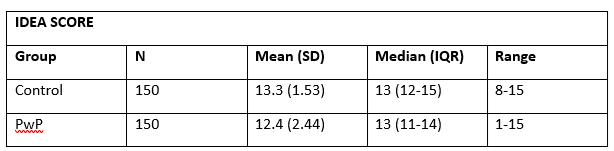
Table 1. Mean and median IDEA score
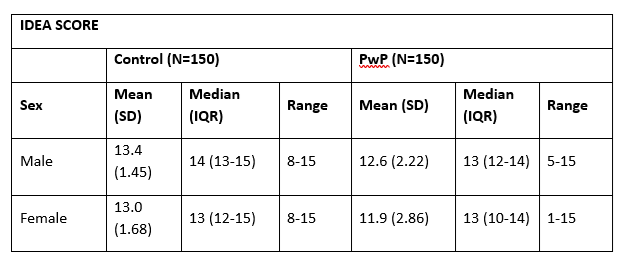
Table 2. Mean and median IDEA score by Sex
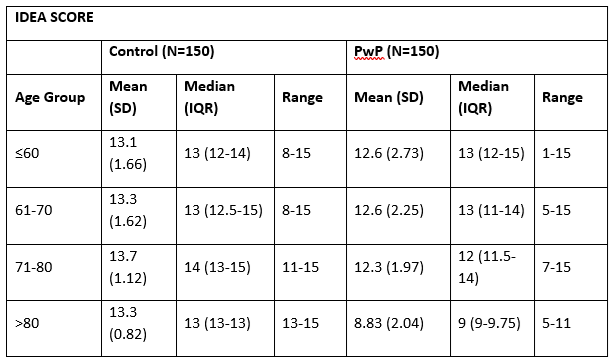
Table 3. Mean and median IDEA score by Age
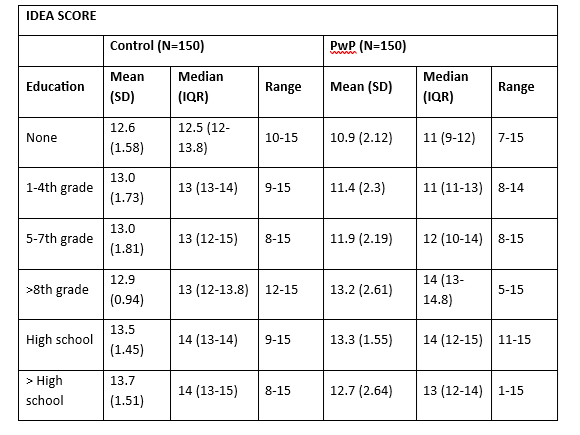
Table 4. Mean and median IDEA score by Education
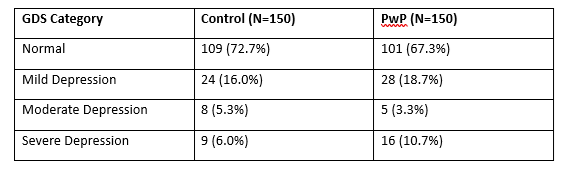
Table 5. Depression by GDS Score
To cite this abstract in AMA style:
S. Gugssa, H. Kiflu, Y. Okkaoglu, G. Mengistu. Normative Data for the IDEA Dementia Screen in Healthy Older Adults and People with Parkinson’s Disease in Ethiopia: A Comparative Cross Sectional Study [abstract]. Mov Disord. 2026; 41 (suppl 1). https://www.mdsabstracts.org/abstract/normative-data-for-the-idea-dementia-screen-in-healthy-older-adults-and-people-with-parkinsons-disease-in-ethiopia-a-comparative-cross-sectional-study/. Accessed October 1, 2026.« Back to 2026 International Congress
MDS Abstracts - https://www.mdsabstracts.org/abstract/normative-data-for-the-idea-dementia-screen-in-healthy-older-adults-and-people-with-parkinsons-disease-in-ethiopia-a-comparative-cross-sectional-study/