
Objective: To evaluate longitudinal progression in online participant reported outcomes (PROs) among people with Parkinson’s disease (PD), prodromal PD, and healthy controls.
Background: Collecting PROs online provides an opportunity to efficiently administer studies and include people with difficulty coming to academic centers. Longitudinal online measurement of PD-related symptoms can improve understanding of PD progression and inform future research.
Method: The Parkinson’s Progression Markers Initiative (PPMI) Online is an online-based study involving people with and without PD who complete PROs quarterly.1 For this analysis, we included participants who completed visits over 24 months. We divided groups into (i) PD with >5 year duration, (ii) PD with <5 year duration, (iii) people without PD with REM sleep behavior disorder or self-reported dream enactment (RBD/DE), (iv) people without PD or RBD/DE with self-reported smell-loss (iHypos), and (v) people without PD, RBD/DE or iHypos (No RBD/DE/iHypos). We describe characteristics of groups and calculated mean within-participant trajectories of total MDS-UPDRS Part 22 and Penn Parkinson’s Daily Activity Questionnaire3 (PDAQ). We then compared people with and without PD, using chi-squared test to determine baseline predictors of a clinically important worsening of motor (>3 point increase in MDS-UPDRS 24) or cognitive (decrease to <49 in PDAQ5) symptoms.
Results: Overall, 10,266 participants met inclusion criteria for MDS-UPDRS 2 (Table 1) and 11,052 for PDAQ (Table 2) analyses. The average within-participant change in MDS-UPDRS 2 and PDAQ were highest in the PD group; progression to a lesser extent in MDS-UPDRS 2 was also observed in RBD and iHypos (Tables 1-2; Figure 1). Clinically important worsening of motor symptoms occurred in 1194/2916 (41%) of people with PD and 509/7350 (7%) of people without PD. Clinically important worsening of cognitive symptoms (among those with baseline PDAQ>49) occurred in 403/2456 (16%) of people with PD and 370/6776 (5%) of people without PD. Univariate associations with motor and cognitive change are shown in Tables 3 and 4.
Conclusion: Online PROs capture symptomatic longitudinal change in people with and without PD. Predictors of motor and cognitive decline are identifiable using baseline measures. This approach allows for scalable methods to collect longitudinal data in studies related to PD.
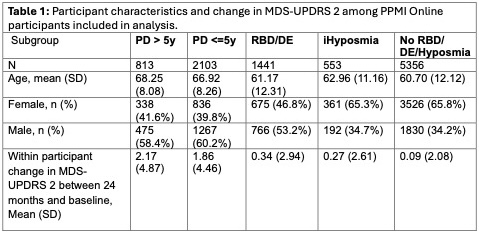
Table 1
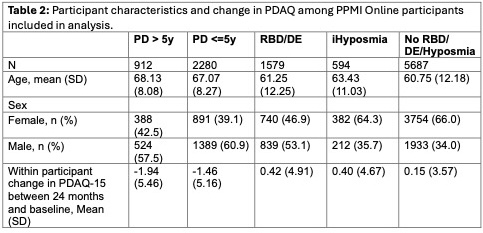
Table 2
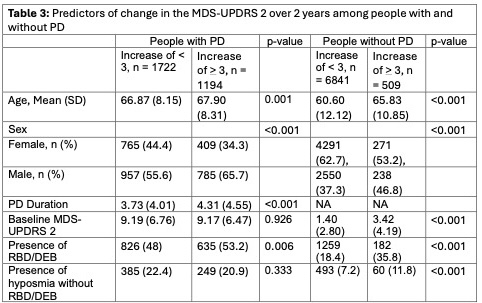
Table 3
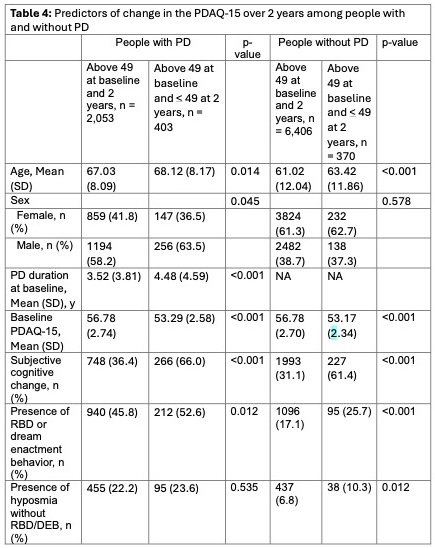
Table 4
References: 1. Tanner CM, Marek K. Parkinson’s Progression Markers Initiative Online Study (PPMI Online). protocolsio. 2024.
2. Goetz CG, Tilley BC, Shaftman SR, et al. Movement Disorder Society-sponsored revision of the Unified Parkinson’s Disease Rating Scale (MDS-UPDRS): Scale presentation and clinimetric testing results. Movement Disorders. 2008 2008/11/15;23(15):2129-70.
3. Brennan L, Siderowf A, Rubright JD, et al. Development and initial testing of the Penn Parkinson’s Daily Activities Questionnaire. Mov Disord. 2016 Jan;31(1):126-34.
4. Horváth K, Aschermann Z, Kovács M, et al. Minimal clinically important differences for the experiences of daily living parts of movement disorder society-sponsored unified Parkinson’s disease rating scale. Mov Disord. 2017 May;32(5):789-93.
5. Brennan L, Siderowf A, Rubright JD, et al. The Penn Parkinson’s Daily Activities Questionnaire-15: Psychometric properties of a brief assessment of cognitive instrumental activities of daily living in Parkinson’s disease. Parkinsonism Relat Disord. 2016 Apr;25:21-6.
To cite this abstract in AMA style:
E. Brown, X. Chen, P. Gonzalez Latapi, D. Weintraub, C. Marras, N. Pavese, L. Chahine, W. Poewe, R. Dobkin, K. Chou, E. Tolosa, A. Noyce, C. Stanley, T. Tropea, L. Racelo, M. Korell, K. Marek, C. Tanner. Online Assessments Measure Motor and Cognitive Progression in People with and without Parkinson’s Disease [abstract]. Mov Disord. 2026; 41 (suppl 1). https://www.mdsabstracts.org/abstract/online-assessments-measure-motor-and-cognitive-progression-in-people-with-and-without-parkinsons-disease/. Accessed October 1, 2026.« Back to 2026 International Congress
MDS Abstracts - https://www.mdsabstracts.org/abstract/online-assessments-measure-motor-and-cognitive-progression-in-people-with-and-without-parkinsons-disease/