
Category: Parkinson's Disease (Other)
Objective: In this preliminary study, we aimed to compare postural sway between individuals with early, untreated Parkinson’s disease (PD), individuals with isolated REM sleep behavior disorder (iRBD) and healthy controls (HC). We hypothesized the frequency content of postural sway signals of the iRBD group to be different from the HC group and akin to that of the PD group, indicating early motor impairments reflective of a prodromal disease state.
Background: iRBD marks one of the strongest risk factors for PD and is considered a PD prodrom [1]. Given that neurodegeneration occurs decades prior to visible symptoms of PD, it is likely that subtle impairments can be found in iRBD that are akin to those with early PD. One of these impairments might be postural instability that is not detectable by clinical experts, where earlier detection through novel quantitative measures may open new opportunities for interventions. While investigations on postural sway in iRBD remain scarce and contradictory [2], we recently showed that elevated sway frequencies might be an indicator of subtle postural impairments in PD [3].
Method: We assessed postural sway in 18 untreated, newly diagnosed individuals with PD (age: 64.0 [52-69] yrs; disease duration: 10.3 [1-30] months), 11 individuals with iRBD (age: 56.7 [38-70] yrs) and 14 HC (age: 58.9 [50-63] yrs). The postural task consisted of standing quietly with feet together and eyes open on firm ground for 30 s, while body sway was tracked with an accelerometer at the lumbar spine. We used t-tests (α=.05) to test for statistical significance.
Results: While there were no differences between groups in 2-D time-domain sway measures [figure1], there was a visible trend in frequency dispersion that was highest for HC, lower in the iRBD group, and lowest for PD [figure2]. In the medio-lateral direction, there was a significant difference in frequency dispersion between HC and PD (p<0.001), but also between HC and iRBD (p=0.03) as well as between iRBD and PD (p=0.03).
Conclusion: Based on frequency signatures of postural sway, our preliminary findings suggest that the postural behavior from individuals with iRBD deviates from healthy aging and might indicate subtle postural impairments that reflect a prodromal stage of PD. If confirmed in larger samples, this would mark a promising step in finding prodromal motor markers of PD.
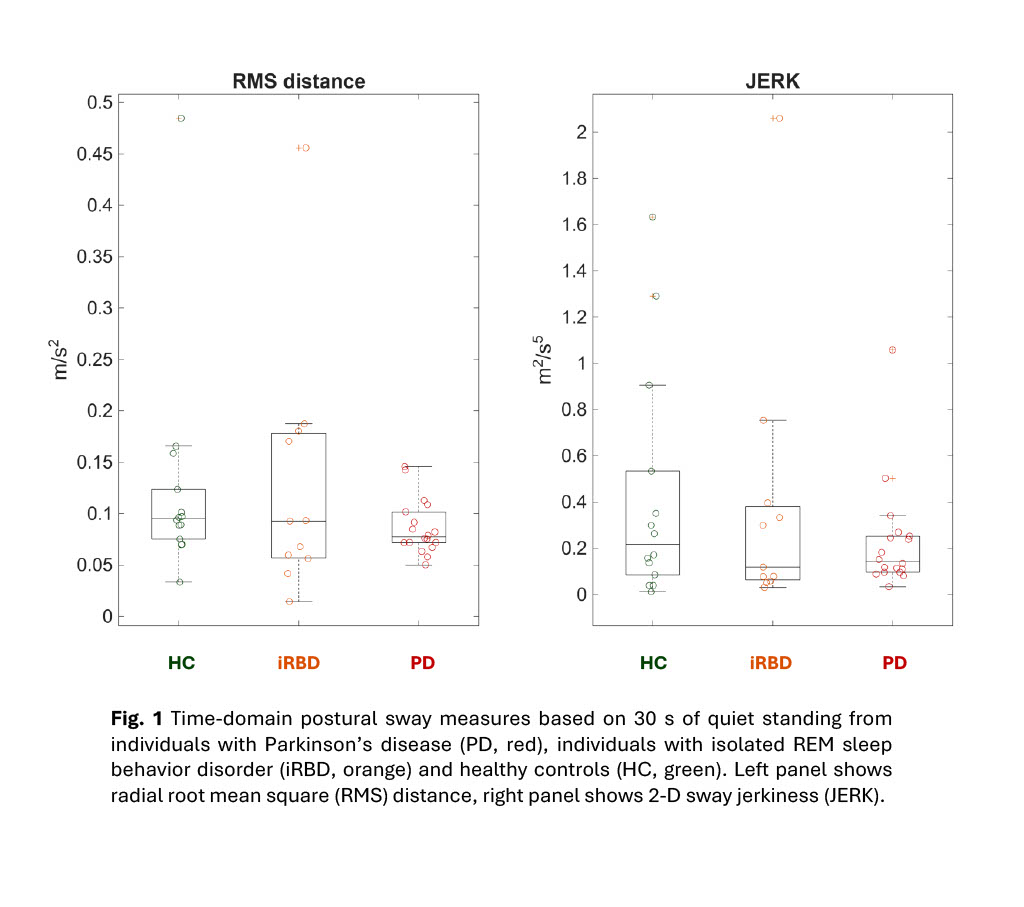
Fig. 1
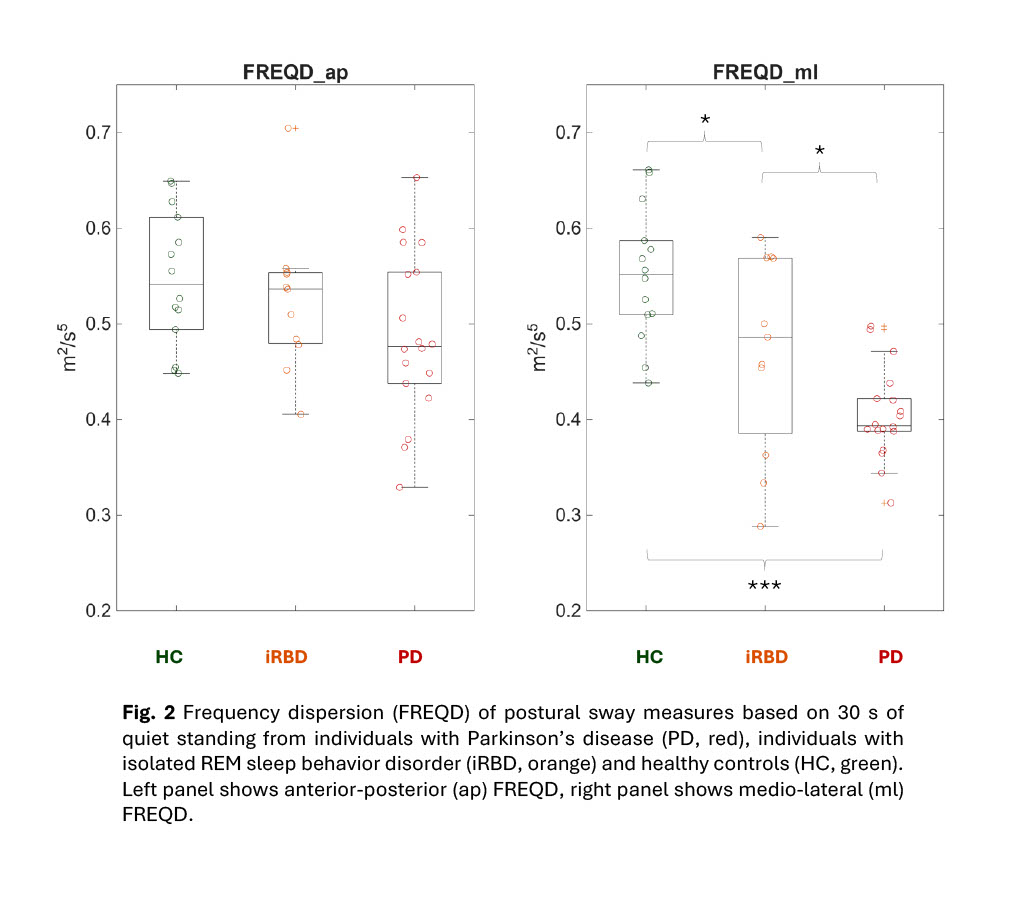
Fig. 2
References: [1]. Postuma, R. B. et al. Risk and predictors of dementia and parkinsonism in idiopathic REM sleep behaviour disorder: a multicentre study. Brain 142, 744–759 (2019). https://doi.org/10.1093/brain/awz030
[2]. Elasfar S, Hameed H, Ehgoetz Martens K. Motor features that distinguish isolated REM sleep behavior disorder patients from healthy controls: A systematic review. Journal of Parkinson’s Disease. 2025;15(7):1155-1193. doi:10.1177/1877718X251359225
[3]. Engel, D., Greulich, R.S., Parola, A. et al. Sway frequencies may predict postural instability in Parkinson’s disease: a novel convolutional neural network approach. J NeuroEngineering Rehabil 22, 29 (2025). https://doi.org/10.1186/s12984-025-01570-7
To cite this abstract in AMA style:
D. Engel, P. Carlson-Kuhta, M. Lim, H. Hameed, K. Ehgoetz Martens, F. Horak, M. Mancini, M. Sommerauer. Postural Sway Frequencies in Isolated REM Sleep Behavior Disorder Might Indicate Subtle Motor Impairments as Prodromal Marker of Parkinson’s Disease [abstract]. Mov Disord. 2026; 41 (suppl 1). https://www.mdsabstracts.org/abstract/postural-sway-frequencies-in-isolated-rem-sleep-behavior-disorder-might-indicate-subtle-motor-impairments-as-prodromal-marker-of-parkinsons-disease/. Accessed October 1, 2026.« Back to 2026 International Congress
MDS Abstracts - https://www.mdsabstracts.org/abstract/postural-sway-frequencies-in-isolated-rem-sleep-behavior-disorder-might-indicate-subtle-motor-impairments-as-prodromal-marker-of-parkinsons-disease/