
Objective: To investigate the brain network mechanisms underlying individual variability in levodopa responsiveness in Parkinson’s disease (PD) and to evaluate the predictive value of baseline individualized effective connectivity (EC).
Background: Levodopa responsiveness is critical for PD management and differential diagnosis. However, clinical response varies significantly among patients. Traditional functional connectivity only captures statistical correlations; whether higher-order causal organization of the brain at baseline can predict medication efficacy remains unclear.
Method: We recruited 97 drug-naïve or long-term-off (LEDD=0) early-stage PD patients (H&Y ≤2.5). All patients underwent resting-state fMRI and a standard levodopa challenge test. Individualized EC matrices were constructed using Neural Perturbation Inference (NPI). Motor improvement was quantified by the UPDRS-III improvement rate (IR). Connectome-based predictive modeling (CPM) with a Multi-Layer Perceptron (MLP) was employed to predict both IR and absolute UPDRS-III scores. Graph theoretical analysis compared global metrics between responders (IR ≥30%) and non-responders, with FDR correction.
Results: CPM demonstrated robust performance in predicting treatment outcomes. For IR prediction, the model achieved a Pearson correlation of 0.916 and R^2 = 0.829 (p < 0.001, 2,506 significant features). For absolute score prediction, the Pearson correlation was 0.894 and R^2 = 0.798 (p < 0.001, 1,026 significant features). In contrast, graph theoretical analysis of the positive EC matrix revealed no significant differences between responder groups in global metrics—including mean strength (in/out/total), global efficiency, clustering coefficient, and modularity—after FDR correction (all p > 0.05).
Conclusion: Baseline individualized EC networks derived via NPI can accurately predict levodopa responsiveness in early PD. While global topological properties do not differ between groups, the high predictive accuracy of CPM suggests that distributed, fine-grained causal patterns drive individual drug sensitivity. NPI provides a quantitative framework for personalized therapeutic decision-making in early PD.
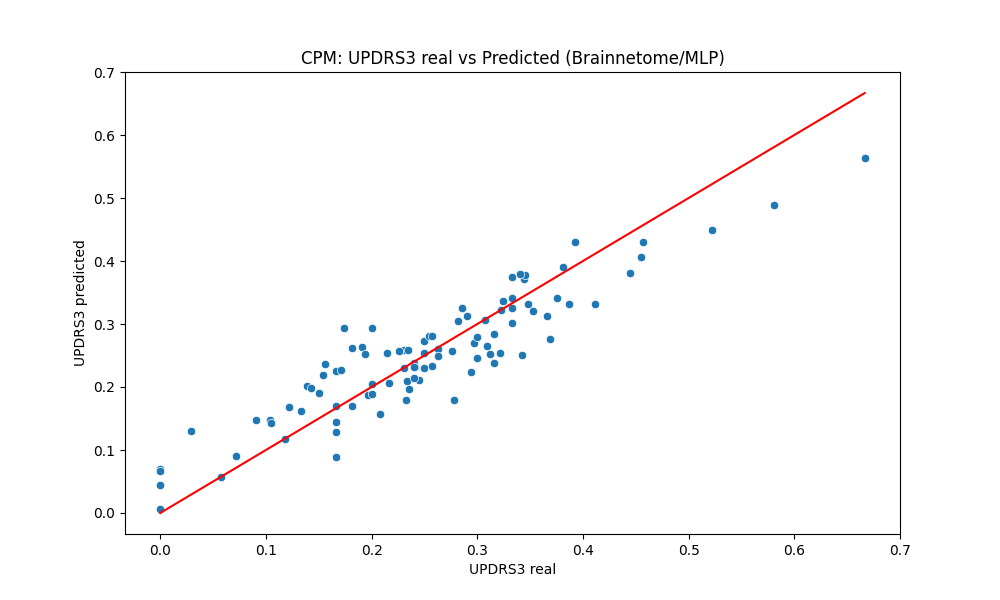
Prediction of Levodopa motor improvement rate
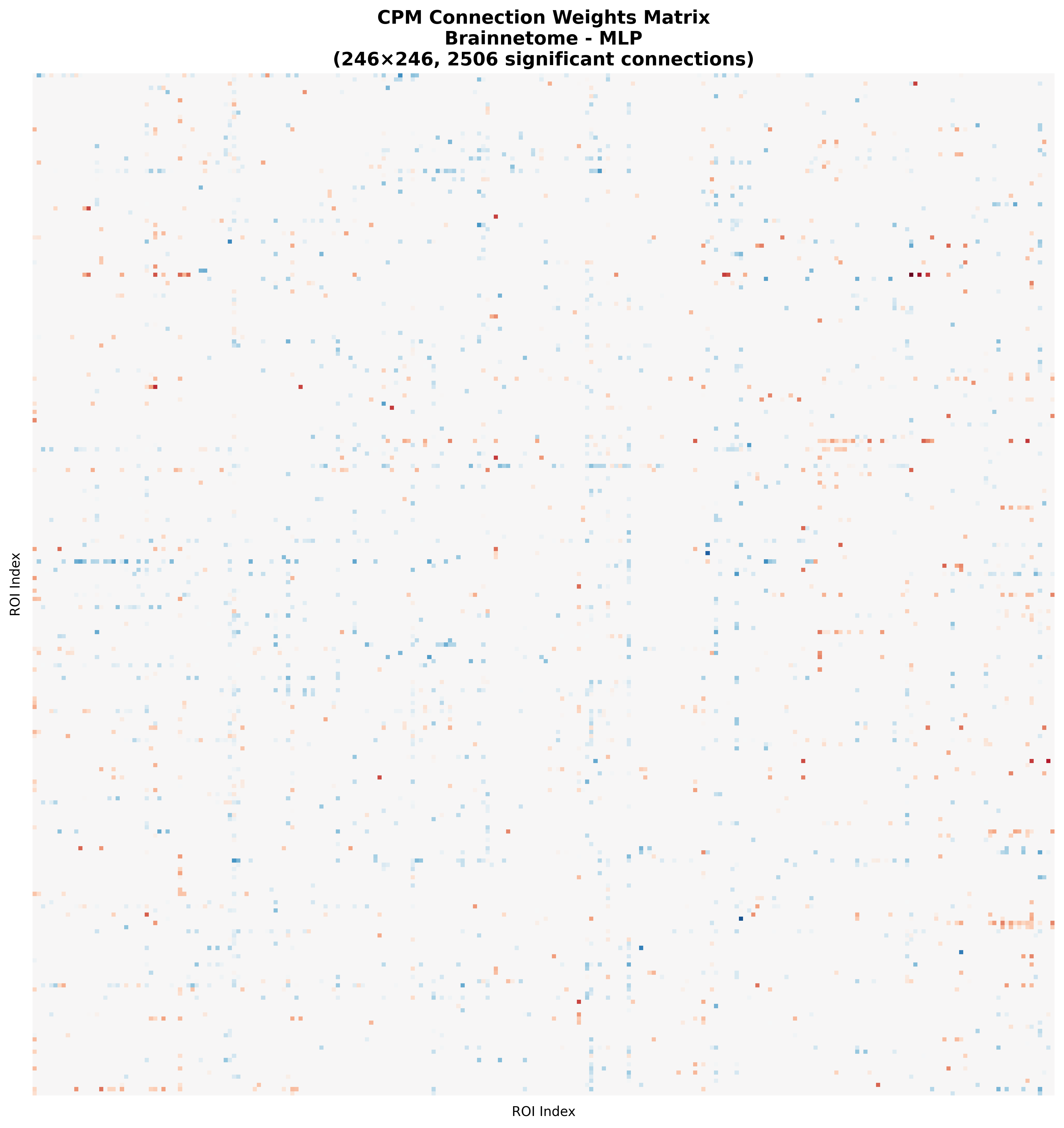
Predictive weights for improvement rate
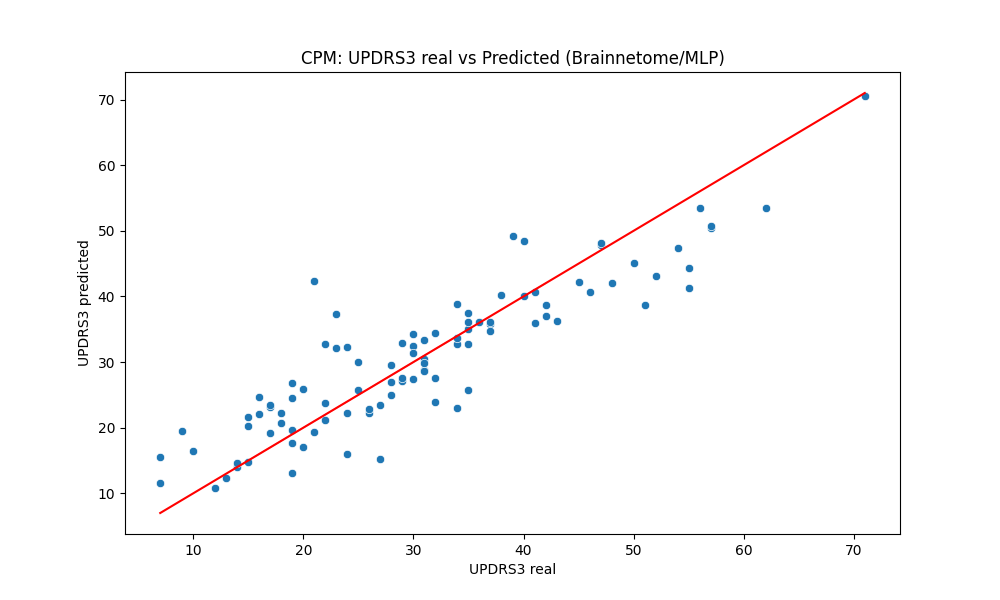
Prediction of post-levodopa UPDRS-III scores
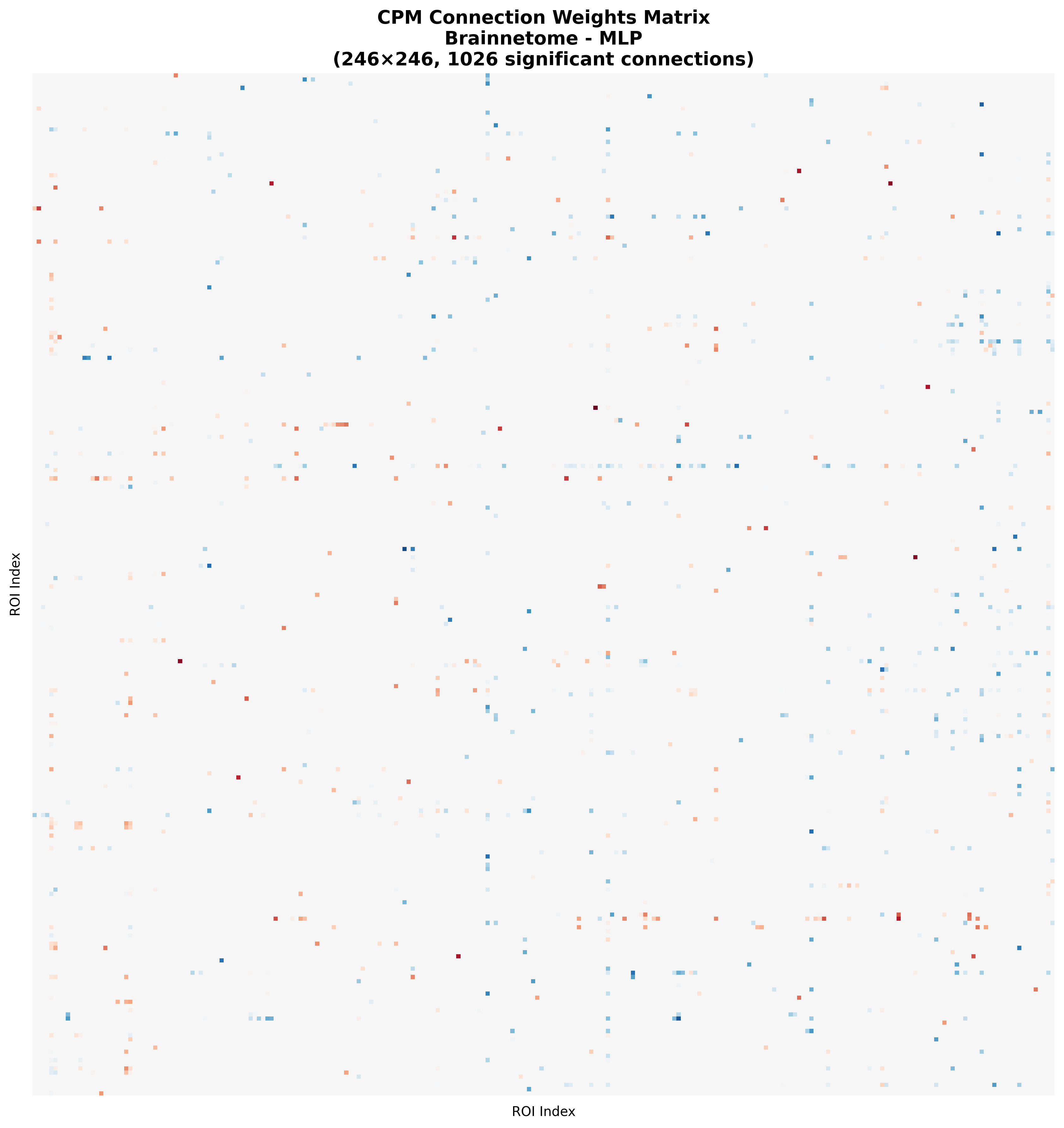
Predictive weights for UPDRS-III scores
References: [1]Luo Z, Peng K, Liang Z, Cai S, Xu C, Li D, Hu Y, Zhou C, Liu Q. Mapping effective connectivity by virtually perturbing a surrogate brain. Nat Methods. 2025 Jun;22(6):1376-1385. doi: 10.1038/s41592-025-02654-x. Epub 2025 Apr 22. PMID: 40263586.
[2]Kalia LV, Lang AE. Parkinson’s disease. Lancet. 2015 Aug 29;386(9996):896-912. doi: 10.1016/S0140-6736(14)61393-3. Epub 2015 Apr 19. PMID: 25904081.
[3]Pitz V, Malek N, Tobias ES, Grosset KA, Gentleman S, Grosset DG. The Levodopa Response Varies in Pathologically Confirmed Parkinson’s Disease: A Systematic Review. Mov Disord Clin Pract. 2020 Jan 7;7(2):218-222. doi: 10.1002/mdc3.12885. PMID: 32071945; PMCID: PMC7011806.
[4]McGregor MM, Nelson AB. Circuit Mechanisms of Parkinson’s Disease. Neuron. 2019 Mar 20;101(6):1042-1056. doi: 10.1016/j.neuron.2019.03.004. PMID: 30897356.
[5]Kaasinen V, Vahlberg T, Stoessl AJ, Strafella AP, Antonini A. Dopamine Receptors in Parkinson’s Disease: A Meta-Analysis of Imaging Studies. Mov Disord. 2021 Aug;36(8):1781-1791. doi: 10.1002/mds.28632. Epub 2021 May 6. PMID: 33955044.
[6]Liu X, Zhang Y, Weng Y, Zhong M, Wang L, Gao Z, Hu H, Zhang Y, Huang B, Huang R. Levodopa therapy affects brain functional network dynamics in Parkinson’s disease. Prog Neuropsychopharmacol Biol Psychiatry. 2025 Jan 10;136:111169. doi: 10.1016/j.pnpbp.2024.111169. Epub 2024 Oct 12. PMID: 39401562.
To cite this abstract in AMA style:
G. Xing, R. Siming. Predicting Levodopa Responsiveness in Early Parkinson’s Disease Using Neural Perturbation Inference-Based Effective Connectivity [abstract]. Mov Disord. 2026; 41 (suppl 1). https://www.mdsabstracts.org/abstract/predicting-levodopa-responsiveness-in-early-parkinsons-disease-using-neural-perturbation-inference-based-effective-connectivity/. Accessed October 1, 2026.« Back to 2026 International Congress
MDS Abstracts - https://www.mdsabstracts.org/abstract/predicting-levodopa-responsiveness-in-early-parkinsons-disease-using-neural-perturbation-inference-based-effective-connectivity/